


Quartz countertop fabrication asks for two different things from the same machine: long straight cuts for the perimeter, and shapes a blade cannot produce — sink cut-outs, hob cut-outs, faucet holes, curved edges and inlays. A waterjet covers the second group. A 5-axis waterjet covers both, and a combined saw-and-waterjet platform covers both without moving the slab.
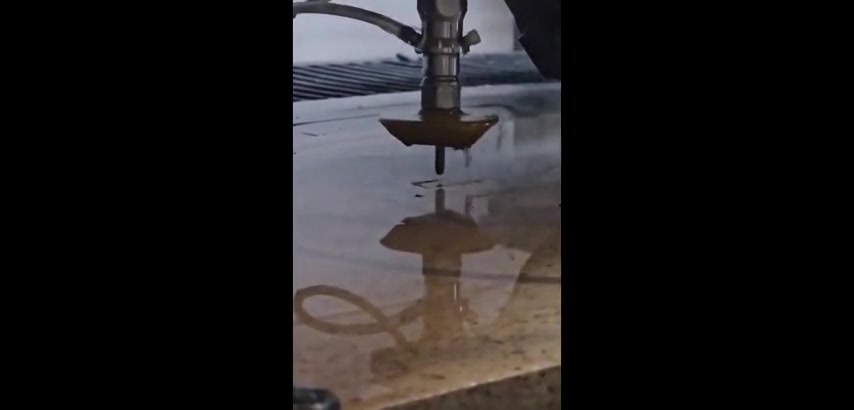
A waterjet cutting a closed shape inside the slab. The jet pierces the material directly, so a sink or hob cut-out needs no lead-in cut and no drilling step.
This page covers what waterjet cutting does on quartz and the materials that behave like it, and which configurations suit which part of the work.
Quartz and sintered stone are dense, brittle and unforgiving. The cut edge is the visible edge on a finished countertop, so chipping or discolouration at the cut cannot be hidden with a trim.
Waterjet cutting is a cold process. There is no heat-affected zone along the cut, which is why engineered stone, sintered stone and large-format porcelain are commonly cut this way rather than sawn. The jet also reaches geometry a blade cannot: closed shapes cut from inside the slab, internal corners tighter than the blade radius, and curved openings.
| Operation | Why waterjet |
|---|---|
| Sink cut-outs | The jet pierces inside the slab and cuts the closed outline — no lead-in cut, no drilling first |
| Hob and tap cut-outs | Small closed shapes positioned to the drawing, with the edge left ready to finish |
| Faucet and tap holes | Pierced directly, at the position the drawing specifies |
| Curved and shaped edges | Any contour the drawing asks for — a blade can only cut straight |
| Internal corners | Reaches the drawn corner rather than the minimum radius of a blade |
| Drainer grooves | Cut to depth and profile rather than routed |
| Inlays and decorative inserts | Both the pocket and the insert cut from the same program, so the fit is set by the cut |
| Bevels and mitred edges | Produced by the tilting head rather than a secondary operation |
The common thread is that these are the operations a shop either declines, subcontracts, or finishes by hand. They are also the operations that decide whether a countertop job is profitable.
Different countertop operations suit different configurations. Specifying one machine for everything is possible; specifying the right one matters more.
Flat countertop work with curves and cut-outs — the 5 Axis Cutting Machine range covers pierced cut-outs, curved profiles and angled edge work on flat slab. For bevels and mitres specifically, the tilting head does the work in one setup.
Quartz and sintered slab where edge quality decides — the AC 5-Axis waterjet with intelligent vision system is specified where the machine needs to work from the slab as it actually sits on the table rather than from a nominal rectangle. On large-format sintered slab with a printed face, that matters.
Mixed batches — straight perimeters plus complex geometry — the Water Bridge Machine runs a blade saw and a waterjet head on the same gantry, so the straight perimeter cuts run at blade feed rates and the waterjet takes the cut-outs, internal angles and chamfers. Both processes work from the same table, so the slab is set up once.
High-volume repeated parts — where the same countertop blank is cut in volume and the parts nest, multi-head configurations shorten the cutting part of the cycle — see dual head waterjet cutting machines and multi head and four head waterjet machines
Three parameters decide most countertop machine specifications:
Platform size. A countertop blank is a large part, and a sink cut-out has to be cut while the whole blank is on the table. Size the platform from the largest top you need to produce in one setup, not from an average.
Axis configuration. A 3-axis machine cuts flat geometry. Bevels, mitred edges and angled faces need the tilting head — see the 3-axis range for flat work and the 5-axis range where the drawing includes angles.
Saw or waterjet or both. If most of your cutting time is straight perimeter cutting, a blade saw removes that from the waterjet's workload. If nearly all your work is shaped or pierced, a waterjet-only machine is the simpler specification.
The fastest route to a specification is your actual drawings — including the parts you currently decline or subcontract.
Material and thickness (quartz, sintered stone, porcelain, granite, marble)
Countertop or part size
Your drawing, including cut-out positions
Production volume — tops per shift
Whether your work includes bevels or mitred edges
Any special processing requirement
Email: sales01@ylwaterjet.com Phone / WhatsApp: +86-18520971183
Send your quartz drawing — or see the applications we build machines for.
The clip shows the platform cutting a stone slab. The blade saw runs the straight cuts while the waterjet head cuts the closed shapes and curves — both processes on one table, with no repositioning between machines.
Can a waterjet cut quartz countertops? Yes. Waterjet cutting is a cold process with no heat-affected zone, which is why engineered stone, quartz, sintered stone and large-format porcelain are commonly cut this way. It also produces the pierced cut-outs and curves a blade cannot.
Can it cut a sink cut-out without drilling first? Yes. The waterjet pierces the slab directly and cuts the closed outline, so no lead-in cut and no separate drilling operation is required.
Do I need 5 axes for countertop work? Only if your work includes bevels, mitred edges or angled faces. Flat countertops with square edges and pierced cut-outs can be produced on a 3-axis machine.
Is a combined saw and waterjet machine worth it for countertops? It depends on how much of your cutting time is straight perimeter cutting. Where that share is high, running it on a blade saw rather than the jet removes it from the waterjet's workload and keeps the slab in one setup.
What material thickness can be cut? Send us the material and thickness and we will confirm the specification. Thickness capability varies by material, and we would rather give you a figure for your specific material than a general one.
How do I get a specification? Send a drawing or a part envelope with the cut-out positions. We will tell you which platform, axis configuration and head count covers the work.
For countertop shops that also cut stone with a blade, the saw-and-waterjet combination is covered on the water bridge machine for stone fabrication page.


