


A multi-head waterjet cutting machine carries three or four cutting heads on one gantry. All of them run from the same program, on the same beam, inside the same travel envelope. Where a dual-head machine adds a second cut, a four-head machine adds four — which is a larger change in what the machine can be scheduled for, and a larger constraint on the parts it can accept.
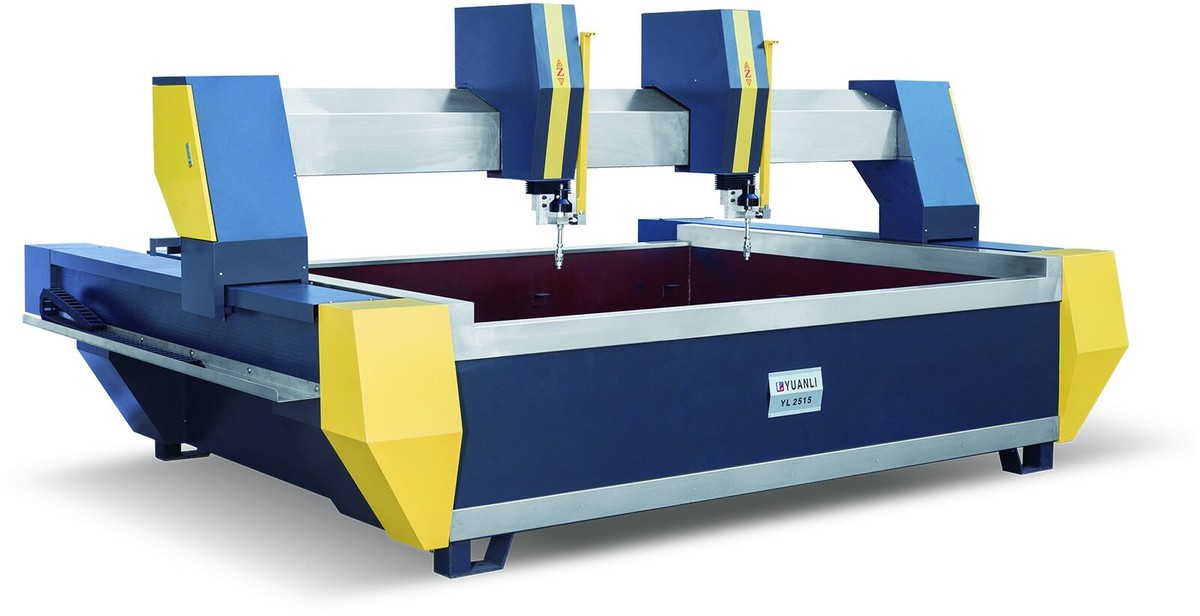
The dual-head build of the platform shown here. Three- and four-head configurations use the same gantry principle and are available as a factory option.
Four heads are available as a factory option on the YL platform range. Whether they are worth specifying is a question about your part geometry and your nesting, not about the machine.
The progression from one head to four is a progression in batch capability, and each step narrows the set of parts that suit the machine.
| Configuration | Cuts per pass | Suits | Requires |
|---|---|---|---|
| Single head | One contour at a time | One-off, irregular, large profiles | Nothing beyond the part fitting the table |
| Dual head | Two | Repeated parts, simple nesting | Two parts inside the shared travel |
| Multi-head (3–4) | Three or four | High-volume repeated parts | Three or four parts nestable together, within one envelope |
Each step up the ladder increases output on suitable work and increases the share of unsuitable work. This is the trade-off that decides the specification.
All heads share one gantry and one travel envelope. They move together across the table. Nothing about the control system changes that.
The practical consequence: to use four heads, you need four cut positions that can be reached simultaneously — meaning four part geometries positioned so that each head's path falls inside the shared travel. On standard batch work — tiles, repeated panels, identical components — this is straightforward. On mixed or irregular work it is often impossible.
A useful way to think about it: a four-head machine is not a faster general-purpose machine. It is a machine for a particular kind of job, and it is much better at that job than a single-head machine is.
"High productivity" in multi-head waterjet cutting comes from four things, of which the head count is only one:
1. Nesting density — how many parts can be placed inside the travel envelope at once 2. Cycle ratio — how much of each cycle is cutting versus positioning and piercing 3. Part consistency — whether the geometry repeats, so the program and the fixturing do not change 4. Table utilisation — whether the platform is sized so the parts fit
A four-head machine cutting parts that only nest two-up gains nothing over a dual-head machine. A dual-head machine on a platform too small to hold two parts gains nothing over a single head. The head count follows from the nesting, not the other way round.
The choice between dual and four heads is essentially a choice about batch size.
Dual-head configurations are built on the larger platforms in the range — the YL2515-D, YL3015-D, YL3020-D and YL4020-D — which is where two parts reliably fit side by side. They suit shops with a steady but varied output, where two parts per pass already removes most of the cutting time from the cycle.
Four heads suit a narrower case: production that is genuinely repetitive, where the same geometry is cut in volume and the nesting can be fixed. If your work changes every job, four heads will spend most of their time idle.
A middle option worth considering: specify the larger platform and a dual-head configuration now, with the platform sized so a four-head build is possible later if the work changes. Platform size is the difficult thing to change after the fact.
The heads in a multi-head configuration carry the same waterjet process as the rest of the range — cold cutting, no heat-affected zone, which matters on sintered stone, porcelain, granite and engineered stone.
Where the work mixes long straight cuts with complex geometry, running all of it through waterjet heads is not always the fastest route: a blade saw handles line cutting at feed rates a jet cannot match. That combination is what the Water Bridge SawJet platform is built for, and it can be specified with the blade saw and multiple waterjet heads on the same gantry.
For flat-sheet production without curves or angles, the multi-head configurations sit inside the 3 Axis Cutting Machine range.
How many cutting heads can a waterjet machine have? The YL platform range supports single-head and dual-head configurations as standard, with up to four cutting heads available as a factory option.
Will four heads give me four times the output? No. Output depends on how many parts can be nested inside the shared travel envelope and how much of each cycle is spent cutting. Four heads remove the cutting portion of a cycle on suitable work; they do not multiply throughput as a rule.
Are all heads cutting the same program? Yes. All heads are mounted on the same gantry and run from the same control. They can be assigned different contours within the program, but they move together and must each have work inside the shared travel.
What is the difference between a dual-head and a multi-head machine? Head count, and the batch profile each suits. Dual-head is built on the larger platforms for two-part nesting; multi-head with three or four heads suits genuinely repetitive production where three or four parts nest together.
Can I start with two heads and add more later? Platform size is the specification that is hard to change later, so the usual approach is to size the platform for the head count you may eventually want, and specify the heads you need now. Send us your production plan and we will advise on the configuration.
Which materials suit a multi-head machine? The same materials as any waterjet in the range: sintered stone, porcelain and ceramic slab, granite, engineered stone and quartz, composites and metals. Multi-head suits repeated parts, so the material matters less than the geometry.
Tell us what you need to cut, how many parts run per job, and how the parts can be nested. We will tell you whether multi-head is the right configuration — and if it is not, what is.
Material and thickness
Part size and parts per job
Your drawing or nesting layout
Required production volume
Cutting head quantity you are considering
Any special processing requirement
Email: sales01@ylwaterjet.com Phone / WhatsApp: +86-18520971183
Send your cutting requirements — or see the full waterjet cutting machine range.
For mixed saw-and-waterjet work rather than repeated parts, the alternative configuration is the water bridge machine for stone fabrication.


