


A dual head waterjet cutting machine mounts two cutting heads on the same gantry, so a single pass across the table produces two parts instead of one. It is a configuration of the standard YL platform rather than a separate machine, which means the platform size you would have chosen for a single-head machine also decides how much the second head can actually do.
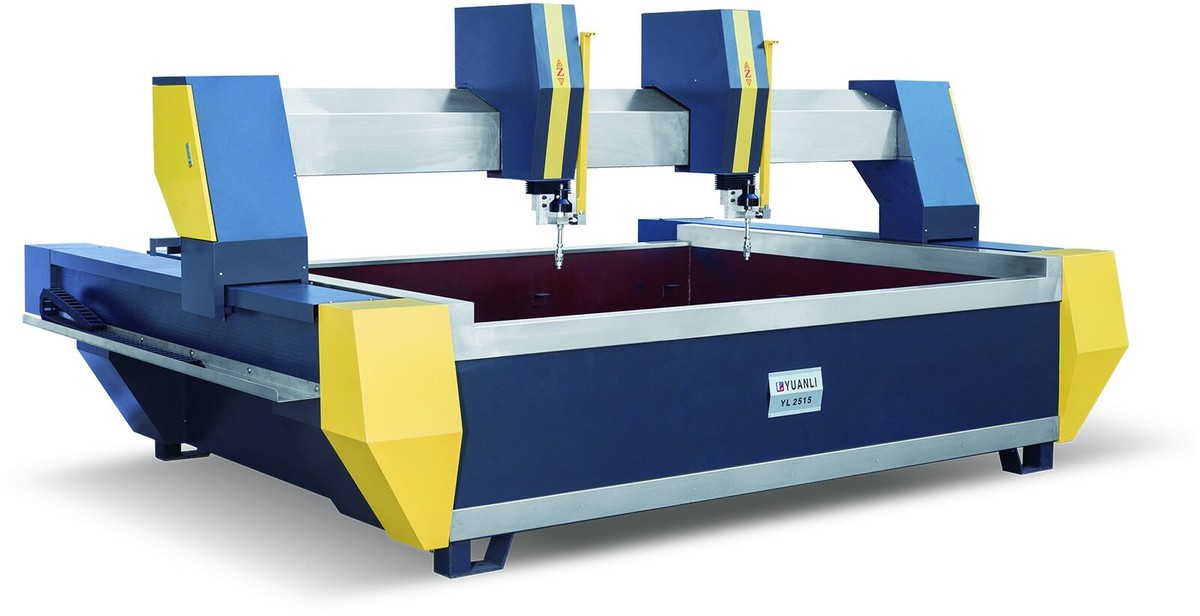
The dual-head configuration: two cutting heads on one gantry. Both heads share the same travel envelope, which is why the platform size decides how much the second head can do.
The benefit is real but conditional. Two heads only shorten a cycle when the parts you are cutting can sit side by side inside the shared travel envelope. When they cannot, the second head waits.
On a single-head machine, the head traces every contour of every part in sequence. Adding a second head to the same gantry splits that sequence in two, provided the geometry allows it.
The two heads are mounted on the same bridge and share the same X and Y travel. They move together. That single mechanical fact decides everything about whether a dual-head machine suits your work:
It helps when you cut several identical parts, or two parts that can be nested alongside each other inside the travel envelope
It does nothing when you cut one large profile that already fills the platform
It constrains when your parts are irregular or need to be positioned individually on the slab
This is why dual-head machines are common in shops producing repeated parts — tiles, standard countertop blanks, batch-run components — and rare in shops cutting one-off architectural pieces.
Both heads run on the same beam and the same control. What differs is what happens at the two cut points:
| Single head | Dual head | |
|---|---|---|
| Gantry and travel | Shared | Shared — both heads move together |
| Parts per pass | One contour at a time | Two, where geometry allows |
| Nesting requirement | Parts placed anywhere on the table | Parts must sit within the same travel envelope |
| Best fit | One-off and irregular parts | Repeated and nestable parts |
| Platform choice | Any | Larger platforms, where two parts fit side by side |
Dual-head configuration is built on four platforms in the YL range. The table below lists the documented specifications.
| Platform | Platform dimensions (mm) | Cutting travel X × Y (mm) | Machine type | Cutting heads |
|---|---|---|---|---|
| YL2515-D | 3500 × 2900 / 3800 × 2500 | 2500 × 1500 | Cantilever / Gantry | 2 |
| YL3015-D | 4300 × 2500 | 3000 × 1500 | Gantry | 2 |
| YL3020-D | 4300 × 2900 | 3000 × 2000 | Gantry | 2 |
| YL4020-D | 5300 × 2900 | 4000 × 2000 | Gantry | 2 |
The same range is also available with a single head, and up to four cutting heads are available as a factory option on the platform. Platform size, head count and control system are specified per machine rather than fixed by platform, so the configuration follows the parts you need to produce.
Three questions usually settle it.
Can the parts be nested side by side? If two of your parts fit inside the cutting travel at the same time, the second head has something to do. If one part already fills the envelope, it does not.
Is the work repeated? Dual-head machines suit batch production where the same geometry is cut many times. A shop cutting a different one-off profile every job gains much less.
Is the platform large enough? A second head on a platform too small to hold two parts is an unused second head. This is the most common mistake in specifying a dual-head machine — the head count is chosen first and the platform second, when it should be the other way round.
It does not double output. Output depends on how densely parts can be nested inside the shared envelope, on how much of the cycle is cutting versus positioning, and on the material. On suitable repeated work the second head removes a large part of the cutting time; on unsuitable work it adds a mechanical axis that never engages.
It also does not let two different jobs run at once. Both heads work from the same program and the same gantry position. Running two unrelated jobs simultaneously is not what this configuration does.
The heads on these platforms carry the same waterjet process as the single-head range: cold cutting with no heat-affected zone, which matters on sintered stone, porcelain and other chip-prone slab. The gantry platforms in this range are the larger ones, so a dual-head machine is normally specified for full-slab work rather than small-format parts. The three- and four-head options are covered in multi head and four head waterjet cutting machines.
If your work mixes straight cuts with complex geometry, the same platform is also built as a Water Bridge SawJet, which adds a blade saw alongside the waterjet for line cutting. For flat-sheet work without curves or angles, the 3 Axis Cutting Machine range covers single-head and multi-head configurations.
Is a dual head waterjet the same as a multi-head waterjet? A dual-head machine carries two cutting heads. Multi-head generally refers to three or four heads on the same platform, which is also available as a factory option. The mechanical principle — heads sharing one gantry and one travel envelope — is the same.
Does two heads mean double output? No. Output depends on how many parts can be nested inside the shared cutting travel and how much of the cycle is cutting. Two heads shorten the cutting portion of a cycle when the geometry allows; they do not double throughput as a rule.
Can the two heads cut different shapes at once? Yes — the two heads follow the same program and can be assigned different contours, as long as both fall inside the shared travel envelope at the same time.
What decides the platform size I need? The parts themselves. Work out how many parts must fit side by side for the second head to be useful, then choose the platform that holds them. Choosing the head count first and the platform second is the usual way to end up with an underused second head.
Can a single-head machine be upgraded later? Configuration is specified per machine rather than by platform, so a dual-head machine is built as such. Talk to us about your production plan before ordering rather than after.
Tell us what you need to cut and we will tell you whether a second head helps — and on which platform. To move quickly, send:
Material and thickness
Part size and how many parts run per job
Your drawing or nesting layout
Production volume
Any special processing requirement
Email: sales01@ylwaterjet.com Phone / WhatsApp: +86-18520971183
Send your cutting requirements — or see the full waterjet cutting machine range.
Shops that also need straight line cutting alongside the waterjet often pair this configuration with the water bridge machine for stone fabrication, which adds a blade saw to the same platform.


