


Stone fabrication covers two kinds of work that pull in opposite directions. Architectural and dimensional work is mostly long straight cuts, run in volume, where speed decides the price. Decorative work — inlays, mosaics, shaped panels, curved profiles — is the opposite: small quantities, tight geometry, and the finish visible on the face.
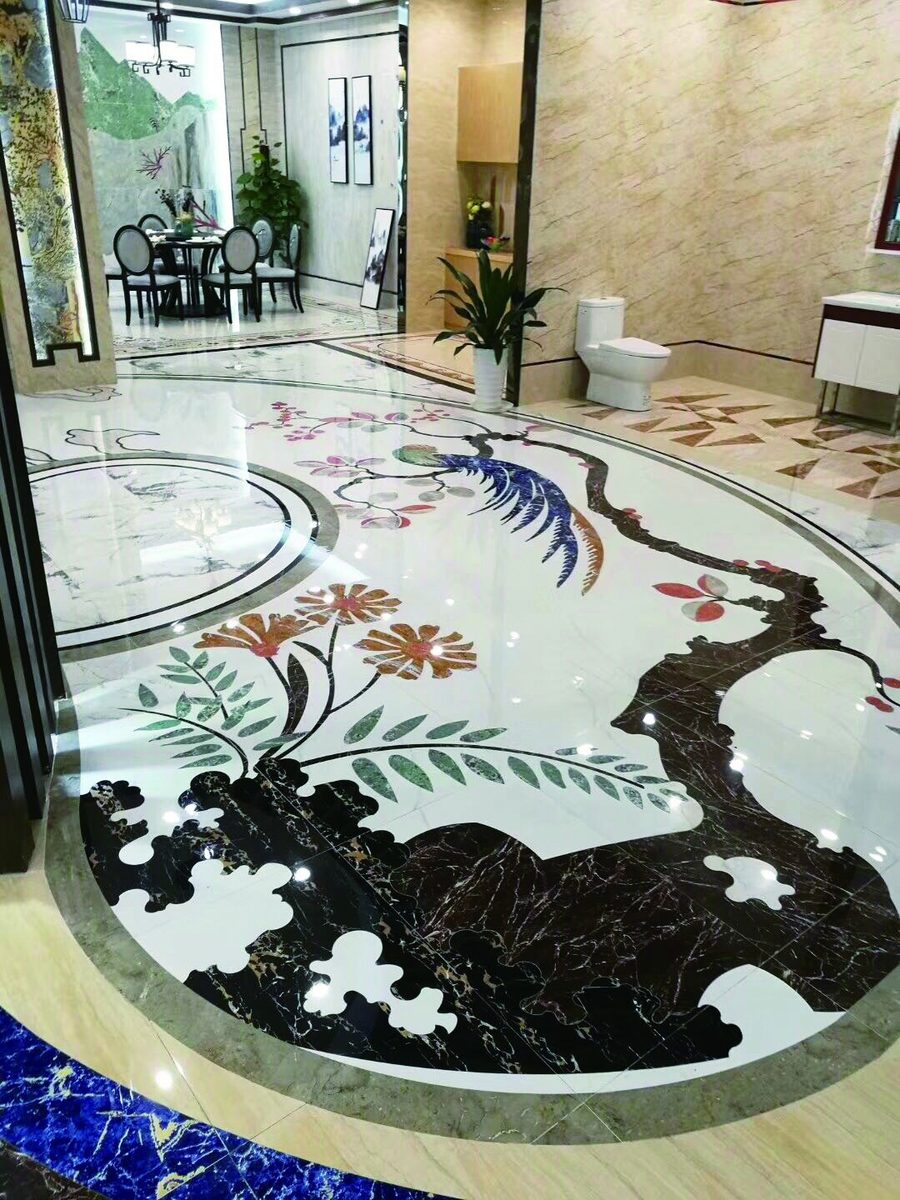
Decorative stone inlay: pocket and insert cut from the same program on the same machine, which is what allows the joint to be tight.
Most shops do both, and most shops do them on two machines. A Water Bridge machine runs both processes on one gantry, on the same slab, in the same setup.
The operations that decide whether a stone shop can take a job are rarely the straight ones.
Inlays and mosaics. An inlay is a pocket and an insert cut to fit inside it. When both are cut from the same program on the same machine, the fit is set by the cut rather than by a second setup — which is what makes tight joints achievable at all. The finished examples below are decorative stone floor inlays produced from precision-cut pieces.
Seamless joints. Where two pieces meet on a visible face, the joint quality comes from how accurately both edges were cut. This is why inlay and mosaic work is waterjet work: the jet produces the contour, and the same program produces the matching piece.
Complex profiles and shaped panels. Arcs, multi-angle joints and shaped openings are geometry a blade cannot follow. On decorative work these are the norm rather than the exception.
Bevels and chamfered edges. Angled faces are produced by the tilting head rather than as a separate operation — which matters where a shaped piece also needs an angled edge.
Sintered stone, porcelain, engineered stone and granite are dense and brittle, and the cut edge is usually the visible edge. Waterjet cutting is a cold process: no heat-affected zone is created along the cut, so the material does not discolour or craze at the edge.
On decorative work this matters more than on dimensional work, because there is no trim or covering to hide a spoiled edge. A panel with a chipped cut is a rejected panel, not a slightly imperfect one.
The practical argument for a combined platform is what happens on a mixed job.
A panel that needs a straight perimeter, a shaped opening and a chamfered edge is ordinary work in a fabrication shop, and it is exactly the job that forces a two-machine layout into repeated slab handling. On a Water Bridge machine the blade saw takes the straight cuts at saw feed rates and the waterjet takes the geometry only it can produce — same table, same program, one setup.
The scheduling point is worth stating plainly: the split between saw and waterjet is decided at programming time, not at the machine. Grouping the straight cuts lets the saw run continuously; grouping the waterjet geometry keeps the jet working on what it is actually needed for.
| Shop profile | Configuration direction |
|---|---|
| Dimensional work only — straight cuts, high volume | Bridge saw; a waterjet adds little |
| Decorative work only — inlays, mosaics, shaped panels | Waterjet, 3-axis or 5-axis |
| Mixed dimensional and decorative work | Combined saw-and-waterjet platform |
| Work including bevels and angled edges | 5-axis tilting head |
| Repeated parts in volume, nestable | Multi-head configuration on a larger platform |
| Large-format slab with a printed face | Vision system, so the program works from the actual slab |
Send the work, not the specification. The most useful thing you can send is a set of drawings that includes the jobs you currently decline or subcontract — that is where the machine pays for itself. For repeated nestable parts see multi head and four head waterjet cutting machines.
Material (granite, marble, sintered stone, porcelain, engineered stone, onyx)
Material thickness
Part or panel size
Your drawing, including shaped openings and joints
Production volume — panels per shift
Whether your work includes bevels or mitred edges
Any special processing requirement
Email: sales01@ylwaterjet.com Phone / WhatsApp: +86-18520971183
Send us your stone cutting requirements — or see the applications we build machines for.
The clip shows the platform cutting a stone slab. The blade saw runs the straight cuts while the waterjet head cuts the closed shapes and curves — both processes on one table, with no repositioning between machines.
What is a Water Bridge machine used for in stone fabrication? It combines a blade saw and a 5-axis waterjet head on one gantry. The saw takes straight line cutting; the waterjet takes curves, shaped openings, internal angles and chamfers. It suits shops where both kinds of work appear in the same order.
Can it cut inlays and mosaics? Yes. An inlay pocket and its insert can be cut from the same program on the same machine, which is what allows the joint to be tight. This is the main reason decorative stone work is waterjet work.
Does waterjet work on sintered stone and porcelain? It is a cold process with no heat-affected zone, which is why hard, chip-prone slab materials are commonly cut this way. On decorative work where the cut edge is the visible edge, that is the deciding factor.
Do I still need a separate bridge saw? For most mixed-work shops, no — the blade saw on the combined platform performs the straight line cutting. A shop running very high volumes of straight cuts only, with no shaped geometry, is still better served by a dedicated saw.
What thickness of stone can it cut? Send us the material and thickness and we will confirm against the specification. Capability varies by material, and we would rather quote for your material than give a general figure.
How large a panel can it handle? Panel size is set by the platform, which is a configurable item — see the waterjet cutting machine range, or send us the largest panel you need to produce in one setup.
Related configurations: the dual head waterjet cutting machine, the multi head and four head waterjet cutting machines, and the custom and OEM waterjet cutting machines.


