
Views: 0 Author: Site Editor Publish Time: 2026-09-24 Origin: Site


You need to cut a 45° miter on a quartz waterfall island. You need a sink opening in a 20 mm quartz slab and a curved front edge on the same piece. You need porcelain slabs mitred to look twice their thickness, or a marble medallion with joints you cannot see.
None of these are material problems. Quartz, porcelain, sintered stone, marble and granite are all cut on waterjets every day. They are control problems — controlling the shape, the angle, the joint, the edge, the repeatability, the slab yield and the number of times your team touches the part.
That is the specific job the AC 5-axis waterjet cutting machine was built for. This page is organised the way a fabricator actually thinks: by the part you have to make, not by a list of materials a machine can cut.
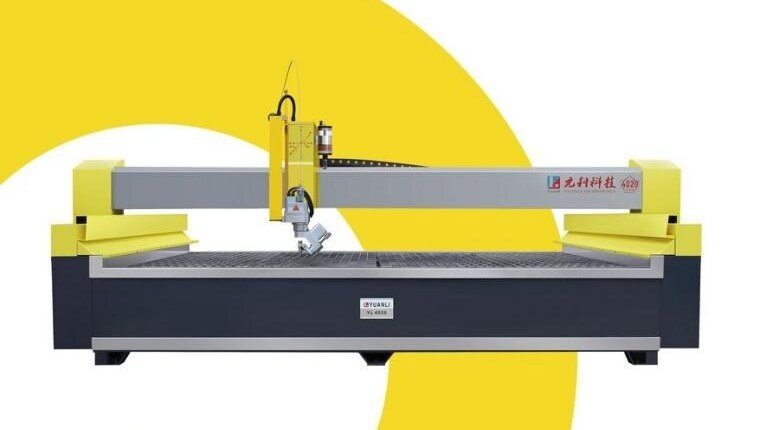
AC 5-axis platform with a tilting cutting head — the configuration that makes angle work part of the cutting cycle rather than a second operation.
Start here. Find the problem you have, and it will point to the section that answers it.
Buyer problem | Application | Relevant capability |
|---|---|---|
45° joint on an island end panel | Waterfall countertop | Controlled-angle / bevel cutting |
Complex sink or cooktop profile | Quartz countertop | CNC contour cutting, internal openings without a lead-in hole |
Decorative pattern with tight-fitting inlay | Marble / granite | Precise profile cutting (3-axis or AB 5-axis often sufficient) |
Slab mitre on large-format material | Porcelain / sintered stone | Controlled-angle cutting with material support and mapping |
Small-format custom tops in volume | Bathroom vanity | Complex contour in a configurable working area |
Beveled metal part with no heat input | Metal fabrication | Cold cutting plus angle/bevel capability |
Profile whose angle changes along the path | Architectural stone | 5-axis interpolation |
If your requirement is a straight 2D profile, an ordinary 3-axis machine will do the job and cost less. The AC platform earns its place when angle, joint and geometry are part of the specification — a distinction worth reading about in our 3-axis vs 5-axis comparison.
"How do I cut the sink opening, the tap holes and the curved front edge without drilling a lead-in hole, without a second machine, and without chipping the surface?"
Engineered quartz is a resin-bonded material. It is dimensionally stable and consistent — which is exactly why designers specify it — but the same density that makes it hard-wearing makes it unforgiving of process errors. Real production complaints from fabricators cluster around three things: edges that chip or crack, openings that need a drilled entry point, and parts that have to be touched twice because the angle work could not be done in the same cycle.
On a flat-table 3-axis machine, an internal opening needs a piercing or drilling strategy, and any bevel or mitred edge becomes a separate operation. Every additional setup adds handling risk to a finished surface — and handling is where polished countertops get damaged.
Yuanli configures the platform around the parts you produce, not a single fixed specification:
Working area sized to your slab. Published platform sizes run from 2000 × 1500 mm to 4000 × 2000 mm (YL2015 through YL4020), with a compact cantilever option for smaller work.
Head count matched to volume. Single, dual or up to four heads on one gantry, depending on the model and configuration.
Cutting-head swing of 0–65° — a published figure for the AC platform — so bevels and mitred edges sit inside the head's range rather than in a secondary operation.
Published accuracy figures for the AC platform / YL3020: ±0.1 mm cutting accuracy, ±0.01 mm repeatability, ±0.025 mm positioning accuracy, with a 6000 mm/min traverse.
Pressure and pump specification confirmed per configuration (standard and optional high-pressure configurations are available).
Cold cutting. Waterjet removes material by erosion rather than by a toothed blade or a thermal process, so there is no heat input from the cutting method itself.
For countertop production, the practical benefit is straightforward: the outline, the internal openings and the angled edge can belong to the same cutting cycle, on the same table, from the same drawing.
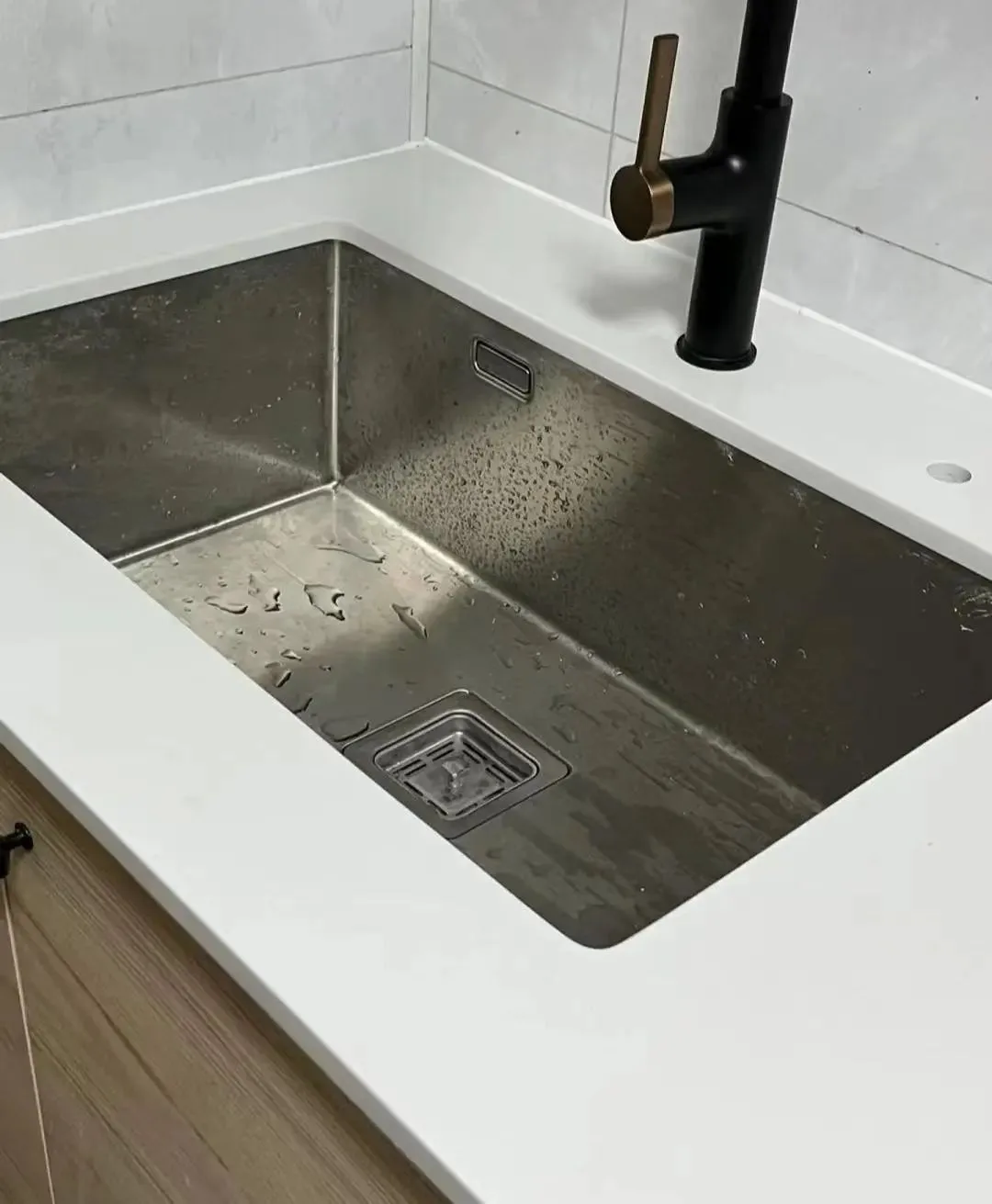
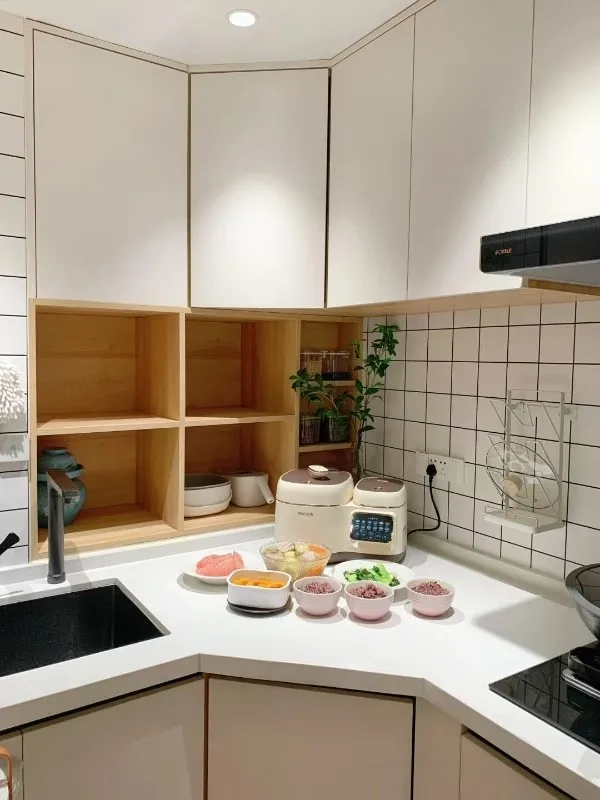
SEND YOUR COUNTERTOP DRAWING FOR A CUTTING TEST — material, thickness, finished part size and the opening or edge detail you need.
This is the requirement that most often decides which machine a fabricator buys, so it gets its own section.
A miter in stone countertop work is an angled cut — almost always 45 degrees — made on two pieces so they meet at a corner with no visible cut face. Two pieces of 2 cm material joined this way present as a 4 cm profile. The name in project drawings is often "waterfall" or "side return": the material continues down the side of the unit rather than stopping at the edge.
The reason fabricators choose it over a laminated edge is the joint itself. A mitre distributes stress across the bonded face and puts the glue line inside the corner instead of on the visible bottom edge — so the finished unit reads as one solid thickness rather than a top with a strip glued underneath.
A waterfall island is a design statement, and it is unforgiving of the joint. Because the two faces meet on a visible 90° corner, any angle error appears as a light leak along the seam. The edge you are cutting is also thin: on 2 cm material the bevel face at the top edge is only a few millimetres, and it will chip or fracture under vibration if it is not fully supported during cutting.
Thin porcelain and sintered stone slabs are usually mitred for the same reason — to create the visual impression of a thicker top with a colour-matched edge. But the material behaves differently from quartz:
It is denser and more glass-like, so it demands tight process control and correct tooling.
Thin slabs frequently need a supporting substrate; thicknesses at or above 12 mm typically do not.
Body colour matters. A through-body slab whose biscuit matches the surface will produce a far cleaner mitred edge than one whose decoration sits only on the surface layer.
This is why the industry advice on porcelain mitring is not "cut at 45°" but "map first, then cut". As one trade source puts it, the more accurate the mapping of your probe, the better the mitre — and all mapping should be completed before any cut is made. That is a machine-workflow question, and it is exactly what the AC 5-axis waterjet with intelligent vision addresses for large-slab work.
Failure mode | Why it happens | What it costs |
|---|---|---|
Chipped or fractured bevel edge | Thin bevel face, insufficient support, vibration during cut | Scrapped part, or a visible repair |
Visible gap at the joint | Angle drift along the cut; blade or head not holding the angle | Light leak on a premium corner |
Visible adhesive line | Poor joint fit, wrong adhesive, incomplete glue coverage | Rejected by the client on site |
Inconsistent joint across a long run | Two pieces cut on different setups or at different times | Rework, or a re-cut |
Unreliable joint strength | Adhesive not suited to the material | Callback risk after installation |
A shop-floor check that costs nothing: cut test pieces, stand them up with the bevel faces in contact and look for light. Even a small gap shows up immediately.
On the AC platform the cutting head swings through a published range of 0–65°. A 45° miter therefore sits inside that range, and it can be produced in the same setup as the outline — no second machine, no re-fixturing of a finished surface.
Two honest qualifications:
A tilting head is necessary, not sufficient. Mitre quality still depends on material support, abrasive selection, piercing strategy, cut parameters and the mapping of the slab. A machine that can tilt is not a machine that automatically produces a perfect joint.
Configuration matters. Different AC machines in the range are built for different parts and different angles. If mitre work is your core requirement, say so at specification stage so the head, the support system and the working area are chosen for it — which is the reason we ask for the drawing rather than a material name.
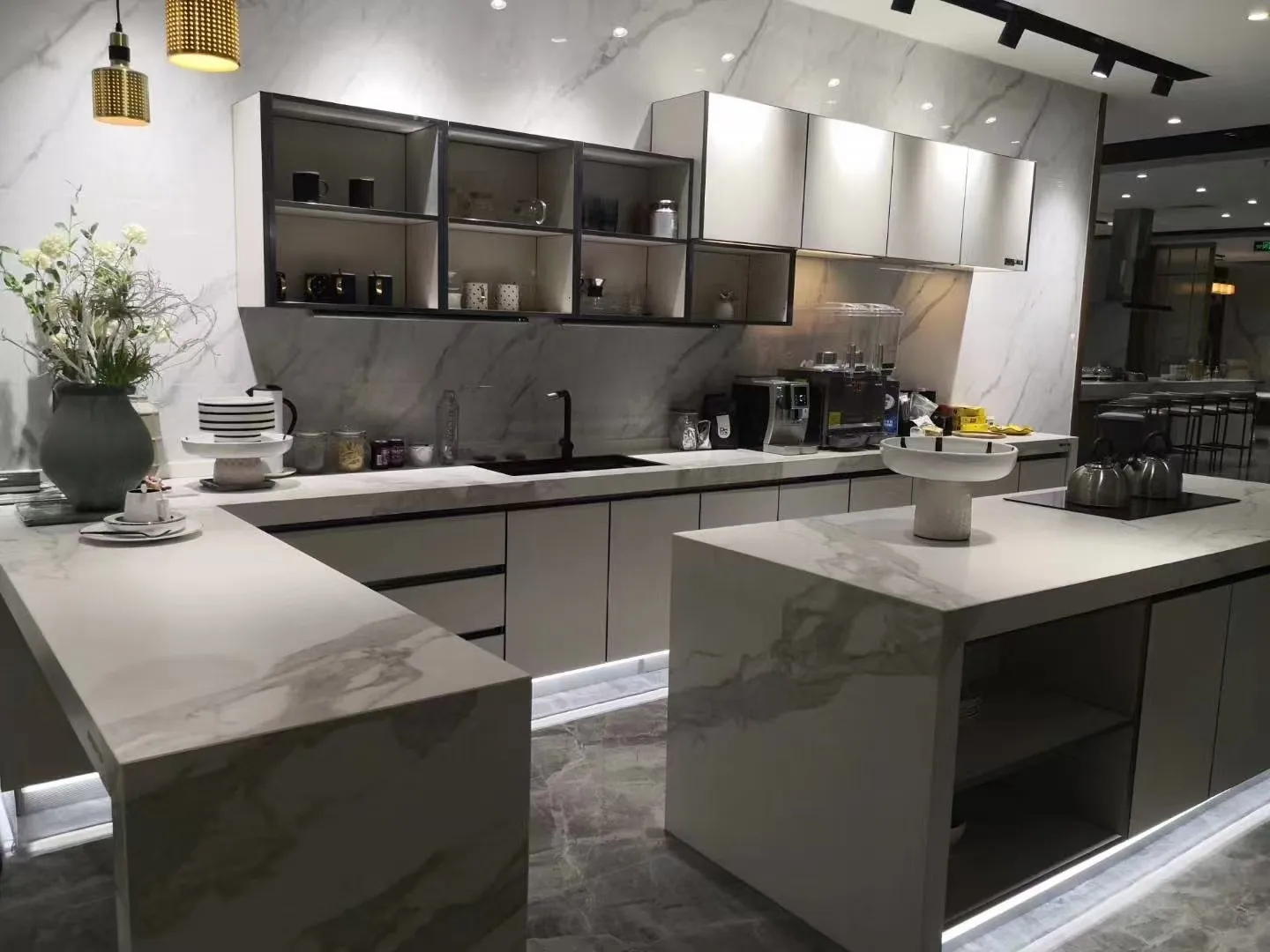
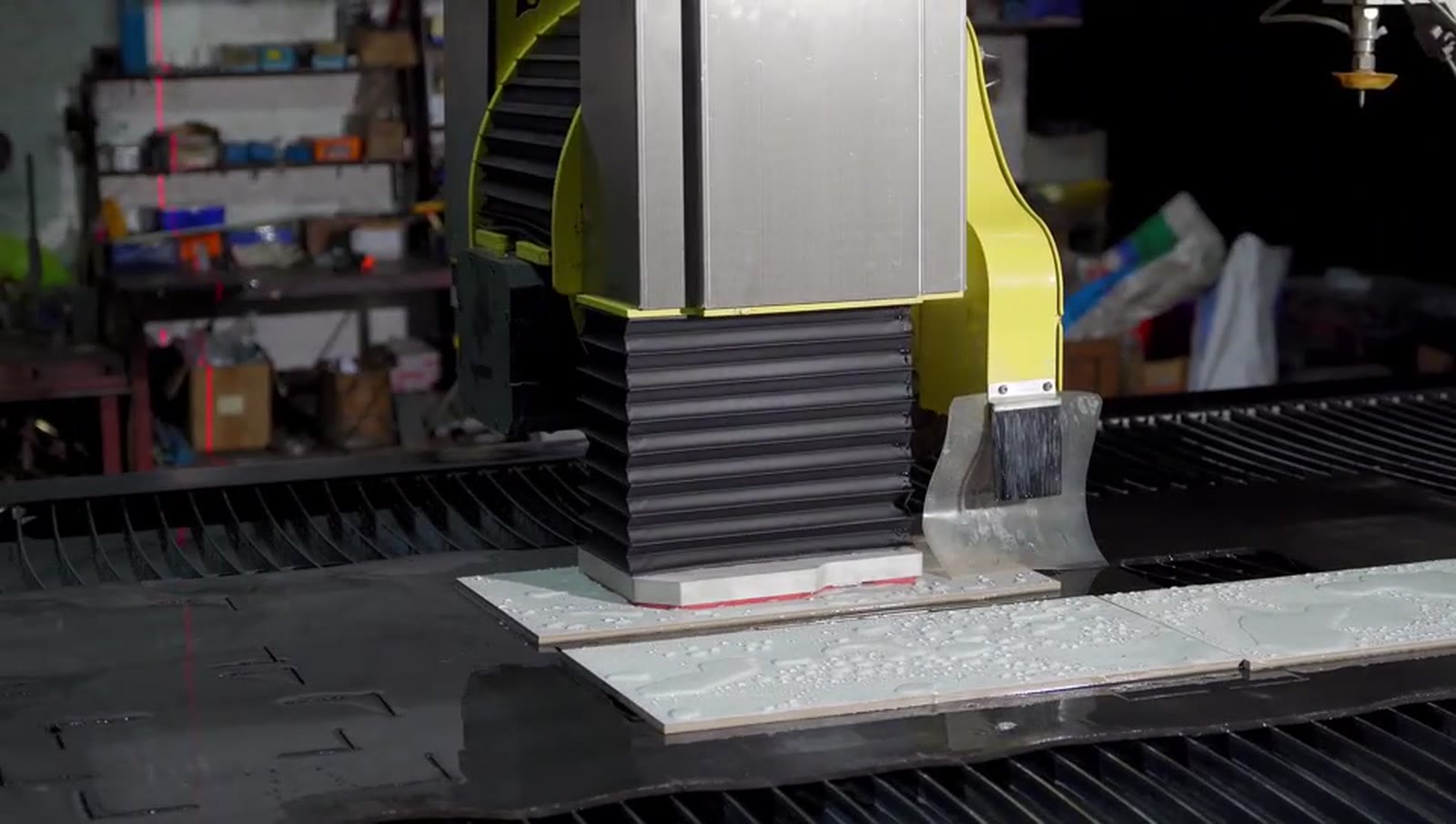
SEND YOUR MITER PROFILE — include the drawing, the material and thickness, the angle, and whether the joint is a 90° corner or part of a waterfall run.
Yes, abrasive waterjet cuts porcelain, ceramic and sintered stone. That is a settled question and it does not deserve a page.
The real question is: can you cut large-format slabs repeatedly, cleanly, with a mitred edge that survives installation? That is a production question with four parts — chipping control, part support, slab handling, and angle accuracy on a part that is often 3200 mm long and 6–12 mm thick.
Edge chipping. Dense, brittle material chipped by a toothed blade is scrap. Abrasive waterjet removes material with a narrow kerf and no blade contact, which reduces the mechanical stress on the edge — and the process can be parameterised to suit the material rather than the other way around.
Handling, not cutting, destroys parts. A 3200 × 1600 mm slab has to be positioned, supported and unloaded. If your machine has no way to align the cut to the actual slab, you are cutting by assumption.
Mitred edges on thin material. A 45° mitre on 12 mm porcelain is the standard way to fake 24 mm — and the standard way to generate scrap if the angle and the support are wrong.
Pattern matching. On veined and book-matched material, the cut must follow the pattern. A contour extracted from the actual slab, not from a nominal rectangle, is what makes this repeatable.
For this profile, three configuration decisions dominate:
Working area — the slab must fit, including the mitred drop edge and any over-travel the cutting cycle needs.
Intelligent vision — contour extraction, coordinate calibration between material and machine, and a WYSIWYG view of the slab with the cutting layout overlaid, so the layout is planned against the material you actually have. Vision also supports basin and sanitaryware applications such as overflow openings and tap holes.
Head and platform choice — the Water Bridge / 5-Axis SawJet platform combines a straight-cutting saw with waterjet on one platform, which suits shops running long straight cuts and internal cut-outs in the same shift.
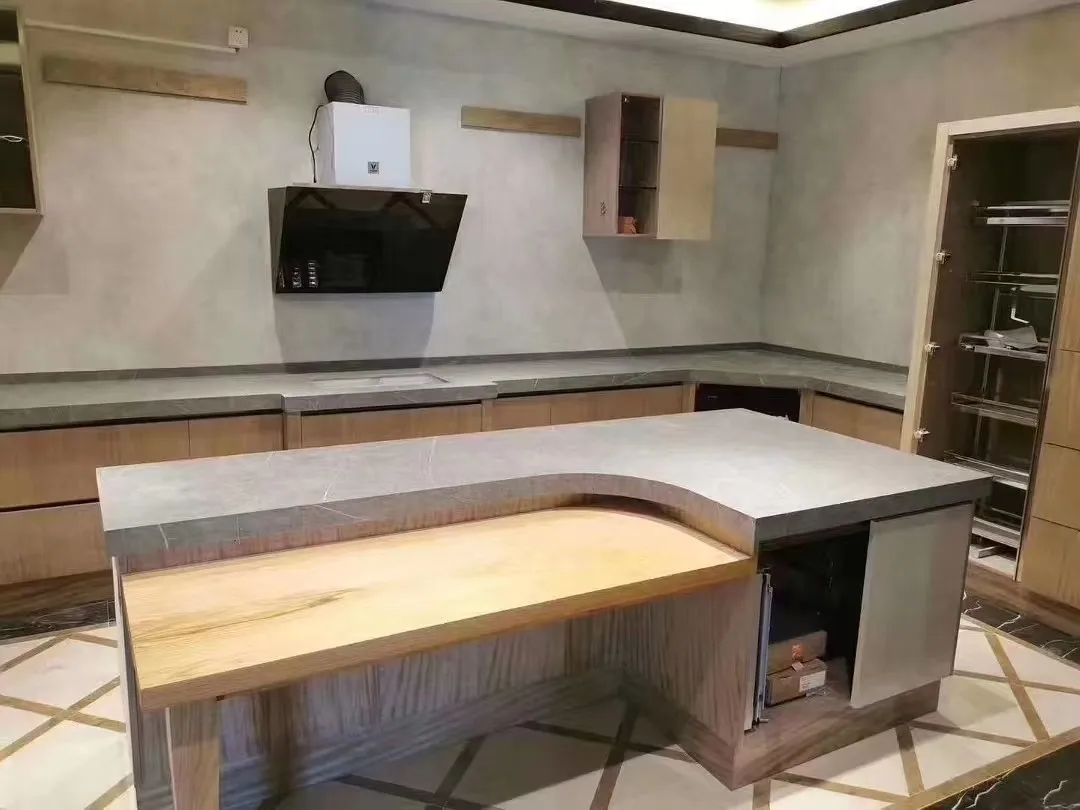
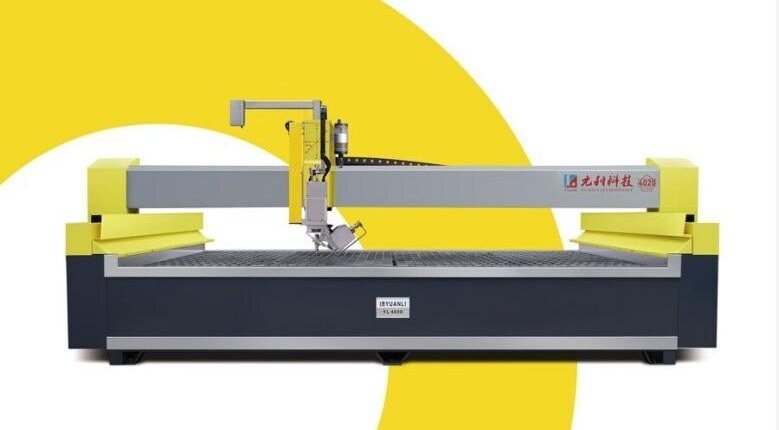
SEND YOUR SLAB DRAWING — include slab dimensions, thickness, material brand if known, and the mitre or edge detail.
Inlay, medallion, mosaic and border work is where the waterjet's narrow kerf and pattern-following ability matter most — stone floor medallions and architectural inlays are a long-established waterjet application, and the tolerance achievable allows joints tight enough to read as grout-free.
Here is the part most suppliers will not tell you: not every marble or granite job needs a 5-axis machine, and almost none needs an AC head.
Work type | Configuration that fits |
|---|---|
Flat 2D inlay, mosaic, borders, medallions, straight countertop outlines | 3-axis — the most cost-effective platform for flat pattern work |
Inlay work where the head must articulate to compensate taper, or where the shop also runs controlled-angle decorative work | AB 5-axis — head articulation published at 0–15° |
Decorative geometry that includes angled faces, bevels, mitred returns or complex contours alongside the pattern | AC 5-axis — 0–65° published swing |
Choose AC when angle is part of the design. Choose AB when the requirement is taper compensation and controlled-angle detail. Choose a 3-axis platform when the requirement is flat pattern accuracy and volume. If you are weighing these against each other, our published AB 5-axis platform page sets out where each one is intended to run.
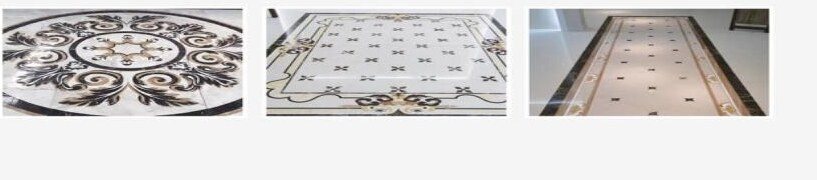
SEND YOUR PATTERN DRAWING — plus the finished panel size and how the pieces are assembled (pre-assembled on a backing, or laid individually).
Vanity tops are the job that keeps a shop busy between kitchen projects — and the job that is hardest to justify putting on a dedicated machine, because the parts are small and the variations are endless.
The requirement set is consistent: a basin opening, a tap hole or three, often a mitred drop front edge, sometimes a curved or shaped front, and a material that may be quartz, marble or porcelain depending on the project.
That is a single-platform argument. A configurable working area with the right head count lets one machine cover kitchen countertops and vanity tops without a separate small-format investment — and because the platform is CNC-driven, switching from one vanity drawing to the next is a program change, not a setup rebuild.
For buyers running both categories, the vanity work is also where a dual-head or multi-head configuration earns its keep: identical parts, repeated. Yuanli builds single, dual and up to four-head configurations depending on model.
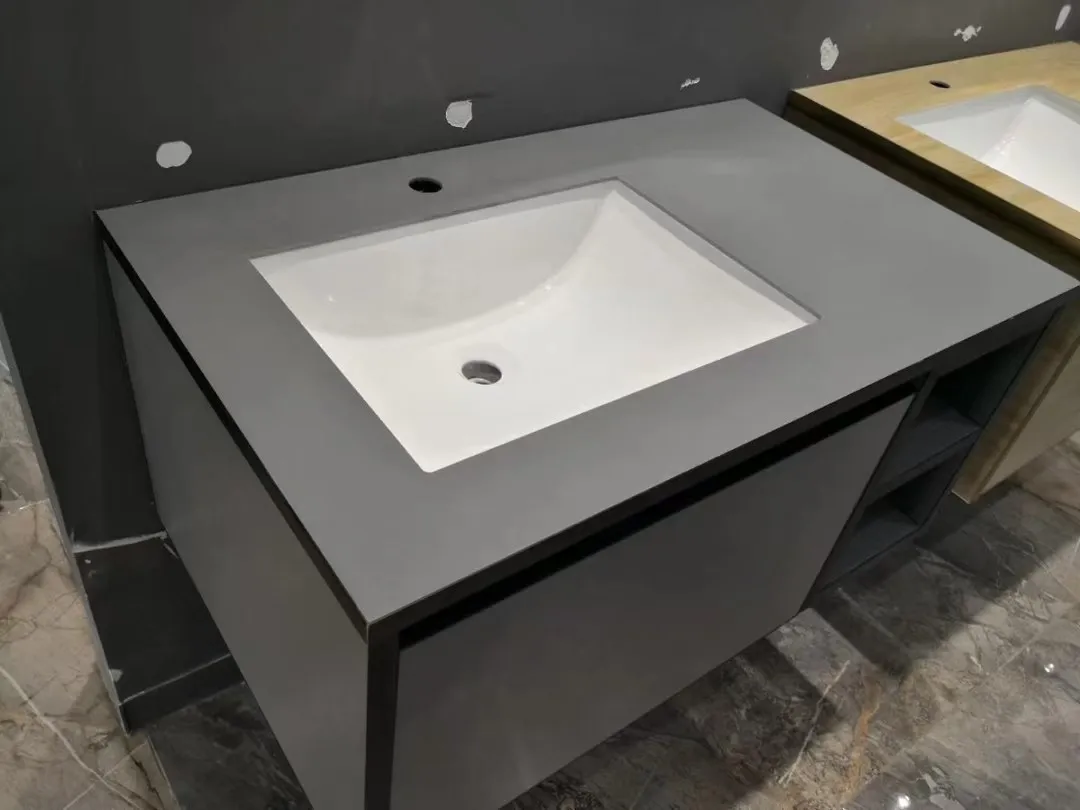
SEND YOUR VANITY DRAWING — basin type (undermount or inset), tap hole positions, edge profile and the material you expect to run most often.
Some parts cannot be described as a rectangle with holes in it. Curved bar fronts, radiused peninsulas, irregular cut-outs that follow a design line, architectural panels with profiled edges, components whose surface angle changes along the path.
On a purely 2D workflow these become a sequence of compromises: multiple set-ups, hand finishing, or a design that gets simplified to suit the machine. On a 5-axis platform the head can be interpolated so its orientation follows the contour while the angle changes — which is what turns "difficult shape" from a production problem into a programming one.
This is also where the practical difference between an AB and an AC machine becomes visible in the parts: taper compensation on a straight cut is one requirement; a controlled angle held along a curved path is another.
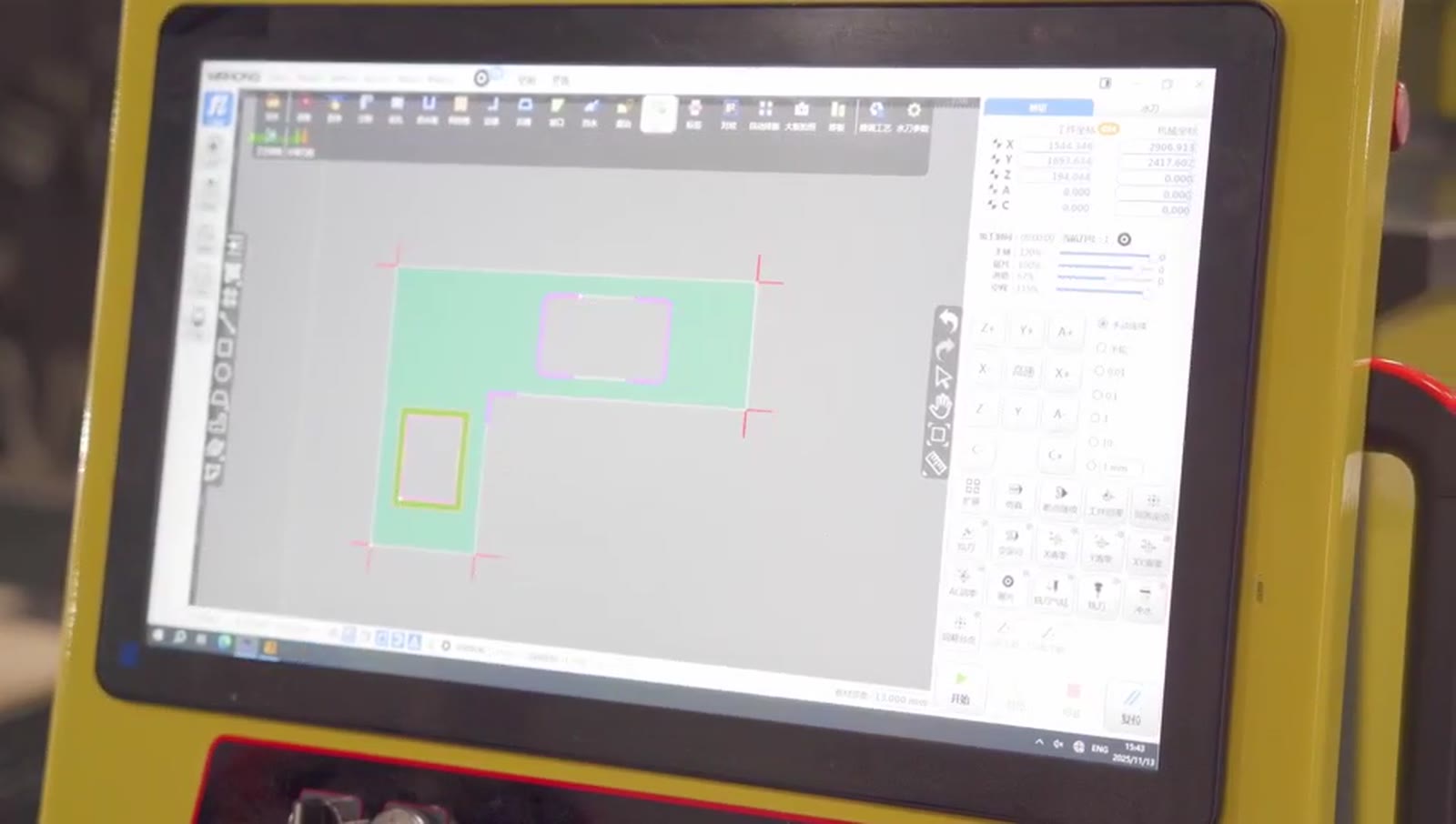
SEND YOUR CAD DRAWING — DXF, DWG, STEP or a dimensioned PDF. If you only have a photo and dimensions, send that; the application review will tell you what we need.
The same platform cuts metal, and for some parts that is the deciding factor.
Abrasive waterjet is a cold cutting process: material is removed mechanically by a high-pressure abrasive jet, not by a heat source. That means:
No heat-affected zone of the kind associated with thermal cutting processes.
Can reduce thermal distortion risk compared with thermal cutting on parts where heat input is a concern.
Complex profiles and internal features can be produced without tooling dedicated to that part.
Bevel and angle capability on the same platform — so weld preparation, chamfers and angled faces do not require a second machine or a second setup.
Published metal-cutting evidence from outside our company supports the capability in demanding applications: a peer-reviewed 2024 study in Machines (MDPI) documented 6-axis abrasive waterjet bevel cutting on 30 mm high-strength DH40 shipbuilding steel, reporting bevel-depth and bevel-direction deviations within tolerance and noting the process was applied in the shipbuilding industry. At service-centre level, a metals supplier documents 5-axis waterjet beveling producing consistent bevels up to 45°, with straight cuts up to 6" thick and bevels typically to 1–1½".
Materials: stainless steel, carbon steel, aluminium, brass, titanium. As with stone, edge finish and achievable thickness depend on material, pressure, abrasive and the cut parameters selected — the right approach is a test cut on your part, not a claim on a page.
SEND YOUR PART DRAWING — material grade, thickness, bevel angle if any, and quantity per month.
Material group | Examples | Typical applications on this platform |
|---|---|---|
Stone | Quartz, marble, granite, limestone, engineered stone | Countertops, sink and cooktop cut-outs, mitred edges, vanities, inlay and mosaic |
Slab materials | Porcelain, ceramic, sintered stone | Large-format countertops, mitred edges, waterfall ends, architectural panels |
Glass | Architectural and decorative glass | Shapes, openings and profiles where a cold process suits the material |
Metals | Stainless steel, carbon steel, aluminium, brass, titanium | Precision parts, brackets, custom profiles, beveled and complex-angle components |
Other hard materials | Suitable configurations by application | Reviewed per project |
Abrasive waterjet is a process with wide material tolerance — the material list is not the interesting variable. The interesting variables are thickness, tolerance, angle and volume, and those are what you should send us. Our application overview shows how these groups map onto production scenarios.
This is Yuanli's published capability comparison. It is written as a requirements table, because the right answer depends on your part — not on a hierarchy.
Requirement | 3 Axis | AB 5 Axis | AC 5 Axis |
|---|---|---|---|
Standard 2D profiles | Yes | Yes | Yes |
Stone inlay & mosaic | — | Optimised | Yes |
Medallions & decorative patterns | — | Optimised | Yes |
Controlled-angle cutting | — | Yes | Yes |
Bevel cutting | Limited | Yes | Optimised |
Complex contours | — | Yes | Optimised |
Advanced angle work | — | Limited | Optimised |
Precision metal parts | — | Limited | Optimised |
Published head articulation / swing | n/a | 0–15° | 0–65° |
How to read it. A 3-axis machine is the correct purchase for flat 2D production — outlines, cut-outs and inlay on flat panels — and it is the lowest-cost way to do it. An AB 5-axis machine adds head articulation for taper compensation and controlled-angle work, and is the platform most inlay and mosaic shops actually need. An AC 5-axis machine is for work where the angle is a design requirement: mitred waterfall joints, bevels on thick material, complex contours and precision metal parts.
Nobody needs AC capability for every job. Some shops need all three on the floor at once. If you are unsure where your part sits, that is a specification conversation, and it is free: see the full comparison page or talk to us directly.
Stone fabrication is regional. The parts, the materials and the edge details differ by market — so here are the application patterns we observe in the markets we serve, with the evidence for each.
Italy and Southern Europe. Italy is a machinery-and-processing specialist supply chain with its own global trade event: the organiser of Marmomac reports 1,400 exhibitors and 50,000 visitors for the 2025 edition, with 66% international operators. The Carrara district alone closed 2024 at €805 M in exports (+12.3%), and trade reporting notes that processed and semi-finished products now represent 79% of Italian stone exports by value — a fabricating market, not only a quarrying one. For porcelain and ceramic slabs, the Bologna cluster behind Cersaie (627 exhibitors, 95,000 attendance in 2025) supplies much of the large-format material now being fabricated across Europe.
Spain, France, Germany, Poland and the UK. Spanish trade press has documented the shift directly: fabricators who previously worked only with natural stone are now also working with large-format porcelain. Germany's Stone+tec fair is built around machinery, tools and technologies for professional stone processing; Poland's STONE fair in Poznań covers cutting and processing equipment; in the UK, mitred edges are marketed to end clients as a premium specification for large or complex layouts.
Gulf markets. The Gulf is a premium-interior market with a heavy hospitality and residential project load. A dedicated stone event runs alongside Big 5 Global in Dubai (Marble & Stone World, next edition 23–26 November 2026), and Saudi Arabia runs stone and surface tracks inside its construction calendar (Saudi Build, Marble & Stone Saudi Arabia). Trade reporting on premium stone imports records significant volumes of high-grade processed marble moving into Saudi Arabia and the UAE for hospitality and residential projects. Grand View Research's own model for the regional granite market places countertops as the largest application segment and names luxury kitchens, high-end flooring and hotel lobbies as demand drivers. Turkey's Marble İzmir fair reported 50,983 professional visitors at its 31st edition — a market with its own quarrying and processing base.
What this means for machine selection. In all of these markets the same three requirements keep appearing: mitred or waterfall edges on premium work, cut-outs in harder and thinner slab materials, and a mix of materials in one shop. That is a configuration problem, and it is why we start from your part drawings rather than a price list.

Send us these eleven items and you will get a specification instead of a brochure:
# | Input | Why it decides the machine |
|---|---|---|
1 | Material | Determines pressure, abrasive and pump configuration |
2 | Thickness | Drives cutting parameters and achievable speed |
3 | Maximum slab / part size | Sets the working area |
4 | Required cutting area | Confirms travel and over-travel needs |
5 | Required angle (e.g. 45° mitre, bevel) | Decides whether AB or AC is needed |
6 | Typical product (countertop, vanity, inlay, panel, part) | Determines support and fixturing |
7 | Production volume (parts per shift) | Determines head count |
8 | Number of heads required | Single, dual or up to four, depending on model |
9 | Pump requirement | Standard or optional high-pressure configuration |
10 | Automation / vision requirement | Large-slab mapping, pattern matching, WYSIWYG layout |
11 | CAD files (DXF / DWG / STEP, or a dimensioned drawing) | The actual basis of the quotation |
Two practical notes. First, voltage: published configurations support 220 V / 380 V / 415 V and 50/60 Hz, which matters for site planning. Second, footprint: the published YL3020 figure is 4200 × 3600 mm at 4250 kg — check access and floor loading before you choose, not after. Machine dimensions vary by model, so confirm the figure for the configuration quoted.
If your requirement includes vision-assisted slab work or multi-head production, those are configured at order stage. See custom and OEM waterjet configurations for the options that are configurable.
Engineered around your process. That is not a tagline; it is the reason the first question we ask is about your drawing and not about your budget.
Foshan Yuanli Precision Machinery builds CNC ultra-high-pressure waterjet cutting machines and has focused on that single product category. The published platform range covers 3-axis, AB 5-axis, AC 5-axis, AC with intelligent vision, a Water Bridge / SawJet combination platform and a waterjet-plus-milling composite machining centre.
What the AC platform delivers, as published:
Cutting-head swing 0–65° — the machine can cut the full 0–65° range; 45° is the typical angle for stone work and up to 75° is occasionally achievable for angle and bevel work on the AC platform
±0.1 mm cutting accuracy, ±0.01 mm repeatability, ±0.025 mm positioning accuracy (AC platform / YL3020 published figures)
Working areas from 2000 × 1500 mm to 4000 × 2000 mm across the model range
Single, dual or up to four cutting heads depending on model and configuration
450 MPa working pressure on standard models; 600 MPa is available as a customised option with a KMT pump
220 V / 380 V / 415 V, 50/60 Hz published power input
CE certified and export-ready, with ISO certification stated on the AC bevel product page
IP68 protection rating on core components, as published for wet and dusty cutting environments
12-month warranty as published, with machinery test reports and outgoing-inspection video provided with each unit
Beyond the machine:
Application support — configuration reviewed against your material, part and volume before the order
Cutting tests — send the material and the drawing; a test cut is the only honest answer to "will it cut my part"
Customisation and OEM/ODM — platform size, head count, vision and branding are configured around the application
Service and spares — installation, operator training, remote troubleshooting and long-term supply of YL-series wear parts
You can see how this works end to end on our services page, or read the company background on About Us.
If you have a quartz countertop, porcelain slab, marble or granite pattern, vanity top, or a metal part that needs complex-angle cutting, the fastest route to a real answer is one email with a drawing attached.
Send us:
The drawing (DXF, DWG, STEP or a dimensioned PDF)
The material and thickness
The finished part size
The angle or joint detail you need to achieve
Your monthly volume and country
Our team reviews the application and recommends a waterjet configuration. If the part is marginal, we say so — and we will tell you which configuration is required rather than quoting the largest one.
SEND YOUR DRAWING FOR A CUTTING TEST → contact us or WhatsApp +86 185 2097 1183
GET A WATERJET QUOTE → request a quote with the five items above
CONTACT A YUANLI ENGINEER → sales01@ylwaterjet.com · +86 185 2097 1183
Can a 5-axis waterjet cut quartz countertops?
Yes. Abrasive waterjet is a standard process for quartz and other engineered stone. The practical advantages for countertop work are internal openings cut without a lead-in hole, and bevel or mitred edges produced in the same setup as the outline. Yuanli's published capability for countertop work is on the quartz countertop page.
Can a waterjet make a 45-degree miter cut?
Yes — on a machine with a controlled-angle cutting head. Yuanli publishes a 0–65° cutting-head swing for the AC platform, so a 45° bevel is within range and can be produced in the same cycle as the outline. The full 0–65° range is achievable; 45° is the typical stone application and up to 75° is occasionally possible. Joint quality still depends on material support, abrasive, cut parameters and slab mapping; it is not automatic.
What is the difference between AB and AC 5-axis waterjet?
The head articulation. Yuanli publishes 0–15° for the AB platform (used for taper compensation, inlay, mosaic and controlled-angle detail) and 0–65° for the AC platform (bevels, mitres, advanced angle work, complex contours and precision metal parts). See the AB 5-axis page and the comparison page.
Can a waterjet cut porcelain slabs?
Yes, including large-format porcelain and sintered stone. Porcelain is dense and brittle, so the production challenge is chipping control, part support and mitre accuracy rather than the ability to cut. Thin slabs may also require a substrate, and body-colour type affects how clean a mitred edge looks.
Can waterjet cut marble and granite?
Yes — inlay, medallion, mosaic and decorative pattern work is a long-established waterjet application because the narrow kerf and tight tolerance allow close-fitting joints. Not every marble or granite job requires a 5-axis machine; flat pattern work is normally handled on a 3-axis platform.
Can waterjet cut bathroom vanity tops?
Yes. Vanity tops are usually small-format parts with a basin opening, tap holes and a mitred drop edge. They are normally run on the same configurable platform as kitchen countertops, which is usually more economical than a dedicated machine for the job.
What thickness can a waterjet cut?
It depends on material, pressure, tolerance and cutting speed. Published Yuanli figures state a cutting capacity of up to 150 mm, with an indicative capacity of up to 200 mm on suitable configurations for cold metal cutting; actual achievable thickness should be confirmed for your material and tolerance as part of the application review.
How much does a 5-axis waterjet cost?
Price depends on working area, head configuration, number of heads, pump specification, vision and automation — so there is no meaningful list price. Send your drawing, material, thickness and volume and you will get a configuration and a quotation for the machine that fits, which is what the number actually depends on.
What information do I need to request a waterjet quotation?
Material, thickness, maximum part or slab size, required cutting area, required angle, typical product, monthly volume, number of heads needed, pump requirement, automation or vision requirement, and a CAD file or dimensioned drawing.
Is waterjet suitable for stainless steel and aluminium parts?
Yes. Abrasive waterjet is a cold cutting process, so it avoids the heat-affected zone associated with thermal cutting and can reduce thermal distortion risk on heat-sensitive parts. It also cuts complex profiles and bevels without dedicated tooling. Achievable finish and thickness depend on material, pressure and cut parameters — a test cut on your part is the reliable way to confirm.
Yuanli Waterjet — AC 5-axis platform, cutting-head swing 0–65°, accuracy and machine specifications: https://www.yuanliwaterjet.com/5-Axis-Cutting-Machine-pl41908986.html
Yuanli Waterjet — three-platform comparison table and published articulation figures: https://www.yuanliwaterjet.com/3-axis-vs-5-axis-waterjet.html
Yuanli Waterjet — quartz countertop cutting capability (sink cut-outs, tap holes, bevels): https://www.yuanliwaterjet.com/Waterjet-Cutting-Machine-for-Quartz-Countertops-pd196103238.html
Yuanli Waterjet — 45-degree bevel / YL3020 published specifications: https://www.yuanliwaterjet.com/45-Degree-Water-Jet-Cutting-Machine-Bevel-Processing-Applications-pd144888438.html
Yuanli Waterjet — AC 5-axis with intelligent vision: https://www.yuanliwaterjet.com/Ac-5-axis-Waterjet-With-Intelligent-Vision-System-pd532155738.html
Yuanli Waterjet — Water Bridge / 5-axis SawJet platform: https://www.yuanliwaterjet.com/Water-Bridge-Machine-5-Axis-SawJet-pl42908986.html
Stone World — "Technical Focus: Advice on handling, fabricating and installing porcelain slabs" (mitre mapping, glue coverage, substrate): https://www.stoneworld.com/articles/93389-technical-focus-advice-on-handling-fabricating-and-installing-porcelain-slabs
Stone World — "A fabricator's guide to cutting porcelain and sintered stone" (density, through-body colour, glass-like approach): https://www.stoneworld.com/articles/95716-a-fabricators-guide-to-cutting-porcelain-and-sintered-stone
Dynamic Stone Tools — 45-degree miter fabrication guide (definition, fragile thin bevel edge, test-cut method): https://dynamicstonetools.com/blogs/news/miter-edge-countertops-45-degree-fabrication-guide
MDPI Machines (2024, 12(6), 408) — peer-reviewed study of 6-axis abrasive waterjet bevel cutting on 30 mm DH40 shipbuilding steel: https://www.mdpi.com/2075-1702/12/6/408
Rolled Alloys — 5-axis waterjet beveling capability (consistent bevels up to 45°): https://www.rolledalloys.com/articles/5-axis-waterjet/
Park Industries — porcelain island fabrication on a 5-axis sawjet (third-party manufacturer example): https://www.parkindustries.com/blog/how-to-cut-porcelain/
BACA Systems — fabricator case study, quartz mitres, sink cut-outs and curved surfaces (third-party manufacturer example): https://www.bacasystems.com/case-studies/natural-stone-designs-boosts-profits-with-a-baca-robo-sawjet/
Flow International — stone cutting FAQ (kerf width, chipping reduction, dust containment): https://www.flowwaterjet.com/explore/faq-stone-cutting
Marmomac (Veronafiere) — 2025 edition figures: https://www.marmomac.com/en/
Cersaie / Confindustria Ceramica — 2025 edition figures: https://www.ceramica.info/en/content/cersaie-2025-a-global-showcase-of-ceramic-tiles-and-bathroom-furnishings/
LITOS — Spanish fabricators adopting large-format porcelain: https://www.litosonline.com/en/article/working-porcelain-and-stone-some-experiences-spain
Big 5 Global — Marble & Stone World, Dubai: https://www.big5global.com/exhibiting-at-marble-and-stone-world/
Marble İzmir (İZFAŞ) — exhibition figures: https://marble.izfas.com.tr/en
Grand View Research — Middle East granite market report (publisher's own model estimates): https://www.grandviewresearch.com/industry-analysis/middle-east-granite-market-report
Image credits. Application photography and machine imagery: © Foshan Yuanli Precision Machinery Co., Ltd. Waterjet cutting machine photograph: U.S. Department of Defense (public domain), via Wikimedia Commons. "5 axis water jet CNC" by WARDJet, CC BY-SA 2.0, via Wikimedia Commons. Kitchen photography by Quang Nguyen Vinh, Curtis Adams and Max Vakhtbovych, via Pexels (Pexels License).


