
Views: 0 Author: Site Editor Publish Time: 2026-10-07 Origin: Site


Are your custom kitchen designs constantly bottlenecked by chipped edges and wasted material? Traditional mechanical processing struggles to keep pace with modern architectural demands. Heat damage, excessive material waste, and labor-intensive manual finishing silently eat into shop profits. This reality forces fabrication business owners to rethink their operational workflows entirely.
Recent industry analyses highlight a massive shift in consumer preferences toward ultra-compact surfaces. We are seeing a surging demand for seamless, large-format porcelain, sintered stones, and exotic quartzites in residential kitchen designs. These materials are stunning but notoriously brittle. As architectural trends push boundaries toward zero-tolerance joints and intricate edge profiles, fabricators are finding that legacy stone cutting tools simply cannot deliver the required precision. In this comprehensive guide, we will break down how advanced abrasive fluid technologies solve these exact issues on the shop floor, transforming raw slabs into flawless countertops efficiently.
Elimination of Heat-Affected Zones: Advanced fluid cutting utilizes a cold erosion process. This prevents micro-fractures, resin melting, and discoloration in delicate engineered materials.
Significant Waste Reduction: Upgrading to a dedicated abrasive system drastically reduces material waste through narrow kerf dynamics and digital nesting. It simultaneously minimizes manual finishing time.
Equipment Versatility: Standard 3-axis machines remain effective for high-volume straight cuts. However, 5-axis technology is an absolute requirement for executing complex miter cuts, waterfall edges, and custom sink hole cutouts in a single setup.
Measurable Return on Investment: Investing in the appropriate fabrication machinery yields a rapid ROI. Shops see increased production output, maximized slab yield, and significantly lowered consumable and labor costs.
The fabrication industry is undergoing a massive technological shift. Because architectural specifications lean heavily toward intricate geometries and exotic materials, the physical limitations of legacy equipment are becoming glaringly apparent. Modern fluid-driven solutions have emerged not merely as an alternative, but as a foundational requirement for shops aiming to maintain high quality and operational agility.
For decades, the standard approach relied heavily on traditional bridge saws and CNC routers. While these tools are functional, they present inherent mechanical constraints. The most prominent issue is the circular nature of a saw blade. Imagine an operator trying to process a tight, 90-degree inside corner on a kitchen island. Mathematically, the circular blade will overcut the intersecting lines. Consequently, fabricators are forced to stop the saw and finish the corner manually with hand tools. This drastically increases labor time and the risk of human error.
Furthermore, diamond blades dull over time. This degradation leads to inconsistent edge quality and increased pressure on the slab, frequently resulting in costly blowouts or edge chipping. Fluid erosion technology bypasses these friction-based constraints entirely. By utilizing a highly pressurized stream of water mixed with abrasive particles, it cuts through accelerated micro-erosion. This cold-cutting process generates zero heat. It ensures the structural integrity of the slab is maintained from the first pierce to the final drop-out.
The hallmark of a premium kitchen installation is its edge finish. Traditional sawing often leaves a rough, striated edge that requires extensive secondary processing. Operators usually have to run multiple stages of CNC routing and manual wet-polishing to achieve a commercially acceptable look.
By contrast, an abrasive water stream produces an exceptionally smooth, satin-like finish directly off the machine table. The precision of the jet measures less than 1mm in diameter. This ensures that the programmed tool path is accurate to within thousandths of an inch. As a result, this level of precision drastically reduces the need for secondary manual polishing. Shop managers can finally move pieces from the cutting table to the installation truck much faster.
The specific material composition of a slab dictates the cutting parameters required for successful fabrication. The distinct differences between engineered composites and natural geological formations require a versatile countertop waterjet. The right machine adapts to varying densities and thermal sensitivities without missing a beat.
Engineered quartz has dominated the residential design market due to its uniformity and stain resistance. However, fabricating a modern quartz countertop presents unique engineering challenges. These slabs are typically composed of about 90 percent crushed natural quartz aggregate bound together by 10 percent polymer resins and pigments. While these polymer resins provide flexibility, they are highly susceptible to thermal degradation.
When a traditional saw blade grinds through quartz, the friction generates intense localized heat. If the water cooling system is even slightly inadequate, this heat literally melts the binding resins. This causes permanent burn marks, yellowing, and invisible micro-fractures along the edge. Because abrasive fluid cutting is an inherently cold process, it completely eliminates the risk of thermal distortion. The water acts as both the cutting mechanism and the coolant, ensuring the resin binder remains perfectly intact.
Natural stones like granite and exotic quartzite are renowned for their extreme hardness and unpredictable density. Quartzite is notoriously difficult to fabricate. It frequently glazes over and rapidly degrades traditional diamond tooling in a matter of hours.
An abrasive fluid system handles these dense materials with remarkable efficiency. By introducing garnet abrasive into the ultra-high-pressure stream, the machine effectively sandblasts its way through the stone at supersonic speeds. This process effortlessly slices through the densest geological formations without slowing down production. It avoids the excessive tool wear associated with mechanical friction. More importantly, the consistent downward cutting pressure ensures that natural fault lines hidden within the stone are not aggravated. This prevents catastrophic slab breakages on the table.
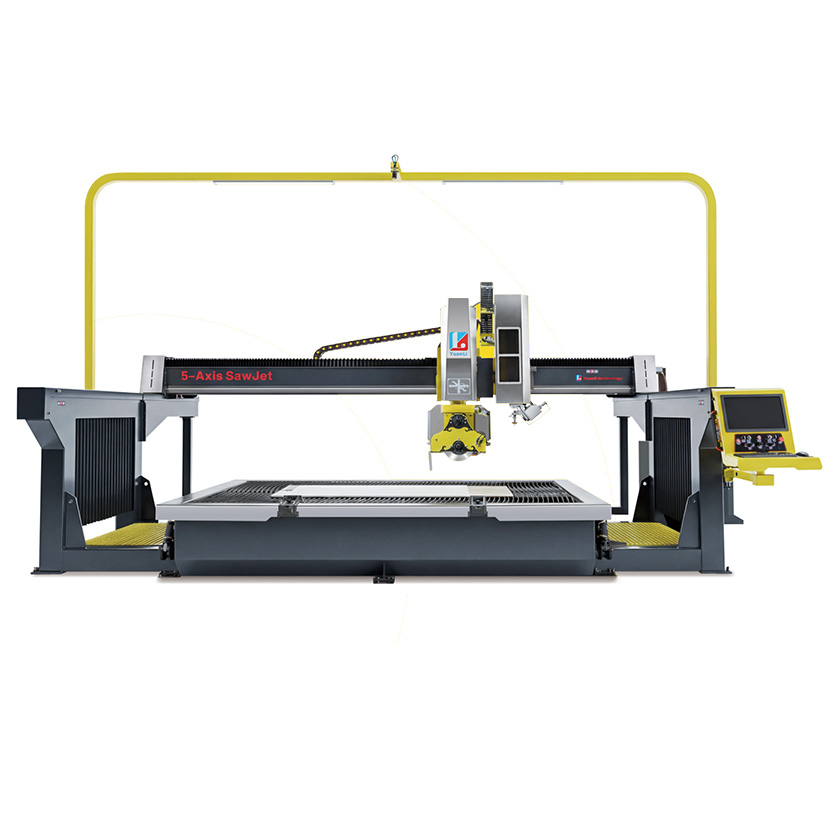
Selecting the appropriate machinery requires a careful evaluation of technical specifications. For decision-makers looking to scale their operations, understanding the core components of these systems is critical. This knowledge ensures long-term reliability, minimal downtime, and peak performance.
Think of the intensifier pump as the beating heart of your shop. For heavy stone processing, consistent pressure is paramount. Fabricators should look for systems capable of maintaining operating pressures around 60,000 PSI. This immense pressure range ensures a clean, efficient cut through materials up to several inches thick without tapering.
Equally important is the abrasive delivery mechanism. A precise, continuous flow of garnet sand is required to prevent cutting interruptions. Advanced systems feature automated abrasive metering. This dynamically adjusts the flow rate based on the material thickness and density, optimizing consumable usage and ensuring a uniform edge finish from start to finish.
Heavy-duty hardware is only as effective as the software controlling it. The premier solutions on the market feature seamless computer-aided manufacturing integration.
User-friendly software interfaces allow shop programmers to easily import digital templates directly from laser templating tools used in the field. Advanced nesting algorithms automatically arrange the countertop pieces on the digital slab representation to maximize material yield. This intelligent software dictates the exact cutting path, cornering speed, and piercing pressure. It allows for a seamless transition from a digital kitchen layout to a physical, precisely cut product.
Stone slabs are exceptionally heavy, often weighing well over 1,000 pounds. Therefore, the physical build of the machine must be uncompromisingly robust. A heavy-duty steel frame and a reinforced cutting table are non-negotiable requirements for a commercial shop.
A sturdy footprint absorbs the kinetic energy and minimizes vibrations generated during the high-speed cutting process. Even micro-vibrations translate into visible, wavy striations on the cut edge of the stone. High-quality linear guide rails and a rigid gantry system ensure that the cutting head moves with absolute stability. This guarantees ultra-precise cuts regardless of the payload weight.
When evaluating this technology, business owners must choose between different kinematic configurations based on their specific daily production volumes and the complexity of the architectural designs they typically handle.
A standard bridge waterjet operates strictly on the X, Y, and Z axes. The cutting head moves left to right, forward and backward, and up and down. The cutting stream always remains perfectly perpendicular to the material surface.
This configuration is highly reliable, generally more affordable, and exceptionally efficient for standard flat cuts. It serves as the ideal workhorse for high-volume shops that primarily process straight perimeter cuts, standard edge profiles, and basic geometric shapes. However, its primary limitation is the lack of angular flexibility. A 3-axis machine cannot perform beveled cuts or complex profiling, which limits its utility for high-end custom fabrication.
To meet the demands of modern interior design, 5-axis technology represents the absolute pinnacle of fabrication machinery. In addition to the standard axes, a 5-axis machine introduces the A and C rotary axes. This allows the cutting head to tilt and rotate dynamically in three-dimensional space.
This articulation allows the machine to perform precise angled cuts, typically up to 60 degrees. More importantly, high-end 5-axis systems utilize specialized software to perform active taper compensation. Because fluid streams naturally have a slight V-shaped taper as they lose kinetic energy, a 5-axis head micro-adjusts its angle in real-time to eliminate this taper. The result is a perfectly square edge. This technology is essential for complex edge profiling and executing flawless miter cuts in a single setup.
Feature & Capability | 3-Axis Bridge Waterjet | 5-Axis Waterjet |
|---|---|---|
Best Suited For | High-volume straight cuts, standard kitchens | Custom architectural designs, exotic materials |
Edge Taper Control | Natural slight taper remains | Active taper compensation for square edges |
Miter & Bevel Cuts | Not possible natively | Flawless 45° to 60° angle cuts |
Sink Cutouts | Excellent, but edges may need slight dressing | Perfectly flush, zero-tolerance fitment |
Setup Efficiency | Requires secondary machinery for edge work | All-in-one setup from slab to finished piece |
In the modern stone industry, standard straight cuts are no longer sufficient to secure lucrative contracts. Today designs require intricate geometries, sweeping curves, and flawless joints. This is where advanced kinematics separate premium fabricators from standard workshops.
Executing interior cutouts for undermount sinks, flush-mount cooktops, and faucet fixtures is traditionally one of the most stressful tasks. Conventional methods usually require operators to nervously drill a pilot hole with a diamond core bit before dropping in a manual saw. This multi-step process consumes valuable time and introduces a high risk of material fracture.
Modern abrasive systems bypass these limitations entirely through dynamic piercing capabilities. Utilizing a specialized low-pressure piercing sequence around 15,000 PSI, the abrasive stream penetrates directly through dense granite or brittle composites without requiring pre-drilled holes. Once the material is safely pierced, the system automatically ramps up to ultra-high pressure to execute the programmed vector path. Because the stream diameter is incredibly narrow, the machine navigates tight inside radii that traditional saw blades cannot physically reach. This ensures undermount sinks fit flush with zero gaps.
Market reports indicate that waterfall islands and continuous-vein backsplashes are becoming standard expectations in modern residential developments. This aesthetic requires the horizontal countertop surface to flow seamlessly into a vertical side panel. To achieve this illusion, fabricators must execute a perfect 45-degree miter cut on both adjoining pieces.
If a miter cut is off by even a fraction of a degree, the resulting joint will be highly visible. Fabricators then have to use thick, unsightly epoxy seams to hide the error. While traditional bridge saws can tilt their blades to attempt miter cuts, blade deflection during the cutting process often leads to uneven edges and chipping. Advanced multi-axis technology eliminates this issue. By utilizing an articulating cutting head, the machine maintains a mathematically precise angle throughout the entire length of the cut. This results in a razor-sharp, chip-free edge that joins together almost invisibly.
For fabrication business owners, acquiring new capital equipment must be justified by a clear and rapid Return on Investment. Transitioning to advanced cutting technology fundamentally alters the unit economics of a shop by minimizing waste, accelerating throughput, and drastically reducing manual labor dependencies.
Natural stone slabs represent a massive financial investment. Any material that ends up in the scrap bin is lost revenue. Traditional cutting methods often result in low material yield due to the wide kerf of diamond blades and the physical clearance space required between parts.
Intelligent software paired with a narrow-kerf cutting stream provides a massive financial advantage. Modern software utilizes advanced nesting algorithms to arrange multiple countertop components onto a single digital slab. Because the water stream is less than a millimeter wide, parts can be nested with mere millimeters of clearance between them. For a shop processing 20 to 30 slabs a week, increasing material yield by just 10 to 15 percent results in tens of thousands of dollars in saved material costs annually.
The hidden costs of traditional fabrication lie in consumable tooling and manual finishing hours. Diamond saw blades and CNC router bits degrade rapidly when processing abrasive materials. They cut slower and produce rougher edges as they wear down, requiring frequent replacements.
Conversely, while garnet sand is an ongoing expense, the cost per linear inch of cutting remains highly predictable. More importantly, the edge quality produced by an abrasive stream is exceptionally smooth. Traditional saw cuts leave deep striations that require a fabricator to spend hours using progressively finer diamond polishing pads. A high-quality water stream leaves a satin-smooth finish that requires minimal secondary processing. This allows shops to reallocate their skilled labor to final assembly and installation.
Selecting the correct machinery requires a careful evaluation of a shop production volume and the complexity of their typical designs. To future-proof a fabrication business and handle the most demanding architectural specifications, upgrading to full 5-axis technology is the most strategic step you can take.
For fabricators seeking a robust, high-precision system, integrating a specialized 5-axis architecture into your workflow provides unparalleled control. These systems automatically eliminate edge taper to ensure perfect fitment for seams and joints without manual grinding. Constructed with highly rigid steel frames that dampen vibration, modern machines effortlessly execute 45-degree miters and complex edge profiling in a single setup. This completely eliminates the need to move heavy stone pieces between different machines across the shop floor.
Upgrading your shop equipment is no longer an optional luxury. It is a fundamental necessity for fabricators who wish to remain competitive in a demanding market. The limitations of traditional mechanical cutting are simply too costly regarding material waste, wasted labor hours, and compromised edge quality.
Whether your shop is processing standard granite slabs or executing a complex engineered composite with a seamless waterfall edge, the technology you employ dictates the quality of your final product. By adopting multi-axis abrasive technology, fabricators eliminate heat damage, maximize slab yield, and deliver flawless custom designs with unprecedented speed and accuracy.
Ready to eliminate bottlenecks and elevate your fabrication capabilities? Explore the high-performance stone cutting machinery at Yuanli Waterjet. From heavy-duty 3-axis bridge systems to advanced 5-axis dynamic cutting heads, find the exact configuration engineered to maximize your shop profitability and precision.
Yes. Abrasive cutting systems utilize ultra-high-pressure water mixed with garnet sand. This powerful combination easily slices through dense natural materials like granite, quartzite, and marble up to several inches thick. The process maintains incredible dimensional accuracy and stability, completely avoiding the heat damage or structural stress often associated with traditional mechanical friction cutting.
No. Engineered stones contain polymer resins that are highly sensitive to the friction and heat generated by traditional saw blades. Because this technology utilizes a cold, low-impact micro-erosion process, it prevents thermal shock. This makes it the safest and most effective method for preventing chipping, cracking, and micro-fractures in delicate engineered materials.
Absolutely. Large-format porcelain and sintered stones are highly prone to cracking under the stress of mechanical saw blades. Waterjet technology uses a specialized low-pressure piercing sequence to gently penetrate the brittle surface before ramping up to cutting pressure. This stress-free, cold-cutting approach is currently the most reliable method for fabricating porcelain countertops without generating scrap.
A traditional 3-axis bridge system cuts strictly in a vertical plane. This is highly efficient for standard flat shapes and straight lines. A 5-axis system features an articulating cutting head that tilts and rotates in real-time. This dynamic movement allows the machine to cut at precise angles, making it mandatory for executing 45-degree mitered edges, taper compensation, and complex three-dimensional edge profiles.
Operating costs vary based on pump size and abrasive flow rates, but typically range between $15 to $25 per hour of active cutting. This includes electricity, water, wear parts, and garnet abrasive. While there is an hourly cost, the massive savings in reduced manual labor, zero blade sharpening, and higher material yield make the cost per finished part significantly lower than traditional methods.
While the linear inches-per-minute cutting speed might be slightly slower than a diamond saw on long straight runs, the overall processing time from slab to finished product is significantly reduced. The technology handles complex shapes, inside corners, and sink holes in a single, continuous setup without tool changes. Furthermore, the exceptionally smooth edge finish drastically reduces the hours required for secondary manual hand-polishing.


