
Views: 0 Author: Site Editor Publish Time: 2026-09-17 Origin: Site


A quartz countertop is usually cut to a drawing, not to a mark on a slab. The outline, the sink opening, the hob opening, the faucet holes and the edge profile are all programmed together, and the machine reproduces that layout to ±0.1 mm cutting accuracy on the AC 5-axis platform. That is the short answer.
The longer answer is that quartz is an engineered surface. It is dense, it is consistent, and it gives you no second chance on a visible edge — which is why the cutting method matters more than the pattern you are cutting.
Finished countertop runs cut from programmed layouts
Natural stone has a grain. Quartz does not. A slab of engineered quartz is manufactured to be uniform across its whole area, and that uniformity is exactly what makes it predictable to program and unforgiving to hand-cut.
The practical consequences are straightforward. Because the material is consistent, a programmed cut lands in the same place on every slab in the batch — useful when you are producing a run of identical countertops rather than one bespoke piece. Because it is dense, an abrasive jet cuts it cleanly, but the edge still has to be finished properly afterwards. And because a quartz countertop is normally the most visible surface in the room, any chip on a front edge, or any opening that the appliance does not sit into, is immediately obvious to the customer.
That last point is what drives most fabricators to move quartz work off the saw and onto a machine that cuts the outline and the internal openings in one setup, without lifting or repositioning the slab between operations. Repositioning is not a small detail on a dense material. Every additional setup is another opportunity for the piece to shift, and on a run of countertops those small shifts accumulate into visible variation between units that are supposed to be identical.
There is also a commercial argument. A quartz countertop is a finished, fitted product sold to an end customer, not an intermediate part. The cost of a badly placed opening is not the material — it is a return visit to site, a replacement slab and a customer who now associates your workshop with rework. Cutting to a programmed layout from a single positioning removes the largest single source of that risk.
A 5-axis waterjet does not just cut the outline. On a typical quartz job it handles everything below, on the same table, in the same setup, from one drawing.
Openings are the part of a quartz job most likely to go wrong on a saw, because a saw has to enter from the edge and the corners of a rectangular opening have to be finished separately. A waterjet starts where the drawing says it starts, which means the opening is cut as a closed profile with the corner radii already in it. On a fixed platform such as the Water Bridge, with its 3600 × 2000 mm table, the slab usually stays in position for the whole sequence.
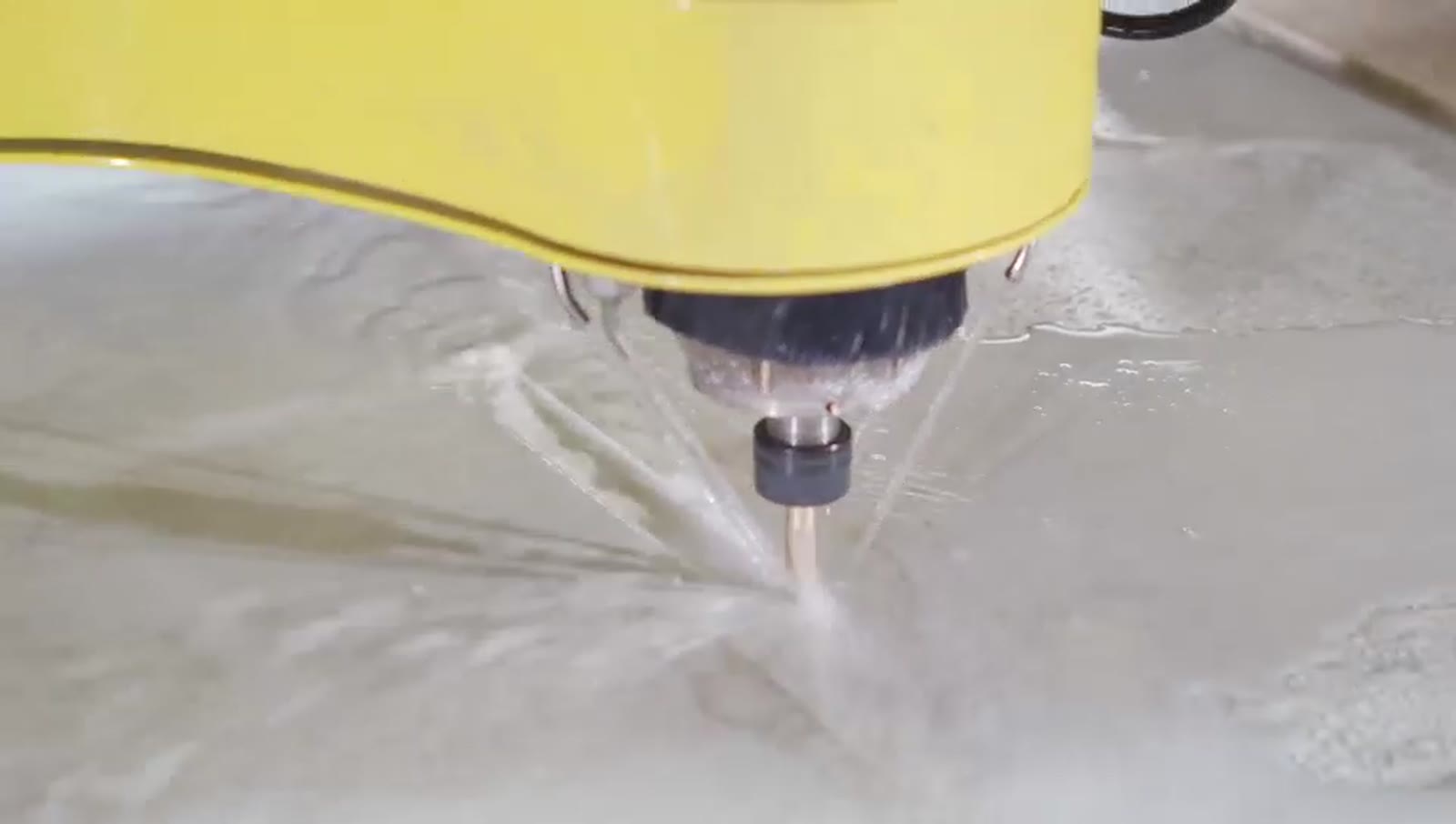
A sink opening cut in one pass, after the slab is positioned
Small openings are a tolerance problem, not a capacity problem. A hole that is a fraction of a millimetre out of position will not line up with the tap body, and the fix on site is always more expensive than the cut was. Programming these from the same drawing as the outline removes the drilling stage and the second setup entirely.
Quartz is often specified for a mitred edge, where the countertop thickness appears doubled at the front, or for a waterfall end. On a 5-axis head with a 0–65° swing, the bevel is cut as part of the same program rather than as a separate operation, and a mitre joint closes along its whole length instead of being ground in by hand. The bevel and mitre capability is one of the main reasons quartz fabricators specify 5-axis rather than 3-axis in the first place.
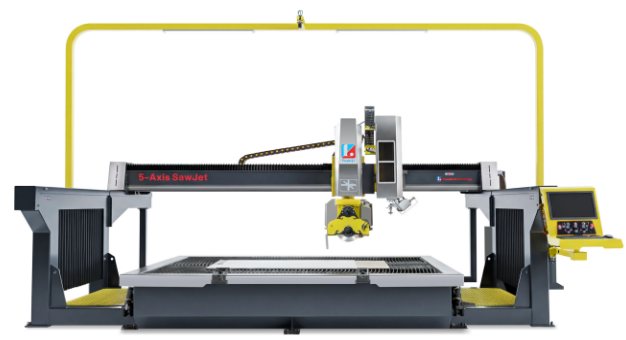
Water Bridge platform: bridge saw and 5-axis waterjet on one gantry
Receive the drawing. Outline, opening positions, edge profile and tap centres — ideally as a DXF or DWG, plus a photograph of the slab if it is a colour with a strong veining pattern.
Confirm the material and the layout. Material type, thickness and the slab size you are actually working with. If you are running several identical units, say so; it changes how the layout is nested.
Program the whole part, not the outline. Outline, openings and edge profile in one file, so nothing depends on a second positioning.
Nest for the slab. On runs of identical pieces, the nesting decision is where the material saving comes from.
Set up and cut. The slab is positioned once. Where the machine is configured with a flip platform, the operator can rotate the piece to finish the underside without re-alignment.
Check the first part, then run. Inspect the first unit against the drawing before committing the batch.
Step 3 is the one that gets skipped. Programming the openings separately from the outline costs you a second positioning on every unit, and a second positioning is where a set of otherwise identical countertops stops being identical.
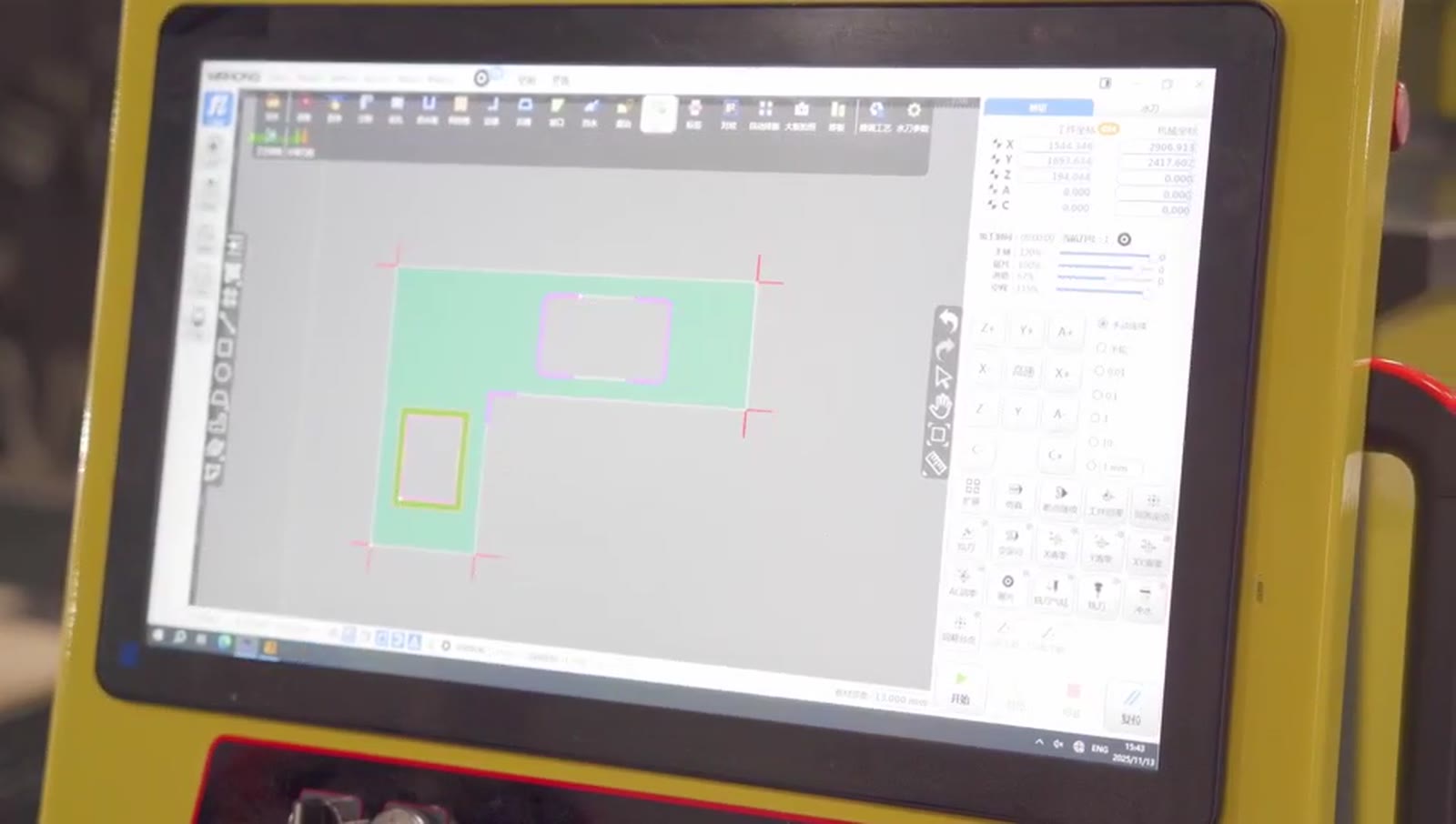
Outline, openings and edge profile programmed together
These three approaches do genuinely different jobs, and most quartz shops end up with more than one of them on the floor.
| Hand tools / grinder | Bridge saw | Waterjet |
|---|---|---|---|
Straight cuts | Yes, slowly | Yes, fast | Yes |
Internal cut-outs | Difficult | From the edge only | Yes, closed profile |
Corner radii | Ground by hand | Separate operation | Cut in the profile |
Bevel / mitre | Ground by hand | Limited | Yes, on a 5-axis head |
Repeatability across a batch | Operator-dependent | Good | Programmed |
Heat at the cut | Friction heat | Friction heat | Cold abrasive jet |
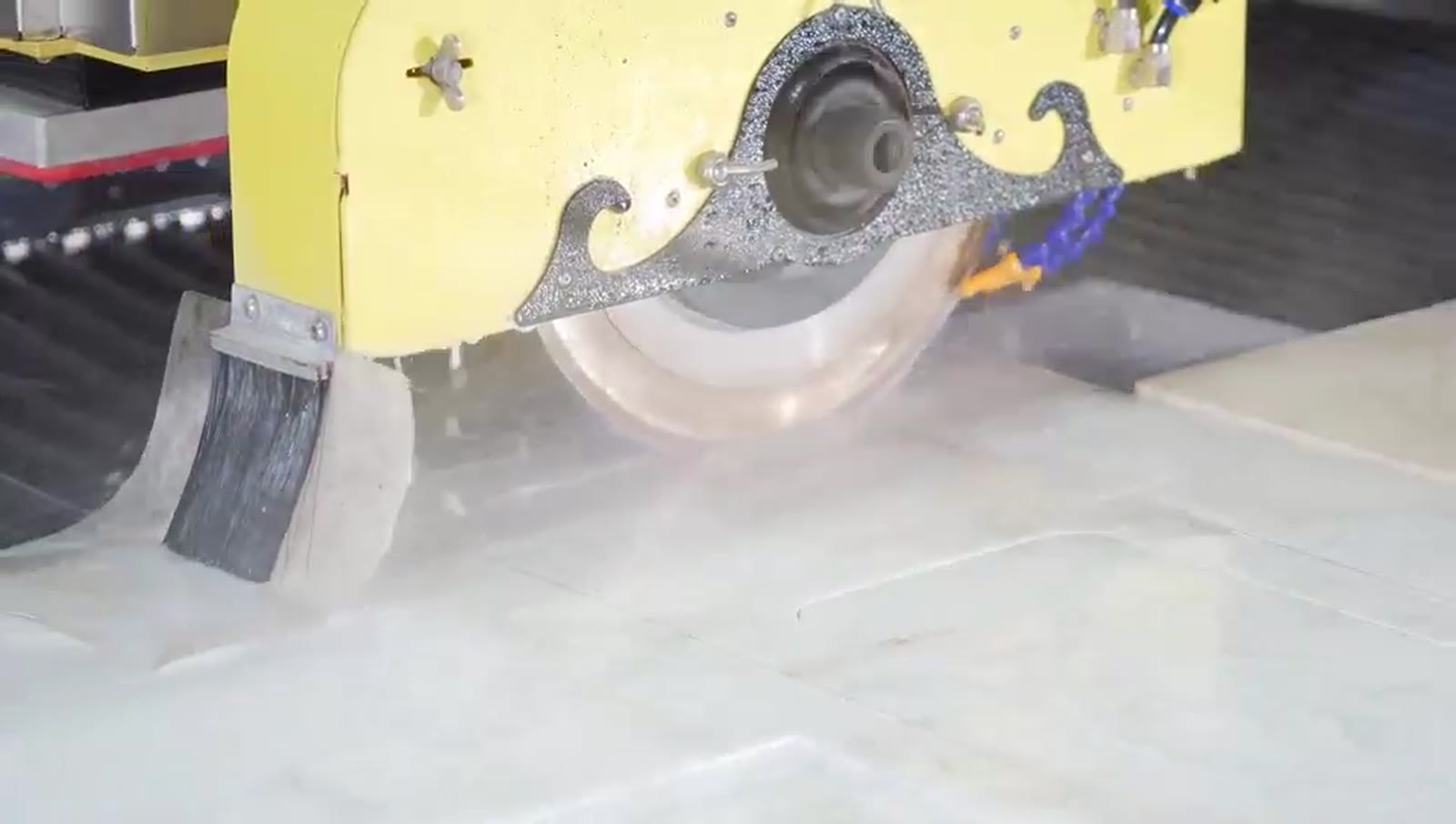
A bridge saw is still the right tool for straight runs, which is exactly why the Water Bridge puts a blade and a waterjet head on the same gantry rather than asking you to choose between them. The blade takes the fast straight cuts; the jet takes the openings, the curves and the closed profiles. For a shop cutting quartz alongside granite, marble and sintered stone, that combination is usually the difference between running two machines and running one.
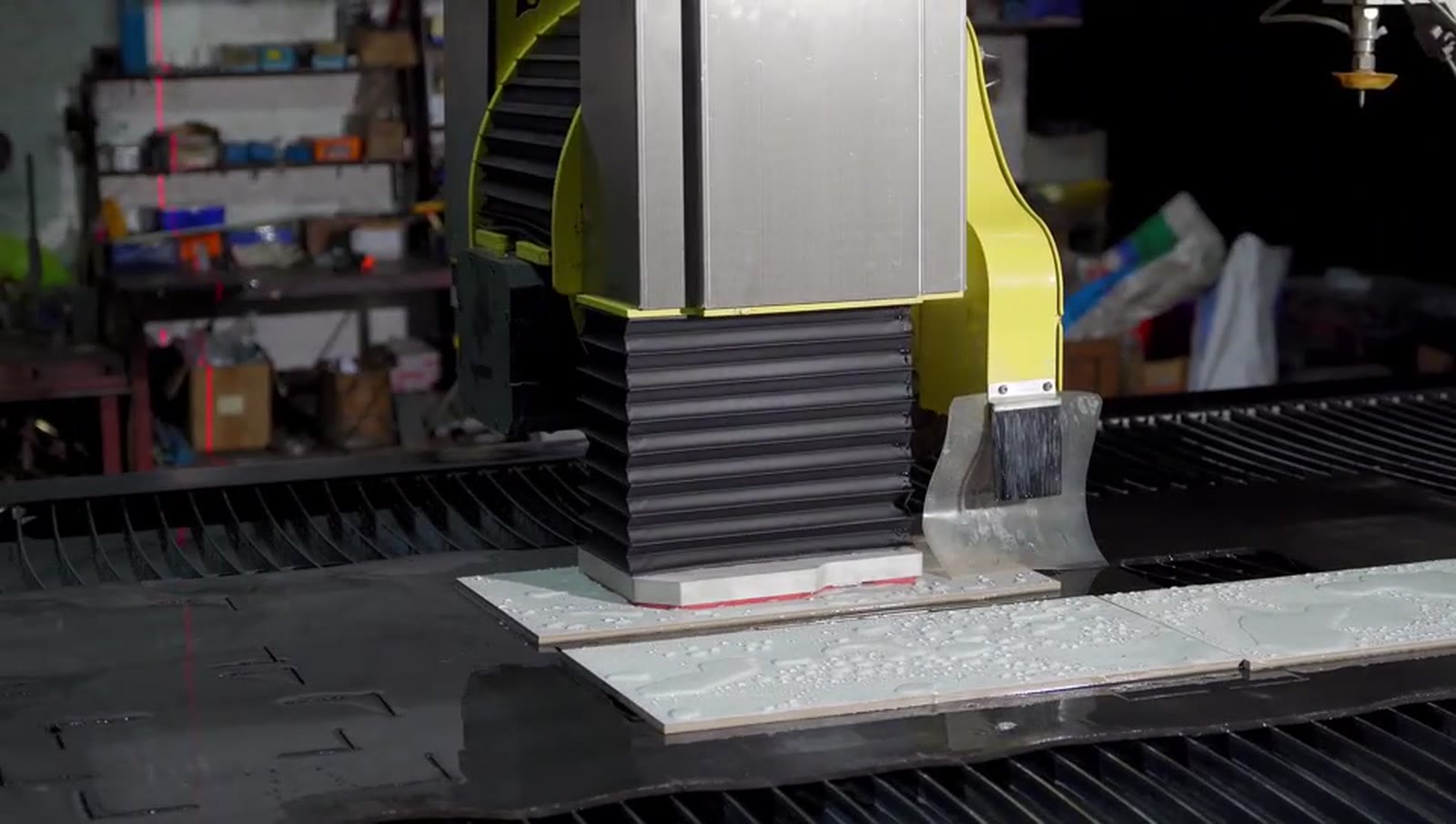
Bevel edge produced on the 5-axis head
Fabricators often send a material and a size, then wonder why the first quote comes back vague. A quote is only as specific as the information behind it. Send these five things and you get a configuration-based recommendation instead of a price range:
Material and thickness you are cutting
Working area the largest slab or nested sheet has to fit
The openings and profiles on a drawing, as a DXF/DWG if you have one
Whether you need bevel or mitre cutting — this is the single biggest factor in whether 3-axis or 5-axis is the right answer
Production volume — units per day or per week, and whether the parts repeat
If you are unsure whether your work needs 5-axis at all, the 3-axis vs 5-axis comparison sets the three configurations side by side on the capabilities that actually decide it. And if you want a recommendation for quartz work specifically, start from the quartz countertop cutting page, which sets out what the platform handles on engineered surface.
This 60-second walkthrough follows the machine through a real production sequence — programming, the bridge saw taking the straight cuts, the waterjet head cutting the openings, and vacuum handling moving the finished piece off the table.
Your browser does not support the video tag.
Cutting the openings before the outline. The outline is your reference. If the openings are cut first, every subsequent measurement has to be taken from a hole rather than from an edge, and the error compounds from there.
Assuming the appliance dimensions are nominal. Sink and hob bodies vary between manufacturers and between production batches of the same model. Cut from the actual unit's template, not from the catalogue drawing.
Leaving the corner radii out of the profile. A square internal corner concentrates stress in a brittle material. The radius belongs in the drawing, not in the operator's judgement at the machine.
Repositioning between operations. Every additional setup is another chance for the slab to move by a fraction of a millimetre, and those fractions accumulate across a run.
Checking only the first and last part. If you are producing a batch, measure in the middle of the run as well. Drift shows up in the middle long before it shows up at either end. A first-and-last check will tell you the program started correctly and finished correctly, and nothing about the forty units in between.
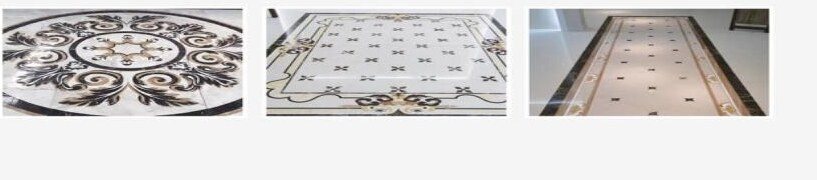
Decorative inlay work cut on the same platform
A correctly set abrasive waterjet produces a clean cut edge on engineered quartz. The edge is normally finished afterwards regardless of the cutting method, but the quality of the cut face determines how much finishing is needed.
It depends on the platform, the pump pressure and the cutting speed you need. Our published thickness figures for stone cover marble at up to 100 mm, and actual capacity depends on cutting speed, tolerance and pump pressure selected. Tell us your thickness and we will confirm it against the configuration.
Yes. Abrasive waterjet is a cold cutting process. It introduces no heat-affected zone, which matters for materials where thermal effects are a concern.
3-axis handles standard 2D profiles well. You need 5-axis when the job includes bevel edges, mitre joints or angled work. See the machine comparison for the full breakdown.
Send us your drawing or a sample part and our engineers will prepare a tailored design proposal. Start with the quartz cutting page or talk to us directly.
Tell us what you are cutting. Send your material, thickness, working area and a drawing. Our team will help you identify a suitable configuration — and if you are still specifying, the 3-axis vs 5-axis comparison is the fastest way to narrow it down.


