
Views: 0 Author: Site Editor Publish Time: 2026-09-12 Origin: Site


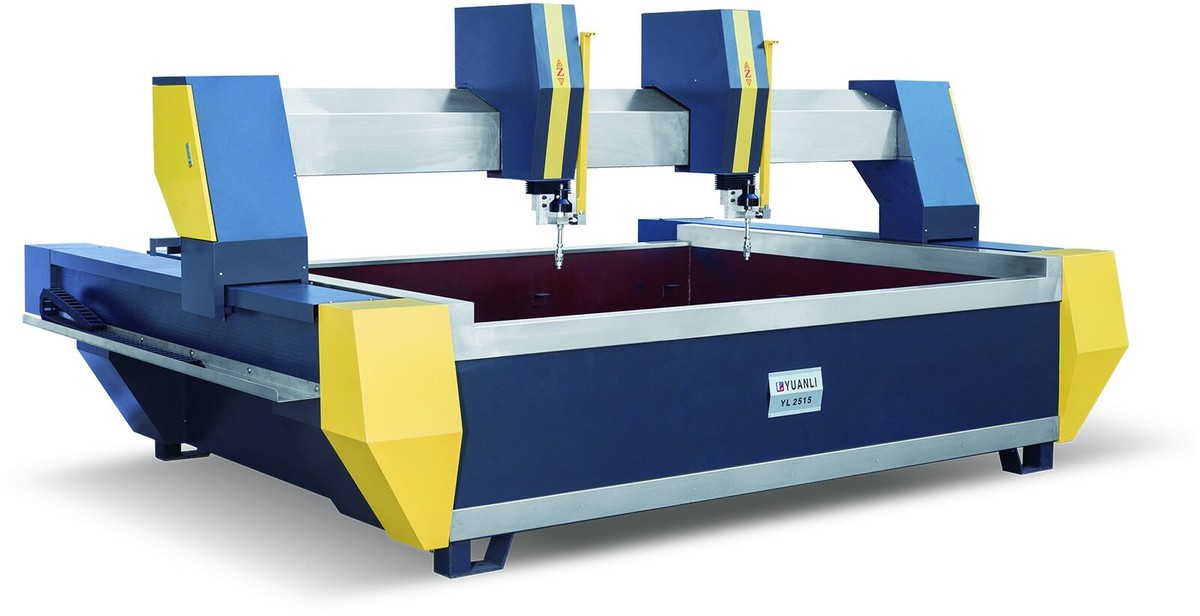
One gantry, two heads, one pump package. Multi-head configuration is the most common custom request — and the one buyers most often misjudge the cost of.
A custom waterjet cutting machine is a standard cutting platform that the factory re-specifies for your parts — table size and travel, cutting-head count, machine structure, control configuration and supply voltage. It is not a new machine designed from scratch; it is an existing model range configured to your production. The important question is therefore not whether a supplier can build “a custom machine”, but which parameters are genuinely free to change, which ones carry hidden engineering cost, and which ones should not be touched at all because doing so breaks accuracy, safety or the warranty.
In waterjet manufacturing, customisation falls into five groups, and they are not equally cheap. Table and travel dimensions sit at the top: extending the bed is the single most common custom request and also the one with the clearest engineering consequences, because a longer gantry needs more stiffness and a different drive arrangement. Cutting-head count comes next — a machine ordered with two or four heads shares one gantry and one pump package, so the incremental cost per head is far lower than most buyers expect. Machine structure follows: cantilever for compact footprints, gantry for wide or long beds. Then control configuration, including whether the console is mounted on the machine or supplied as a separate station. Finally electrical supply — 220 V, 380 V or 415 V at 50 or 60 Hz — which matters enormously in export markets and is usually free to specify at the order stage. Everything else on the machine is standard.
Table size is the parameter buyers change most often, and it is the one that most directly determines what your shop can process without repositioning. A small cantilever platform suited to signage and thin sheet is a fundamentally different machine from a gantry platform sized for full slabs or oversized structural plate. When specifying, work from the largest part you cut at least weekly rather than the largest part you have ever cut, then add the clamping or fixture margin your process genuinely needs, and round up to the nearest standard bed before considering a fully bespoke dimension. This ordering matters commercially: standard bed sizes across a manufacturer’s range have mature tooling, known lead times and predictable pricing, while a bespoke dimension usually adds engineering review, drawing approval and a longer build slot. If your mix is likely to grow, a modular gantry design lets the bed be extended later rather than replaced — which is normally a far better outcome than over-buying capacity today.
Adding cutting heads is the most cost-effective way to raise throughput, because the heads share the same gantry, pump and control system. Two heads roughly double the parts per hour on work that can be nested in pairs, while four heads suit high-volume runs of small, repeated parts. The trade-off is not simply price. Multiple heads increase the load the gantry must carry and the volume of abrasive the system must deliver consistently to every nozzle, so the pump package and abrasive feed arrangement have to be specified to match rather than assumed. Multi-head machines also change your programming: offset compensation between heads becomes part of the nesting strategy, and your operator training needs to cover it. For shops cutting large single pieces — slab work, medallions, oversized panels — a single head is usually the right answer, because the second head cannot be used at all when the part already fills the bed.
Structure choice follows from size and accuracy requirements rather than from preference. Cantilever machines carry the cutting head on a single-side arm, which keeps the footprint small and the price low — sensible for compact platforms and lighter work. Gantry machines bridge both sides of the bed, which resists deflection across the full cutting width and is the reason large-format machines are almost always gantry type. When a bed is extended, the structure has to be re-assessed: a design that performs well at one length will not necessarily hold accuracy when stretched, because unsupported span grows faster than frame cost does. This is why a responsible supplier will sometimes decline a requested dimension or propose a different structure instead, rather than simply quoting the longer bed. It is worth asking that question directly: what is the longest bed you build in each structure, and what happens to the stated accuracy beyond that length? A supplier who can answer with a number has an engineering boundary; a supplier who says “any size” has a sales boundary.
The control and electrical specification is where export orders most often go wrong, and it is also one of the cheapest things to get right if it is settled early. Supply voltage and frequency must match the destination — 220 V, 380 V or 415 V at 50 or 60 Hz — and the machine’s internal components, motor protection and control transformer are all sized around that choice. Panel documentation and safety labelling should match the target market. Beyond electrical supply, three site conditions should be confirmed before the order is fixed: the floor loading the machine will impose, the water supply quality and pressure available, and the drainage and abrasive-slurry handling arrangement. None of these change the machine’s headline specification, but any of them can delay commissioning if they are discovered on arrival. Ask who issues the electrical drawings and in what format, because a surprising share of commissioning delays turn out to be documentation problems rather than machine faults.
Not every request is a good one, and a supplier who agrees to everything is telling you something. Structural members, safety guards and interlock systems should not be altered, because they are sized against load and safety standards rather than against convenience. Accuracy specifications should not be “stretched” by adjusting published tolerances to match a competitor’s number — either the machine achieves the tolerance under stated conditions or it does not. Pump pressure ratings should be treated as fixed engineering limits, not marketing figures to be negotiated. And control software behaviour that governs motion limits and collision prevention should stay as designed. If a supplier offers to change any of these to close a deal, the engineering basis of the quotation is worth questioning.
Where you have a genuine requirement the standard configuration cannot meet, the right route is a different model or a larger structure — not a relaxed safety or accuracy figure. Those constraints exist because they were calculated, not because they were convenient.
A useful custom enquiry reads like an engineering brief, not a shopping list. State the largest part you cut repeatedly with its dimensions, material and thickness. State the throughput you need, expressed as parts per shift rather than as a cutting speed figure, because speed depends on material and thickness. State the space you can actually commit, including service and loading access, not the space you would ideally like. State your supply voltage and frequency, and whether the machine will operate in a multi-shift pattern. Then say which parameters are firm and which are flexible — this single sentence determines whether the supplier proposes a standard bed with a short lead time or starts an engineering review. Photographs of the parts, or a DXF of the largest profile, remove more ambiguity than a page of description. Finally, ask for the tolerance the supplier will commit to in writing, and the conditions under which it applies.
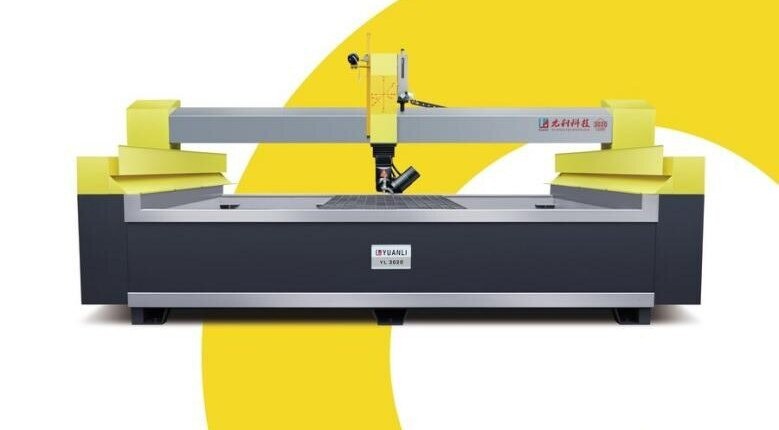
The YL 3020 — one of the standard bed sizes. Specifying within an existing range, rather than outside it, is what keeps a custom order predictable.
The table below is a structure for comparing quotations, not a price list. Fill it in from your own suppliers’ responses and the deltas become visible immediately.
Cost element | Standard model, in build schedule | Standard model, different bed size | Fully bespoke structure |
|---|---|---|---|
Engineering review | None | Included | Substantial |
Drawing approval cycle | None | Yes, one round | Yes, usually several rounds |
Frame and gantry | Catalogue parts | Catalogue parts, re-cut | New design |
Drive and rack sizing | Fixed | May need re-sizing | Designed from scratch |
Pump package | Sized to standard bed | Usually unchanged | Re-sized for the layout |
First-article testing | Standard test run | Standard test run | Application-specific trial |
Lead time | Shortest | Moderate | Longest |
Spare parts commonality | Full | Full | Partial |
The pattern worth noticing is that two of the three custom routes carry identical engineering overhead — the difference between “different bed size” and “fully bespoke” is mostly in the frame and drive, not the paperwork. That is why specifying a bed size that already exists somewhere in a supplier’s range is usually the single biggest saving available on a custom order.
Use this before signing anything. Each line is a question with a yes-or-no answer, and a “no” is a reason to ask why rather than to walk away immediately.
Have you stated the largest part cut weekly, with material and thickness?
Have you stated required throughput as parts per shift, not as a cutting speed?
Have you confirmed the floor loading and whether the slab needs reinforcement?
Have you confirmed supply voltage, frequency and available current?
Have you confirmed water supply quality, pressure and drainage?
Have you agreed where slurry is collected and how it is removed?
Have you agreed the loading method for slabs or heavy plate?
Has the supplier committed to a tolerance in writing, with its measurement conditions?
Are drawings issued for your approval before production starts?
Is the finished machine test-run under load before shipment?
Is the spare-parts list supplied with the machine, with lead times?
Is the warranty position on the customised elements stated explicitly?
If a supplier cannot answer the tolerance and warranty lines, the customisation is being treated as a sales conversation rather than an engineering one.
Custom machine cost is driven less by the changed dimension itself than by what the change forces elsewhere in the design. Extending a bed may require a stiffer gantry, additional drive components and a larger pump package to maintain pressure at the far end of the circuit. Adding heads changes the abrasive delivery and the pump sizing. A bespoke voltage means different electrical components and re-certification documentation. Lead time behaves the same way: a standard model in the current build schedule ships fastest, a standard model with a different table size adds engineering review and drawing approval, and a fully bespoke structure adds design, approval and first-article testing. The practical consequence is that buyers who specify early, before the build slot is planned, usually get both a shorter lead time and a better price than buyers who reopen the specification late in the process. Ask for the review, approval and testing steps to be itemised in the quotation — it turns lead time into something you can compare between suppliers instead of one opaque number.
Can any waterjet size be customised? Bed dimensions are the most commonly customised parameter, but the sensible range is bounded by the structure. Beyond a certain span, a cantilever design loses accuracy and a gantry design is required instead — so the honest answer is that the dimension is customisable, but the machine type may have to change with it.
Is a custom machine more expensive than a standard one? Usually yes, but far less than buyers assume, and mostly because of secondary changes — structure, drive and pump sizing — rather than the dimension itself. The largest cost is often the engineering review and drawing approval process, which is a one-off.
How many cutting heads should I specify? Two heads are the usual answer for shops nesting small to medium parts in pairs; four heads suit high-volume runs of small repeated parts. If your typical job already fills the bed, additional heads add cost without adding output, because they cannot be used.
Do custom machines take much longer to deliver? They take longer than a standard model in the current build schedule, but the difference is measured in review and testing steps rather than in months. Specifying early in the build cycle is the single most effective way to shorten it.
What happens to the warranty on a customised machine? It should remain the same as on the standard model, provided the customisation was carried out by the manufacturer rather than by a third party after delivery. Modifications made outside the factory are normally excluded, which is a good reason to specify everything you need at the order stage.
How do I know whether I actually need a custom machine?
If your largest routine part fits a standard bed with clamping room, and your throughput target can be met with head count, you do not need one. Customisation is justified when a standard bed forces repositioning on your routine work, when your material sizes are outside the standard range, or when site conditions — supply voltage, floor loading, access — rule out the standard configuration.
Can I see the machine being built or tested before it ships?
Ask for it explicitly, and ask what the test run will consist of. A factory that manufactures its own frame and pump package can normally arrange a witnessed test or supply video of the machine cutting your material before shipment — which is a considerably better use of a trip than reading a specification sheet.
What happens if my requirements change after I order?
The earlier you raise the change, the less it costs — changes before drawing approval are usually cheap, changes after frame fabrication are expensive, and changes after testing can mean rebuilding. This is why suppliers ask for a written sign-off on the drawings, and why it is worth taking that step seriously rather than treating it as a formality.
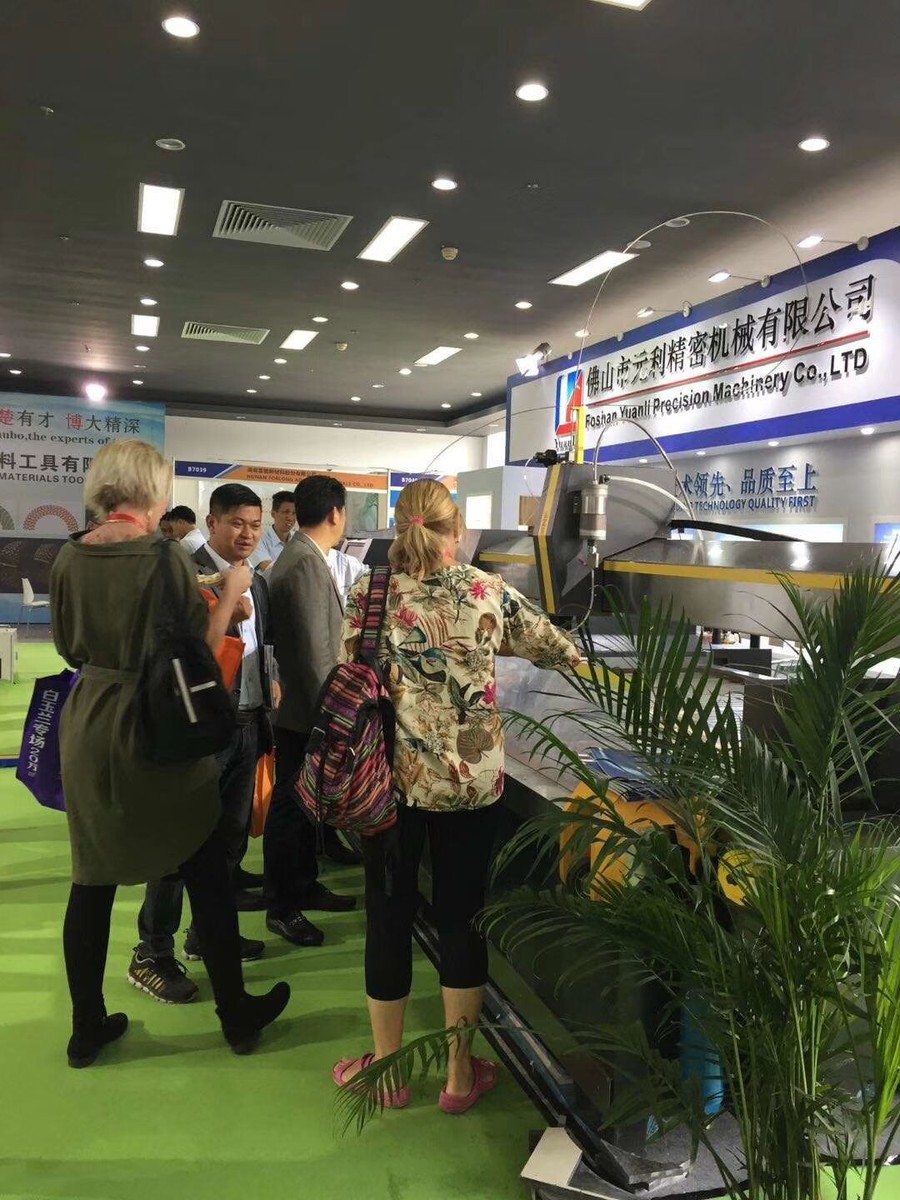
Configured machines are exhibited and demonstrated in person — the most reliable way to judge what a factory can actually build.
Send us the largest part you cut repeatedly, the material and thickness, the floor space you can commit and your supply voltage. Our engineers will size the bed, recommend a structure and head configuration, confirm whether a standard platform will do or whether the job genuinely needs a custom build, and come back with a written tolerance and a factory-direct quotation.
Request a custom machine quotation — we respond within 24 hours.
We build cantilever and gantry platforms across a wide range of bed sizes, and custom dimensions are handled as a normal part of the process rather than as an exception, with drawings issued for approval before production starts.
You can also see a configured example on our customised waterjet cutting machine for metal signage production, or compare bed sizes across the range on the large format automatic waterjet machine and the YL4020 gantry platform.


