
Views: 0 Author: Site Editor Publish Time: 2026-09-26 Origin: Site


You are not looking for a machine that can cut stone. You are looking for a machine that can hold the shape, the angle and the joint — the three things that decide whether a countertop leaves your workshop looking fabricated or looking bought.
That is the problem this page addresses. Not "what can a waterjet cut", but the jobs that go wrong on a fixed-head machine: the 45° miter on a quartz waterfall island, the sink opening that has to be pierced from inside the slab, the curved apron in 12 mm porcelain, the marble medallion where every piece has to seat against the one beside it.
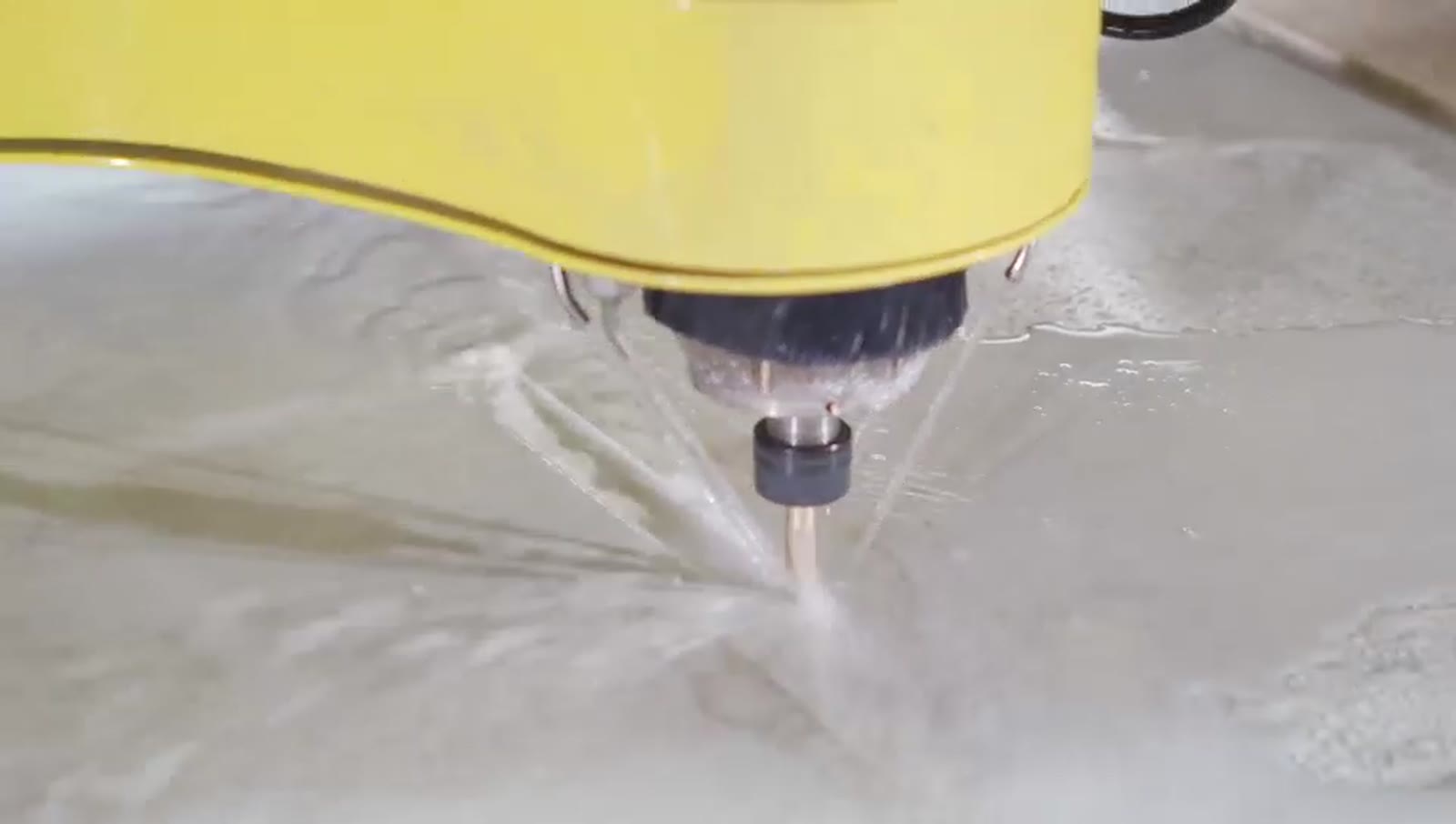
Sink opening cut in one pass inside a quartz slab
Five capabilities decide whether a stone job is straightforward or difficult: the shape you can cut, the angle you can cut at, the joint you can close, the edge you can leave, and whether the result repeats across a batch. A fixed-head machine handles the first and struggles with the rest.
Buyer problem | Application | Capability involved |
|---|---|---|
Countertop meets floor with a visible seam | Waterfall island / mitred apron | Controlled-angle cutting |
Sink opening cut with a drilled lead-in | Quartz countertop | Pierced closed profiles |
Pattern pieces that do not seat | Marble or granite inlay | Contour accuracy and fit |
Porcelain chips at the mitred edge | Large-format slab | Cold cutting, edge control |
Vanity batch interrupts slab workflow | Bathroom fabrication | Programmed contour per drawing |
Angled face on a metal bracket | Metal component | Angle cutting |
Most countertop shops already own a way to cut flat geometry. The purchase decision is almost never about flat geometry. See the 5-axis waterjet range.
The buyer's question: Can I cut the sink opening without drilling a lead-in first — and can the same setup handle the curve?
Quartz and engineered surfaces are dense and brittle. The cut edge on a finished countertop is a visible edge, so a chip or a discoloured band at the cut cannot be trimmed away afterwards. A blade also cannot start a cut in the middle of a slab: to cut a sink opening you either drill a lead-in and accept the mark, or cut in from the perimeter and accept a seam.
A quartz countertop needs a straight perimeter, one or two closed cut-outs (sink, hob), small holes (tap, soap dispenser) and increasingly a shaped or mitred edge; a curved peninsula adds contour cutting to the same job.
Abrasive waterjet is a cold process, so there is no heat-affected zone along the cut — a main reason engineered stone, sintered stone and large-format porcelain are cut this way rather than sawn. More importantly, the jet pierces the slab directly and cuts the closed outline from inside the material: no lead-in cut, no separate drilling operation, no compromise on where the opening sits.
Contour cutting is then a programming question rather than a mechanical one: the opening follows the drawing, including internal corners and curves a blade radius cannot reach. Bevels and mitred edges come off the tilting head in the same setup rather than as a second operation.
The AC configuration is specified at ±0.1 mm cutting accuracy and ±0.01 mm repeatability — the figure that matters when the same countertop runs repeatedly and the parts are interchangeable.
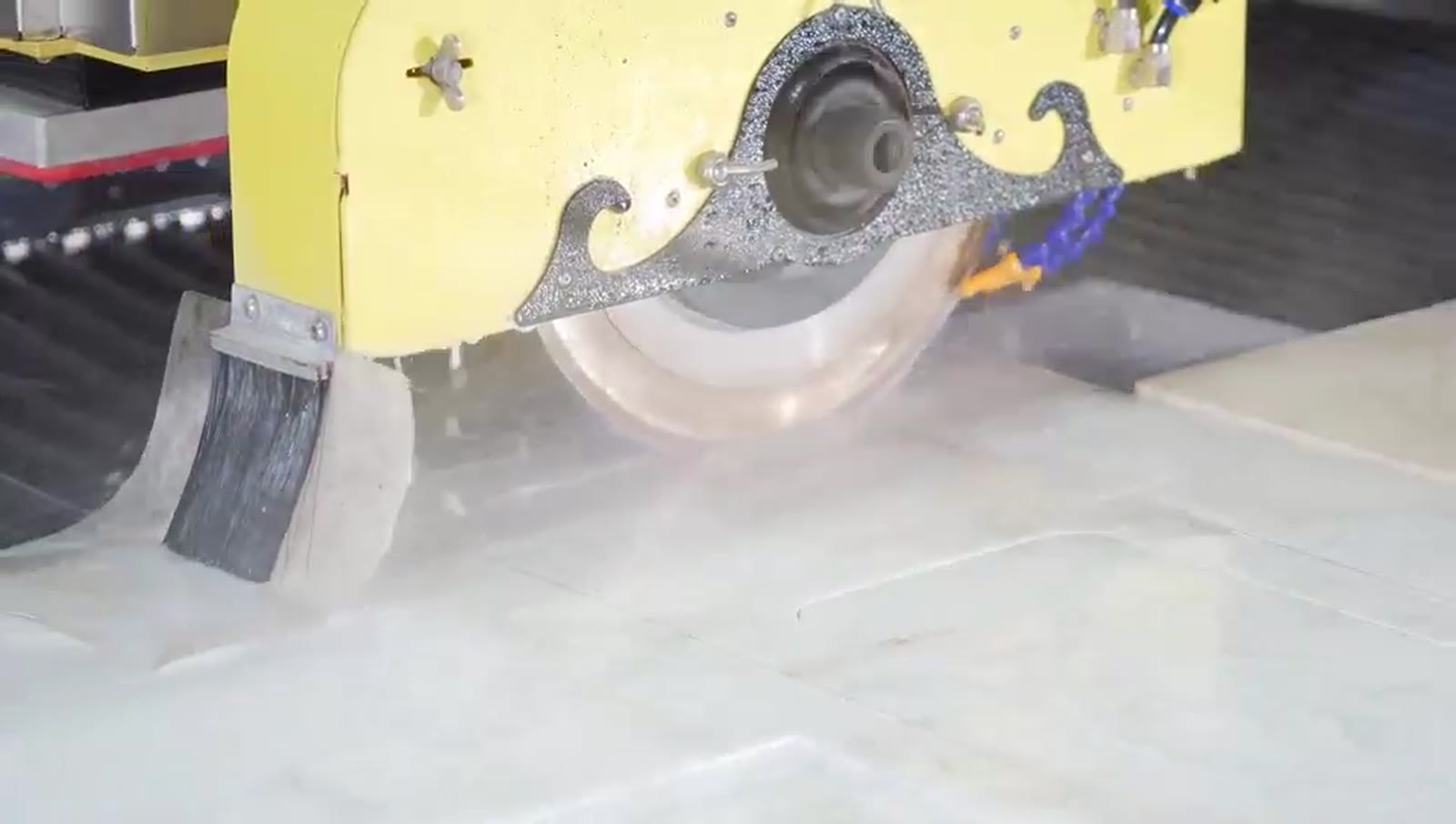
Finished quartz countertop runs cut from programmed layouts
Case. Yuanli's quartz countertop application page sets out the operation-by-operation breakdown — sink, hob and tap cut-outs, curved edges, drainer grooves, inlays — and which configuration suits each part. (Yuanli application page — capability documentation, not a named customer project.)
SEND YOUR COUNTERTOP DRAWING FOR A CUTTING TEST → contact
The buyer's question: How do I produce a clean 45° miter so the waterfall joint reads as one continuous surface?
What a 45° miter is. A mitred edge is a fabrication technique rather than a material. Two pieces are cut at matching 45° bevels and bonded so the assembly presents a thick edge from a thin slab — a 20 mm slab reading as a 40 mm or 60 mm front edge. The same technique produces the waterfall: the surface turns down at the end of the island and continues to the floor.
Why the miter is the hardest operation in the job. Everything about the finished piece is decided at the joint. If the two bevels do not match, the seam opens; if they match but the faces are not flat, the seam reads as a step; if the adhesive line is too wide, it reads as a stripe through the pattern. Published fabrication guidance treats 45° as a strict figure rather than a target — a Caesarstone fabrication guide, reported by C&K Feeds in July 2026, specifies mitre edges fabricated at exactly 45°, noting that angles below 45° leave an open edge. Treat that as the industry norm it is, not as a Yuanli specification.
What the machine has to control. Producing that bevel requires the cutting head to leave perpendicular. On a fixed-head machine the angled face is either not producible, or producible only through a secondary operation — saw or hand tool — which reintroduces the variation the mitre cannot tolerate.
The AC configuration tilts the cutting head through 0–65°. That range covers the 45° mitre with margin, and it covers the angled work that turns up in the same order book: chamfered edges, angled reveals, and the non-45° mitres that appear when a designer wants a specific edge thickness from a specific slab thickness.
Two notes that matter more than the headline angle figure:
The wider swing is what lets the angled face and the flat cut come off the same setup. That is where repeatability between parts comes from — not from the angle range alone.
A 45° mitre does not automatically come off every configuration. It depends on the head configuration, material, thickness and programmed strategy. Anyone who says a specific edge result holds regardless of those inputs is describing a brochure, not a process.
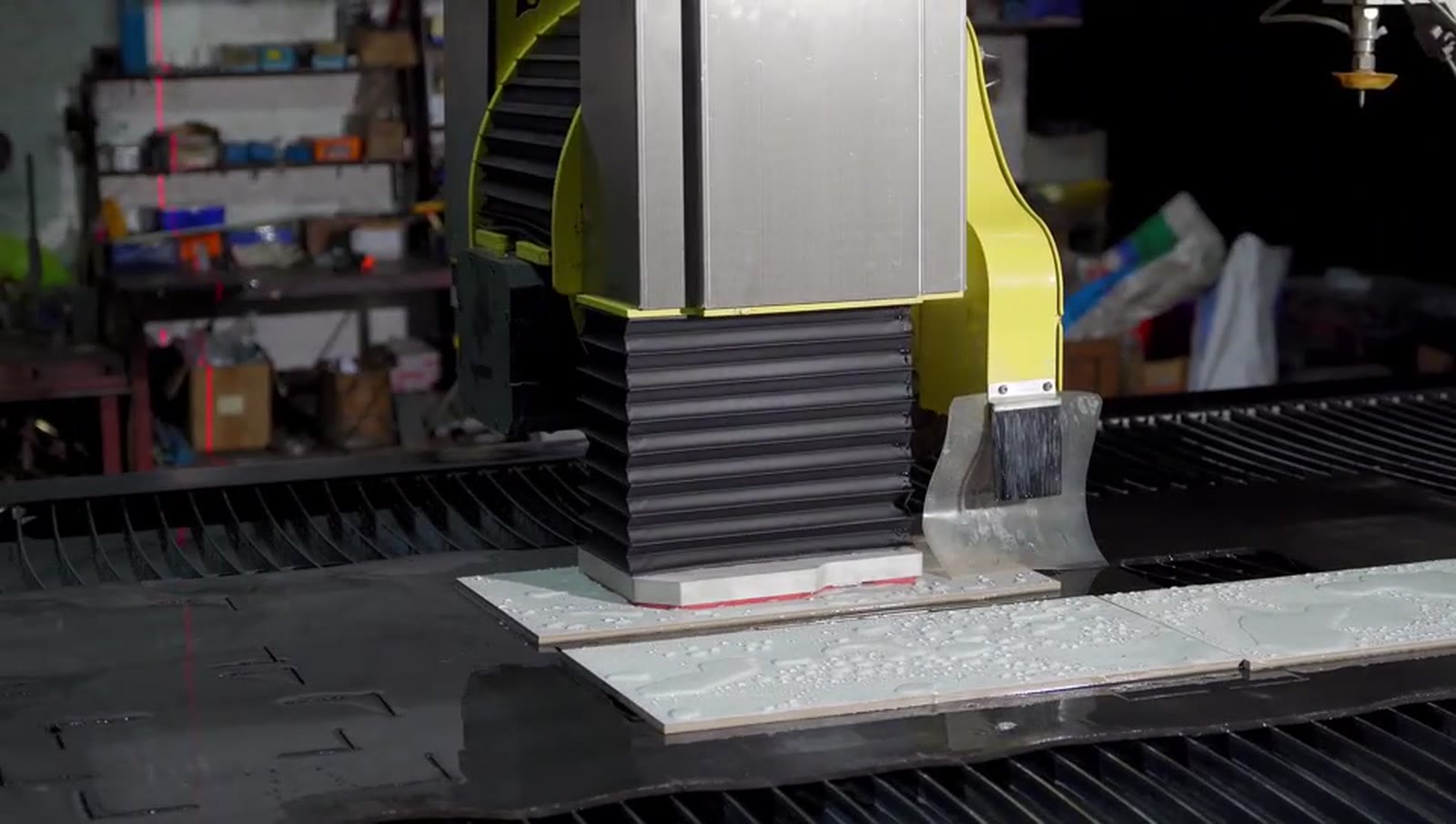
Bevel edge produced on a 5-axis waterjet head
Case and further reading. Yuanli publishes a dedicated page for 45° bevel processing applications. (Yuanli application page.) For an independent view of the technique, published guidance from slab and tooling suppliers — Slabwise (Jul 2026) and Dynamic Stone Tools — describes the two-bevelled-pieces method. (Published industry examples, not Yuanli cases.)
SEND YOUR MITER PROFILE → contact
The buyer's question: Porcelain is thin and brittle — why does it chip at the mitre, and what machine keeps the edge clean?
Large-format porcelain and sintered stone behave differently from quartz at the edge. Trade coverage of the process — notably Stone World's fabricator guide to cutting porcelain and sintered stone (June 2026) — makes the point that slab construction matters: a double-loaded slab carries the vein partway into the material, and that distinction becomes visible at a mitred edge where porcelain is considerably less forgiving than engineered quartz.
Countertops and mitred aprons, vanity tops, sink and tap cut-outs, waterfall edges, architectural panels and complex profiles on large-format slab. Porcelain is frequently specified in the Gulf, where its resistance to staining and thermal cycling is an advantage over porous natural stone.
Two things matter. First, cold cutting: no heat input at the cut, which removes the thermal-shock and discolouration risk a poor blade cut can introduce at a visible edge. Second, contour and angle from one program — on a large-format slab the cost of repositioning is high, so keeping the perimeter, openings and mitre on one table matters more than on a small part.
Where the machine has to work from the slab as it actually sits rather than from a nominal rectangle — common on printed and veined sintered slab — the platform can be specified with an intelligent vision system that captures the slab contour and establishes the coordinate relationship between the material and the machine before cutting.
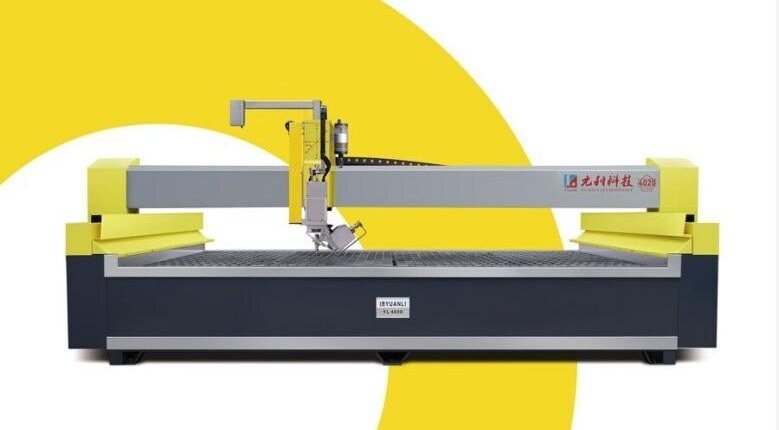
AC 5-axis waterjet with intelligent vision for large slab contour extraction
SEND YOUR SLAB DRAWING → contact
The buyer's question: Do I need AC 5-axis for inlay and medallion work, or is a narrower-angle machine enough?
Inlay, medallion and mosaic work is a fit problem rather than an angle problem. The pieces are cut individually and assembled to a pattern, and every piece has to seat against the one beside it. The accuracy requirement is on the contour; the angle requirement is usually modest.
Honest configuration guidance — this is where buyers are most often mis-sold:
3-axis produces flat, 2D profiles and handles inlay, mosaic and medallion parts very well. If your work is flat geometry cut to a drawing, this is the configuration the job calls for.
AB 5-axis adds controlled-angle capability with a 0–15° articulation range plus taper compensation — the configuration for inlay and mosaic work where controlled bevels or tapered cuts are part of the pattern.
AC 5-axis is the configuration to choose when the order book also contains architectural edges, mitred joints, complex contours or precision metal components.
AC is not required for every marble or granite application. Claiming otherwise is a sales position, not a technical one.
Case. Yuanli publishes a marble medallion production page. (Yuanli application page.)
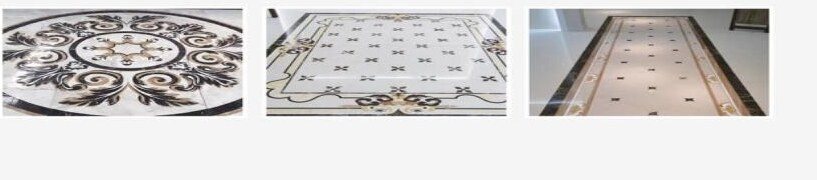
Decorative stone inlay and mosaic work cut on a 5-axis waterjet
SEND YOUR PATTERN DRAWING → contact
The buyer's question: Can one machine cover vanity tops and kitchen tops, or do I need two?
Vanity work is small-part work: an undermount basin opening, one or two tap holes, often a shaped or mitred apron, in quartz, marble or porcelain. It interrupts the slab workflow because the parts are small, vary per job, and repeat in short batches. If the machine cannot switch quickly between programs, vanity work goes to a second machine or becomes unprofitable.
A vanity top uses the same operations as a countertop at smaller scale — perimeter, pierced opening, tap holes, edge treatment — so it is a programming change rather than a machine change. The specification questions are platform size (sized from your largest top, not your average) and head configuration (whether the apron is mitred). One platform, one setup routine, one set of consumables, programmed per drawing: that is what makes mixed small-part batches viable on the machine that runs full-size tops.
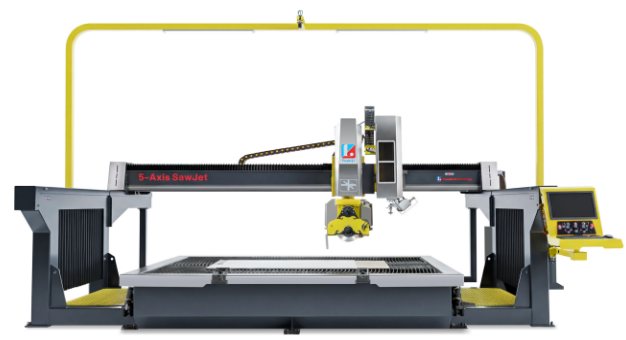
Water Bridge platform combining a bridge saw and 5-axis waterjet head
SEND YOUR VANITY DRAWING → contact
The buyer's question: My profile has a curve and an angled face on the same edge — which machine handles both?
A 2D workflow can produce a curve. It cannot produce an angled face along that curve. On a curved apron that also needs a bevel, a fixed-head machine forces the work into two operations — cut the profile, then introduce the angle by another method — and the join between the two operations is where the visible defect appears.
Curved countertops and peninsulas, irregular or offset sink openings, custom architectural panels, curved stone profiles, angled contours and bespoke components.
The tilting head lets the contour and the angle be produced by the same toolpath, so the two features are related by the program rather than assembled from two setups. Work that used to be declined or subcontracted becomes a programming task.
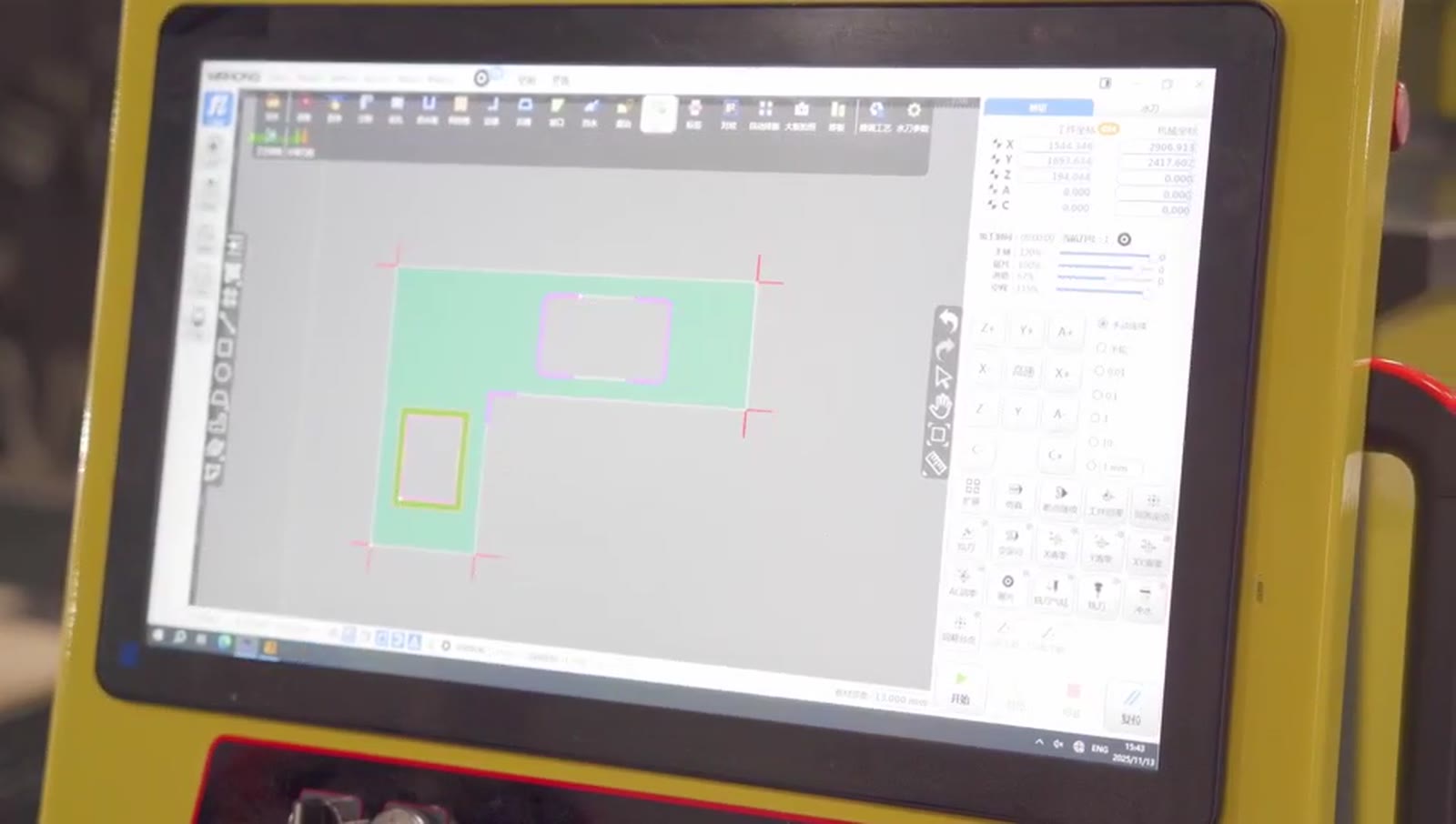
CAD layout with outline openings and edge profile programmed together
SEND YOUR CAD DRAWING → contact
The buyer's question: Does waterjet distort metal, and can it produce angled faces?
Thermal cutting introduces heat at the cut. In thin stainless or aluminium components that heat is associated with distortion and a heat-affected zone along the cut edge — a real issue for architectural metalwork and for parts where flatness is specified. Applications include stainless steel, carbon steel, aluminium, brass and titanium: brackets, custom profiles and bevelled parts.
Abrasive waterjet can reduce thermal distortion risks compared with thermal cutting, because there is no heat input at the cut. The angle capability extends the same benefit to bevelled components, which on a fixed-head machine often return to a secondary machining operation.
A note on wording, because it matters commercially: waterjet cutting is not a promise of a burr-free edge with no finishing operation, and no machine builder can honestly describe it that way. It offers a cold cut, complex profiles in one setup, and angled capability — evaluated against the finish your part requires.
SEND YOUR PART DRAWING → contact
Family | Materials |
|---|---|
Stone | quartz, marble, granite, limestone, engineered stone |
Slab materials | porcelain, ceramic, sintered stone |
Glass | architectural glass, decorative glass |
Metals | stainless steel, carbon steel, aluminium, brass, titanium |
Other | composite materials |
On thickness: Yuanli's 2026 catalogue gives indicative maximums for six families on 5-axis platforms at standard pressure — carbon steel 200 mm, stainless steel 150 mm, titanium 50 mm, marble 100 mm, glass 40 mm, ceramic 30 mm — qualified by the note that actual thickness depends on cutting speed, tolerance and pump pressure. The catalogue gives no figure for quartz, granite, sintered stone or composite, so this page does not invent one. Send your material and thickness and we will confirm it.
Capability | 3-Axis | AB 5-Axis | AC 5-Axis |
|---|---|---|---|
Standard 2D cutting | Yes | Yes | Yes |
Inlay / mosaic | Yes | Yes | Yes |
Non-standard 2D profiles | Yes | Yes | Yes |
Angle cutting | Limited | 0–15° | 0–65° |
Bevel cutting | Limited | Yes | Yes |
Complex angle geometry | Limited | More capable | Advanced capability |
Advanced miter work | Configuration dependent | Yes | Yes |
Precision metal components | Limited | Configuration dependent | Yes |
Typical order book | Flat profiles, general stone, volume work | Inlay, mosaic, medallion, controlled angles | Bevels, mitred joints, complex contours, metal parts |
How to read this table. Each configuration addresses a different production requirement, and the right answer is the one that matches your drawings:
3-axis — flat geometry cut to a drawing, where volume matters more than angles.
AB 5-axis — inlay, mosaic and medallion work where controlled bevels or tapered cuts are part of the pattern, and the widest angle range is not required.
AC 5-axis — architectural edges, mitred joints, complex contours, or a platform that has to cover both stone and precision metal components.
A shop that buys a wider angle range than its drawings contain has bought capability it will not use; a shop that buys a narrower configuration than its order book requires will subcontract its best-paying work. For a deeper comparison see 3-axis vs 5-axis waterjet.
Middle East. Project work dominates: hospitality, villa and mixed-use developments where stone appears as countertops, vanities and architectural surfaces in one specification. Large-format porcelain and sintered slab are common because they resist staining and thermal cycling better than porous natural stone, which places more mitred and angled work in the workshop than a residential market would. Buyers also weight service distance heavily: a consumable taking weeks to arrive is a different commercial problem from one taking days.
Europe. Contract kitchens and bathroom furniture, where mitred and waterfall edges are a standard retail expectation. Italy and Spain carry a strong natural-stone and decorative tradition; Germany, Poland, the UK and France lean toward large-format porcelain and sintered slab. The common thread is that the mitre is a routine requirement, not a special request.
What this means for configuration. In both regions the deciding factor is usually not the maximum angle a machine can reach, but whether it can produce the routine mitre repeatably, on the material the shop actually processes, without a second operation.
Send us these twelve things and you will get a configuration recommendation rather than a price range:
Material — quartz, porcelain, sintered stone, marble, granite, glass, or metal
Thickness — per material
Maximum slab or part size — the largest piece you need in one setup
Cutting area required on the table
Required angle — and whether 45° mitres are routine or occasional
Typical product — countertop, vanity, panel, medallion, metal part
Production volume — parts per shift, and whether parts repeat
Number of heads — single or dual, depending on throughput
Pump requirement — pressure and flow for your materials
Automation requirement — loading, vacuum handling, nesting
Vision requirement — whether you need to work from the slab as it sits
CAD/drawing files — including the parts you currently decline or subcontract
The last item is the most valuable and the most often omitted. The jobs you turn away describe your machine requirement more accurately than the jobs you accept.
Yuanli builds the AC configuration across a range of working areas, from the compact YL1313 cantilever platform through the YL2015, YL2515, YL3015, YL3020 and YL4020 gantry sizes, with single-head and dual-head variants depending on the model selected.
Verified specification for the AC configuration:
Specification | Value |
|---|---|
Cutting-head swing | 0–65° |
Cutting accuracy | ±0.1 mm |
Repeatability | ±0.01 mm |
Working pressure | 450 MPa standard; 600 MPa optional depending on configuration |
Control | CNC-controlled multi-axis cutting |
Working area | Configurable — see the model range |
Head configuration | Single or dual head, depending on the model selected |
Certification | CE, where applicable to the configuration supplied |
Customization | Available depending on machine configuration |
Figures vary by model. Platform size and head count in particular are model-specific, so confirm a specification against the model you are considering rather than reading across the range.
Company position, as published by Yuanli: 18 years in waterjet technology, 7,500+ installations, 18+ national core patents, CE-certified production, installations in 40+ countries, 12 months' machine warranty and a documented wear-parts programme.
Yuanli's design principle is "Engineered Around Your Process." The configuration conversation starts with your drawings, not a stock model — and where a standard platform does not fit, a customized configuration can be quoted.
Have a quartz countertop, porcelain slab, marble, granite or metal part that needs complex-angle cutting?
Send us your drawing, the material and the thickness. Yuanli can review the application and recommend a suitable waterjet configuration — including a cutting test, so the recommendation is based on your material rather than on a specification sheet.
Email: sales01@ylwaterjet.com · Phone / WhatsApp: +86 185 2097 1183
Can a 5-axis waterjet cut quartz countertops? Yes. Quartz is commonly cut by abrasive waterjet because it is a cold process with no heat-affected zone. A 5-axis machine adds bevels and mitred edges in the same setup as the perimeter and cut-outs.
Can a waterjet make a 45-degree miter cut? Yes, where the machine is configured with a tilting head. Yuanli's AC configuration tilts through 0–65°, which covers a 45° mitre with margin. The result still depends on material, thickness and the programmed strategy, so the edge outcome should be confirmed against your specification rather than assumed.
What is the difference between AB and AC 5-axis waterjet? Both control the cutting head beyond the flat plane. AB has a narrower articulation range — 0–15° with taper compensation — and suits inlay, mosaic and controlled-angle work. AC has the wider 0–65° range used for bevel and mitred joints, complex contours and precision metal components.
Can waterjet cut porcelain slabs? Yes. Porcelain and sintered stone are frequently cut by waterjet, particularly in large-format work, because cold cutting avoids introducing heat at a visible edge on a thin, brittle slab.
Can waterjet cut marble and granite? Yes. For inlay, medallion and mosaic work, a 3-axis machine handles flat 2D profiles very well. AB and AC become relevant when the pattern includes controlled angles or the order book includes architectural edges.
Can waterjet cut bathroom vanity tops? Yes. A vanity top uses the same operations as a countertop at smaller scale — perimeter, pierced opening, tap holes, edge treatment — so it is a programming change rather than a machine change, which is what makes mixed small-part batches workable on one platform.
What thickness can a waterjet cut? It depends on the material. The catalogue gives indicative maximums for six families on 5-axis platforms at standard pressure, with actual thickness depending on cutting speed, tolerance and pump pressure, and gives no figure for quartz, granite, sintered stone or composite. Send your material and thickness for a confirmed figure.
How much does a 5-axis waterjet cost? Price is configuration-driven rather than model-driven. The variables are working area, axis configuration, pump and pressure, head count, vision system and automation. Send your drawings and we will quote the configuration that covers the work — request a quote.

