
Views: 0 Author: Site Editor Publish Time: 2026-09-11 Origin: Site


A large format waterjet cutting machine is a CNC cold-cutting system built on an oversized table — typically 3,000 × 2,000 mm and above, with gantry machines reaching 6,000 mm or more on the long axis. It exists to solve one problem: cutting full slabs, oversized plates and long structural parts in a single setup instead of repositioning the workpiece three times. If your shop handles stone slabs, thick steel plate or architectural cladding, table size is the most consequential specification you will choose — and it is the most expensive one to get wrong.
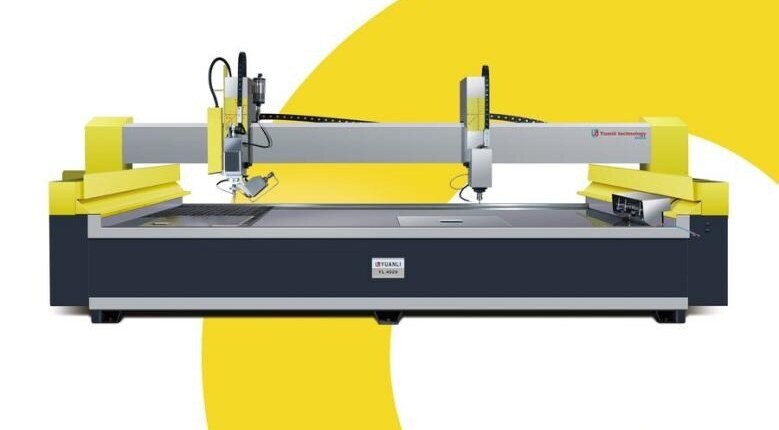
The YL 4020 gantry platform — a 4,000 × 2,000 mm bed carrying a 5-axis head and a vertical spindle.
Most manufacturers treat 1,300 × 2,500 mm as a standard table. Anything from roughly 2,000 × 4,000 mm upward is normally sold as large format, and the category keeps climbing from there. A 3,000 × 6,000 mm gantry machine is routine in stone fabrication, and custom beds beyond 8,000 mm are built for shipyards and heavy steel work.
The distinction is not only about the bed. Large format machines almost always use a gantry architecture, where the cutting head rides on a bridge supported at both ends, rather than a cantilever arm supported at one end. Cantilever designs are cheaper and perfectly adequate for a 1,500 mm table, but they deflect as the arm extends. On a 4,000 mm span that deflection becomes a dimensional error your customer will measure.
Axis count is a separate decision from size. A three-axis large format machine cuts vertically and is the right answer for flat sheet and slab work. A five-axis head adds two rotational axes so the nozzle can tilt, which lets you cut bevels, mitred countertop edges and angled holes without re-fixturing. Many fabricators order a large bed with a five-axis head because slab work increasingly demands mitred joints.
The economics of a large table come down to setup elimination. Every time a part is too long for the bed, someone has to cut part of it, release the clamps, slide the material, re-square it and cut again. That repositioning step consumes operator time, risks a visible joint line, and introduces a fresh alignment error at every restart.
A larger bed removes those restarts. Cutting a 3,200 mm countertop run on a 4,000 mm bed is one continuous operation with one edge quality. Cutting the same run on a 2,500 mm bed means two operations, a butt joint, and a fitter who has to hide the seam.
Nesting efficiency moves in the same direction. On a small bed you nest within a small rectangle and accept the offcut. On a large bed you nest multiple parts of different sizes around each other, which typically lifts material yield by several percentage points. On expensive material — stainless, engineered stone, titanium — that yield difference alone can justify the larger machine over its service life.
The counter-argument is floor space and capital cost. A large gantry machine occupies considerably more area, needs a stiffer foundation, and costs more up front. The decision should be driven by the largest part you must cut repeatedly, not by the largest part you might cut once.
Table size (mm) | Typical architecture | Best suited to |
|---|---|---|
1,300 × 2,500 | Cantilever or small gantry | General job shop, small parts, prototypes |
2,000 × 3,000 | Gantry | Metal fabrication, signage, mixed sheet work |
2,000 × 4,000 | Gantry | Standard stone slab cutting, cladding panels |
3,000 × 6,000 | Heavy gantry | Slab-to-slab production, large architectural panels |
Custom up to 8,000+ | Engineered gantry | Shipbuilding, wind tower components, heavy plate |
This table is a starting point, not a rule. Shops that cut a mix of slab and plate often settle on 2,000 × 4,000 because it covers a full quartz slab with room for clamping. Shops cutting only large architectural panels skip straight to 3,000 × 6,000.
Before you fix on a size, measure the largest part you cut at least weekly, add the clamping or fixture margin your process needs, then round up to the nearest standard bed. Specifying for your routine work — rather than for the occasional oversized job — keeps floor space and capital free for the parts that actually pay the bills. If your mix shifts toward larger panels later, a modular gantry design lets the bed be extended instead of replaced.
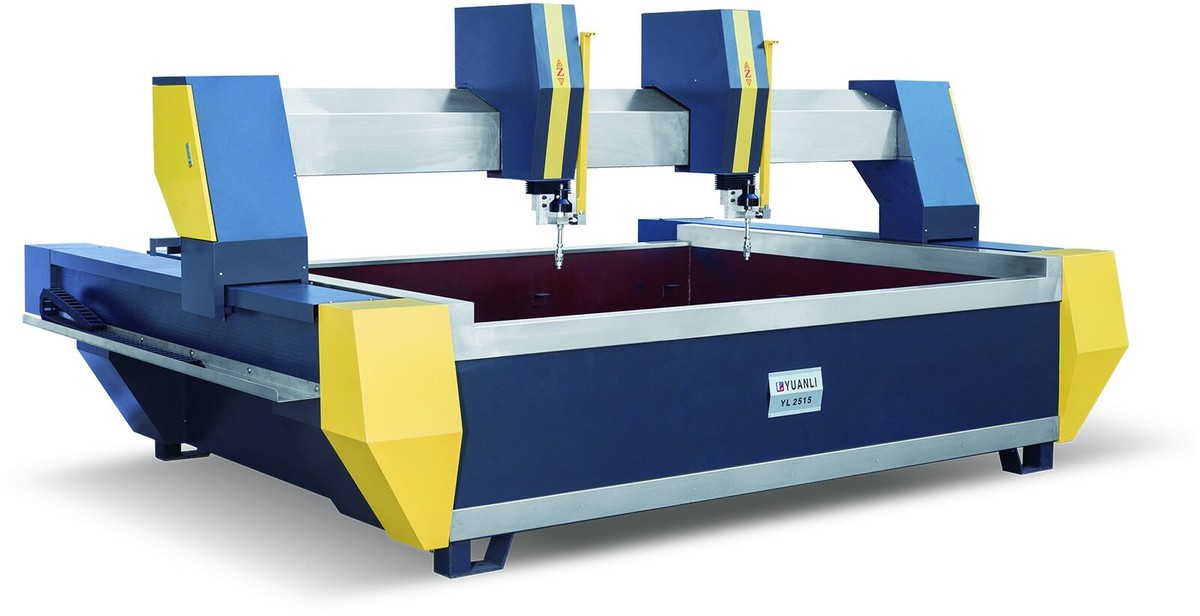
Dual cutting heads on one gantry. Multi-head configuration is the cheapest way to raise throughput once the bed is already large.
Buyers often assume a large format machine is simply a bigger version of a standard one. In practice four things change, and only one of them is the bed.
Standard machine | Large format machine | |
|---|---|---|
Typical bed | 1,300 × 2,500 mm | 2,000 × 4,000 mm and up |
Architecture | Cantilever or light gantry | Heavy gantry, both ends driven |
Setups per large part | Two or more, with a visible joint | One continuous operation |
Nesting yield | Limited to a small rectangle | Multiple mixed parts per sheet |
Floor requirement | Modest | Large, with loading access on both sides |
Foundation | Standard slab | Often requires assessment or reinforcement |
Pump sizing | Smaller intensifier is adequate | Larger pump to hold pressure at the far edge |
Price driver | Frame and control | Frame, pump and gantry drive system |
The consequence worth internalising is that the machine’s cost structure changes, not just its footprint. On a standard machine the pump is a supporting component; on a large bed the pump becomes a limiting factor, because pressure losses along longer high-pressure plumbing are real and the machine must still hit its rated cutting speed at the far corner of the table.
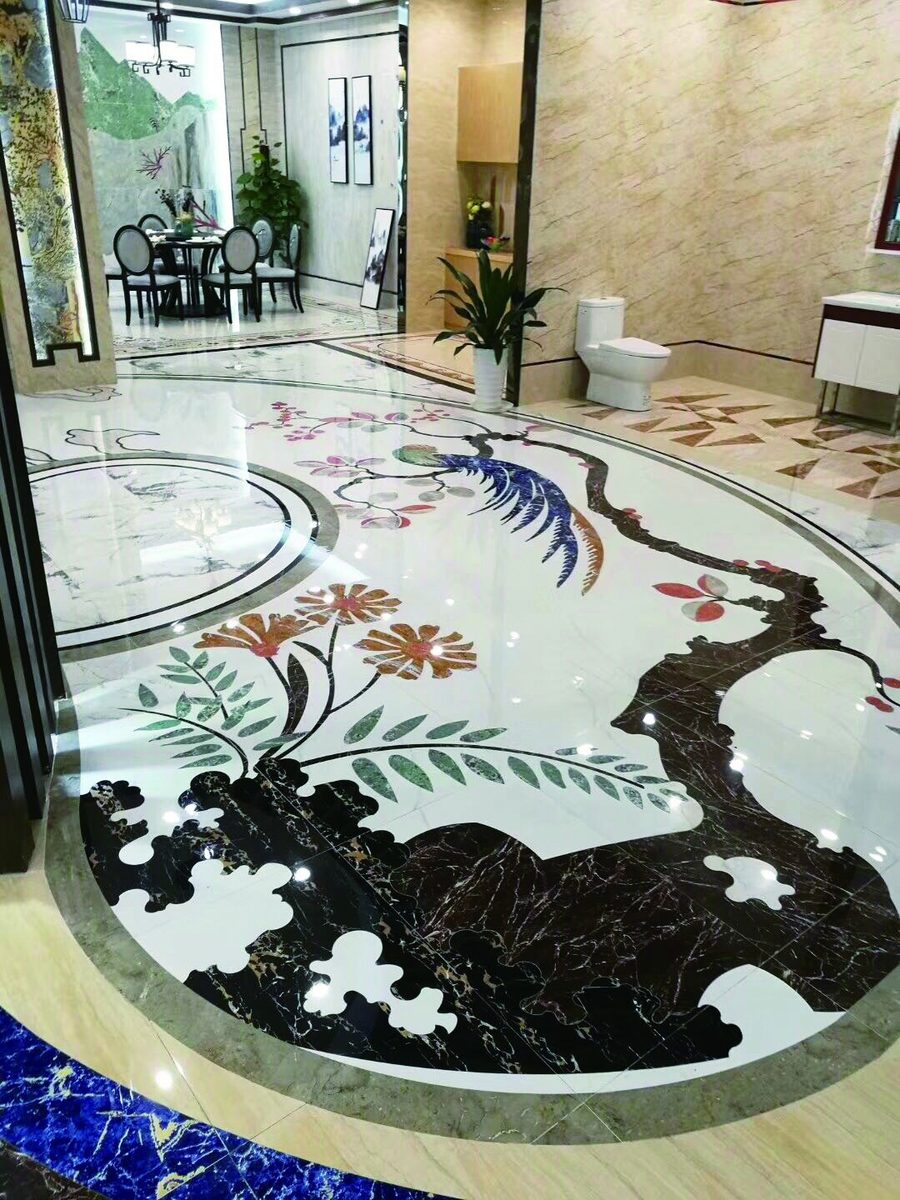
Large-format decorative inlay in polished stone. Work of this size is only economic when it is cut in a single setup.
The clearest cases are the ones where the part itself is large, and repositioning is not merely slow but visible in the finished product.
Stone and engineered slab. Full slabs run around 3,200 × 1,600 mm, so a 2,000 × 4,000 mm bed covers a slab with clamping room. Quartz, sintered stone and porcelain slab are the fastest-growing segment here, because large-format porcelain now ships in sizes that simply do not fit a standard table when you also need a mitre.
Architectural cladding and facades. Panels are frequently 1,500 × 3,000 mm or larger and must be cut to identical dimensions, because a 2 mm variance shows on a facade as a shadow line. Cutting them on one bed removes the variance entirely.
Decorative inlay and medallion work. Multi-colour stone floors, medallions and backlit panels require many pieces cut from different materials to fit together seamlessly. This is where a large bed with good repeatability pays for itself immediately — the pieces are laid out together, cut once, and assemble without hand fitting.
Structural and heavy plate. Base plates, crane components and wind tower parts are cut from plate up to 50 mm and beyond, where the limiting factor is usually thickness rather than length, but where the part is often longer than a standard bed too.
Shipbuilding and heavy fabrication. This is the segment that pushes beds past 8,000 mm, and where accuracy over the full span becomes the main engineering problem rather than the frame’s size.
A long bed is not automatically an inaccurate one, but the failure modes are different from a small machine, and knowing them tells you what to ask a supplier.
Gantry squaring. The bridge must stay perpendicular to the rails at every point along its travel. Single-side drive allows skew under acceleration; a well-built large machine drives both ends and keeps them synchronised electronically or mechanically.
Bed levelling and support. Over 4,000 mm, a bed that is not supported at adequate intervals will sag under a heavy slab. Ask how many support points the frame uses and whether the bed is levelled in the field.
Thermal behaviour. Long steel members grow with temperature. A machine in an uncontrolled workshop will see several degrees of variation across a working day, and a gantry designed without that in mind will show it as a slow drift that gets blamed on the controller.
Drive system choice. Rack-and-pinion drives are usual on long axes because ball screws are impractical beyond a certain length. That makes the quality of the rack, the pinion preload and the encoder arrangement the accuracy-determining parts of the machine.
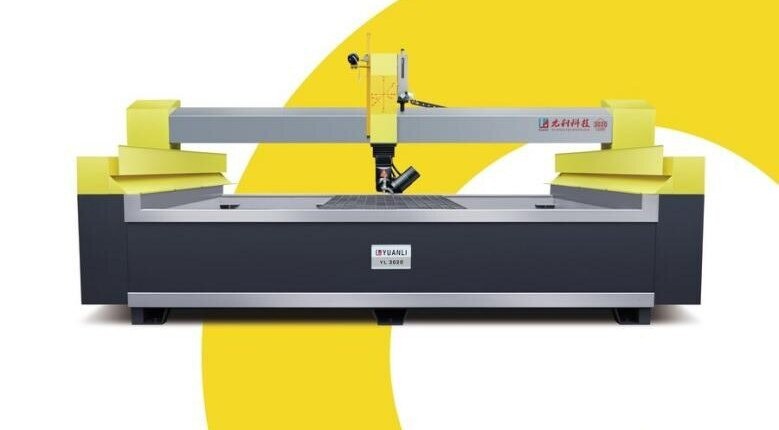
A large bed is only useful if the machine can be moved, levelled and commissioned without delaying your production.
Cutting speed on thick material is governed by pressure, not by table size. Machines running at 4,200 bar will cut noticeably faster on 20 mm stainless than machines limited to 3,000 bar, and the difference compounds across a production day. Check whether the intensifier is a single or dual design; a dual intensifier keeps pressure steady while one side refills, which matters on continuous cutting.
Ask for the accuracy figure and the repeatability figure, because they are different measurements. Accuracy describes how close the machine gets to the commanded position; repeatability describes how consistently it returns to the same point. For countertop fabrication, repeatability is usually the more commercially important number, since it determines whether parts assembled on site actually line up.
On long spans, the bridge must be driven and guided at both ends. A single-side drive on a 4,000 mm machine will skew under acceleration. Ask how the gantry is squared — mechanical linkage, dual servo with electronic synchronisation, or a rigid single-piece bridge.
Beyond the standard catalogue, a manufacturer with in-house engineering can typically modify bed length, bed width, gantry height, pump configuration and the control platform. What matters is how far that customisation goes before it becomes a one-off prototype.
The practical questions to ask are: does the factory design and build the frame itself, or buy a frame and bolt components onto it? Can they supply drawings showing the custom dimensions before production? Do they test the finished machine under simulated customer working conditions, or only run a basic power-on check? A supplier offering a four-stage process — requirements review, layout design, precision manufacturing, and performance verification under load — is materially different from one that simply quotes a number.
Customisation should also include the loading side. If you are cutting slabs, ask how the bed is designed for loading: tilt tables, roller beds and vacuum lifters are often the difference between a machine that gets used and one that sits idle.
A large format machine is a heavier installation than its footprint suggests. Before ordering, confirm the floor loading the machine imposes per square metre and whether your slab needs reinforcement, particularly if the building is older or has a suspended floor.
Power supply depends on the pump. High-pressure intensifier pumps typically draw tens of kilowatts and often require a dedicated supply rather than sharing a circuit with other shop equipment. Confirm voltage and phase against your local supply before the order is placed — retrofitting the electrical side after delivery is slow and expensive.
Water quality and disposal matter too, and they are the most commonly underestimated part of the project. Abrasive waterjet cutting produces a slurry of spent garnet and cut material that has to be handled. Ask the supplier how the tank is cleaned out, and whether they provide a settling or separation arrangement, before the machine arrives rather than after.
Four factors explain most of the price spread between two machines with the same stated bed size.
The first is the frame and gantry. A heavy, stress-relieved, machined frame costs more than a welded assembly and holds accuracy for years longer.
The second is the pump. The intensifier, its seals and the high-pressure plumbing are the components that wear fastest, and their quality determines your maintenance cost over the machine’s life.
The third is the control system and drives. Servo quality, encoder resolution and software capability determine what the machine can actually cut, not just how big its bed is.
The fourth is service coverage. A machine sold into your country without local support, spare parts stock or an engineer who responds within a contracted time is a machine that stops paying for itself the first time it goes down. Price comparisons that ignore this are not comparisons.
The useful comparison is therefore never the purchase price on its own. It is purchase price plus maintenance plus downtime over five years, divided by the parts you actually ship out of the door.
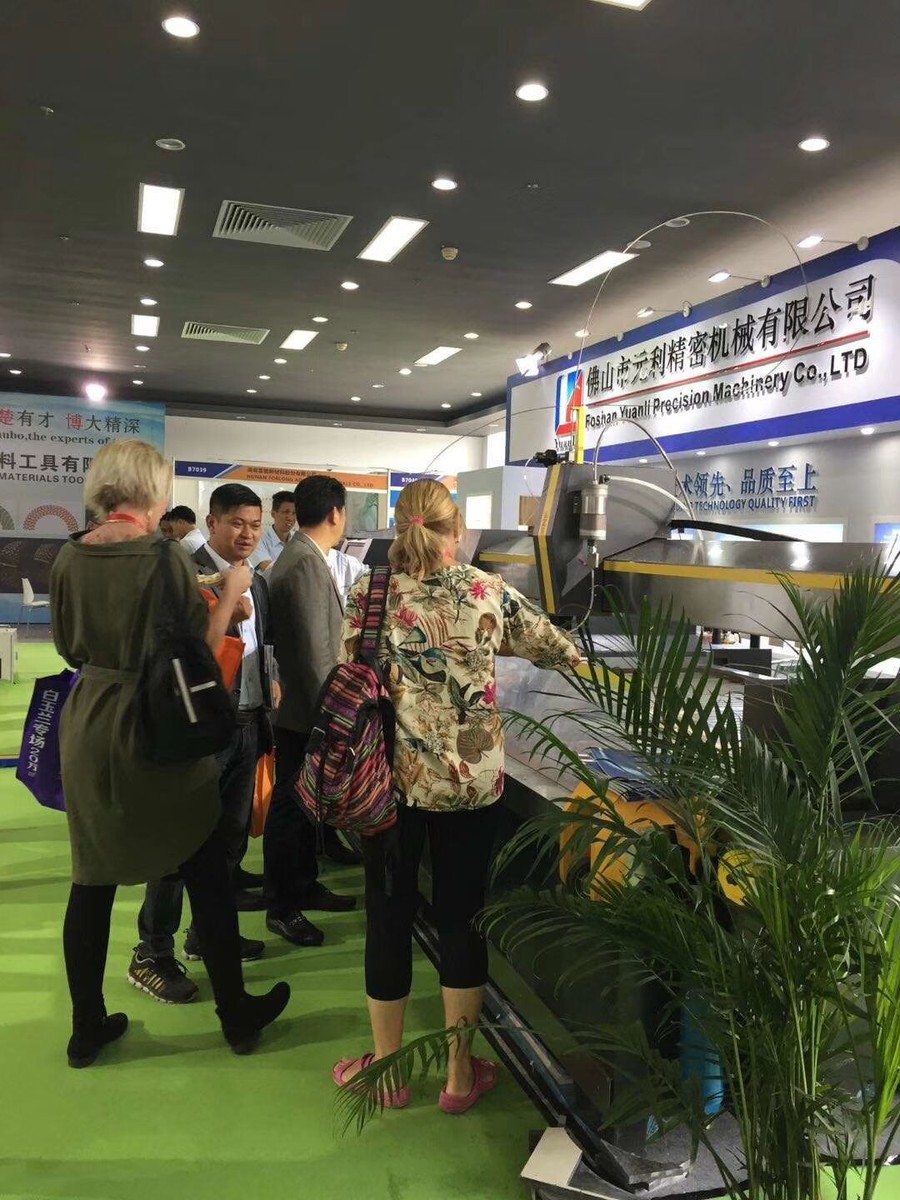
Seeing the machine in person, and meeting the people who will support it, is worth more than any brochure.
Work through the same checklist for every supplier you consider, and insist on evidence rather than brochure claims.
Ask for the accuracy and repeatability figures with the measurement method stated.
Ask which parts are manufactured in-house and which are bought in.
Ask for at least three reference customers running the same model in a similar application.
Ask what happens on day one of a breakdown: who responds, in what language, within what time.
Ask for the delivery schedule in writing, including the customisation lead time.
Ask to see the machine cutting your material at the thickness you actually run.
A supplier who answers all six is a supplier you can hold to a schedule. A supplier who answers three is a supplier you will be chasing.
If you want to see how a configured large bed is specified end to end, our large format automatic water jet machine for marble and ceramic tiling page walks through one build, and the waterjet cutting machine overview covers how three-axis and five-axis systems differ. You can also see how these machines behave in real production on our applications page.
What is the largest waterjet cutting table available?
Gantry machines are routinely built to 3,000 × 6,000 mm, and engineered custom beds beyond 8,000 mm exist for shipbuilding and heavy plate work. The limit is usually the accuracy you need to hold over the full span, not the frame itself.
Is a large format machine harder to keep accurate?
It requires more attention to gantry squaring and bed levelling, but a well-built large machine holds accuracy as well as a small one. Machines that drift are usually those built on light frames or driven from one side only.
Can I add a five-axis head to a large table?
Yes, and it is a common configuration. The bed and the head are specified separately, so you can pair a 3,000 × 6,000 mm bed with a five-axis head for mitred slab joints and bevel cutting.
How much floor space does a 3,000 × 6,000 mm machine need?
Allow for material loading on both long sides. In practice a machine with a 3,000 × 6,000 mm bed needs a working area considerably larger than the bed itself, and you should confirm the exact envelope and floor loading with the supplier before laying out the shop.
Do large format machines cost more to run?
The energy and abrasive cost per part is usually lower, not higher, because setup elimination and better nesting raise throughput on the same running hours. Maintenance cost depends far more on pump quality than on bed size.
How long does installation and commissioning take?
Allow for foundation or floor preparation, machine placement and levelling, electrical connection, high-pressure plumbing, water and drainage, then a commissioning and training period. The machine itself installs quickly; the site works around it are what determine the schedule, which is why they should be planned before delivery rather than after.
What water and abrasive consumption should I plan for?
Both scale with cutting hours rather than with bed size, so a large machine running the same hours as a small one consumes similar amounts. What changes is that abrasive and water handling become continuous processes rather than occasional ones — plan for slurry removal and abrasive delivery at the layout stage, not as an afterthought.
Can a large format bed be extended later?
On modular gantry designs, yes, and it is usually far cheaper than replacing the machine. Ask at the order stage whether the specific frame is extendable, because not every design is, and retrofitting a non-modular frame means a new machine rather than an upgrade.
If you are specifying a large format waterjet cutter, send us three things: the largest part you cut repeatedly, the material and thickness, and the floor space you can commit. With those, our engineers can size the bed, recommend a gantry and pump configuration, and tell you honestly whether a standard table will do or whether the job genuinely needs a custom build.
Because we manufacture the frame, the pump package and the control integration ourselves, custom bed dimensions are a normal part of the process rather than an exception. You receive drawings for approval before production starts, and every machine is tested under simulated working conditions before it ships.
Foshan Yuanli Precision Machinery has been building CNC ultra-high-pressure waterjet systems for more than a decade and exports across the Middle East, Southeast Asia, South Asia and Africa, with 24-hour technical response and on-site support for installation and commissioning.
Send your specification through the form and we will come back within 24 hours with a recommended configuration and a factory-direct quotation.
Request a quote and we will respond within 24 hours.


