
Views: 0 Author: Site Editor Publish Time: 2026-09-22 Origin: Site


A 5-axis waterjet for a Middle East production environment is specified on four things beyond the cutting envelope: how the machine rejects heat, how it handles the power and water you actually have on site, which stone and metal work the region puts through it, and how fast a technician and a spare part can reach you. Get those four right and the rest of the specification follows naturally.
This guide works through each of them in the order they affect the purchase decision, and it is written for fabricators, workshop owners and project buyers evaluating a machine for Gulf and wider Middle East production.
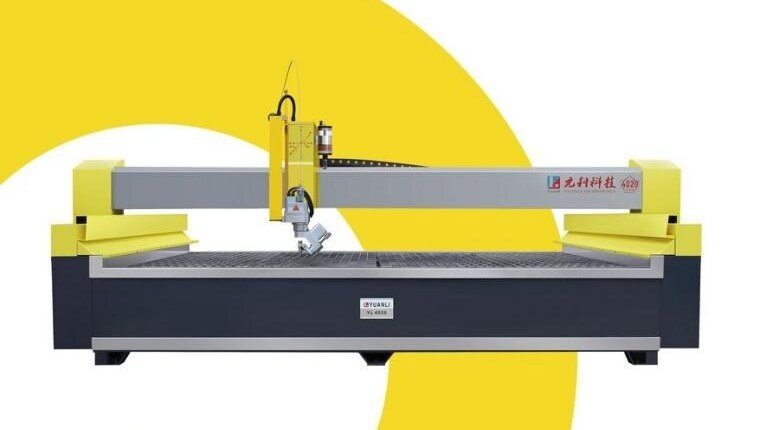
AC 5-axis platform — 0–65° head swing for bevel, angle and complex contour work
An abrasive waterjet is a hydraulic and mechanical system, and it is sensitive to the conditions around it in ways that a saw is not. High ambient temperatures, airborne dust and long operating hours change what you should specify.
The first consideration is heat rejection. An intensifier pump running continuously converts a significant amount of energy into heat, and the hydraulic oil and the high-pressure water both have to be cooled. Yuanli machines are offered with three cooling system options — water cooling, air cooling, or air-conditioning cooling — and the choice between them should follow the ambient conditions of the building the machine will stand in, not the catalogue default. A machine in a shaded, well-ventilated workshop and a machine in a closed unit without climate control are two different specifications.
The second is dust. Abrasive waterjet cutting already generates a wet, abrasive slurry, and in a dusty environment that slurry plus airborne grit gets into guideways, linear rails and electrical cabinets. This is the argument for specifying the guideway protection and cabinet sealing level deliberately, and for planning a cleaning routine into the operating day rather than treating it as an occasional task.
The third is water. Waterjet cutting consumes water, and the quality of the supply affects both cut quality and consumable life. If your site runs on high-hardness or high-solids water, that has to be part of the configuration conversation — not something discovered after installation.
A 3-axis machine cuts flat, 2D profiles very well. The question is whether your order book contains work that a 3-axis machine cannot do, and in the Middle East stone sector the answer is usually yes.
The region's stone and hard-surface work concentrates in a few categories that all benefit from an angled cutting head. Architectural cladding and façade elements often require mitred and bevel edges so the joint reads as a continuous surface rather than a visible seam. Decorative screens and perforated panels — the contemporary reading of traditional mashrabiya — are closed-profile work with dense internal geometry, which is natural waterjet territory. Inlay and mosaic for hospitality interiors, mosques and residential feature walls involve small pieces cut to tight tolerances and assembled to a pattern. Sanitaryware and basin work involves openings, overflow holes and shaped cut-outs where a deviation of a fraction of a millimetre is visible in the finished room.
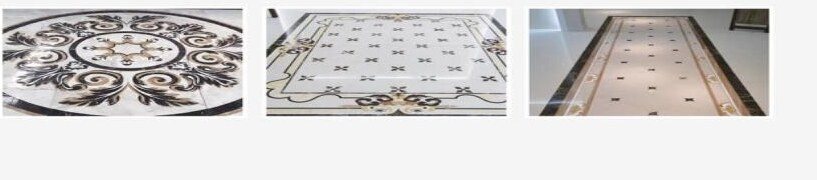
Inlay, mosaic and perforated screen work — closed profiles with dense internal geometry
On the metal side, stainless steel architectural metalwork, aluminium façade components and precision parts all benefit from a cold cut. That last point matters more in hot climates than it does in a temperate workshop, because the argument for waterjet over thermal cutting is the absence of a heat-affected zone and the distortion that comes with it.
The AC 5-axis head gives you a 0–65° swing for bevel and angle work. Where the work is inlay, mosaic and controlled-angle cutting rather than full contouring, the AB 5-axis is the more economical configuration. And where the constraint is large-format slab handling rather than angle, the Water Bridge platform combines a bridge saw for fast straight cutting with a 5-axis waterjet head for the internal cut-outs and curves on the same gantry.
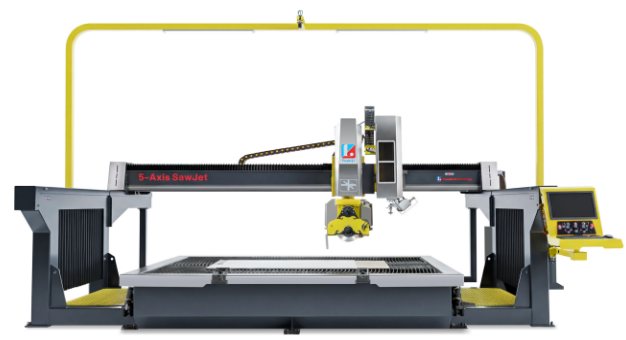
Water Bridge / SawJet — blade for straight runs, 5-axis head for cut-outs and curves, one gantry
These three utility questions decide whether a machine performs as specified on your floor, and all three are easier to answer before the order than after installation.
Power. Yuanli machines are built for 220 V / 380 V / 415 V at 50 or 60 Hz, which covers the supply arrangements used across the region. Before ordering, confirm the voltage, phase and frequency at the actual position the machine will occupy — not the nominal supply for the site — and confirm the available capacity against the machine's connected load. A large platform with an intensifier, a bridge saw spindle and a vacuum system draws considerably more than the cutting head alone.
Water. Confirm the supply pressure, flow rate and quality. Hard or high-solids water shortens consumable life, so it is worth testing the supply before the machine is specified rather than after. The abrasive delivery system is a separate consumable stream and should be planned with the same care.
Heat. Decide the cooling arrangement against the real operating conditions of the room. If the machine will run through the day in a building that is not climate controlled, air-conditioning cooling is a specification decision, not an upgrade to consider later. The same logic applies to the electrical cabinet's own cooling.
Where the operation is large-format slab work with pattern matching or contour extraction — common in high-value stone fabrication — the AC 5-axis with Intelligent Vision adds slab contour capture and layout onto the same platform.
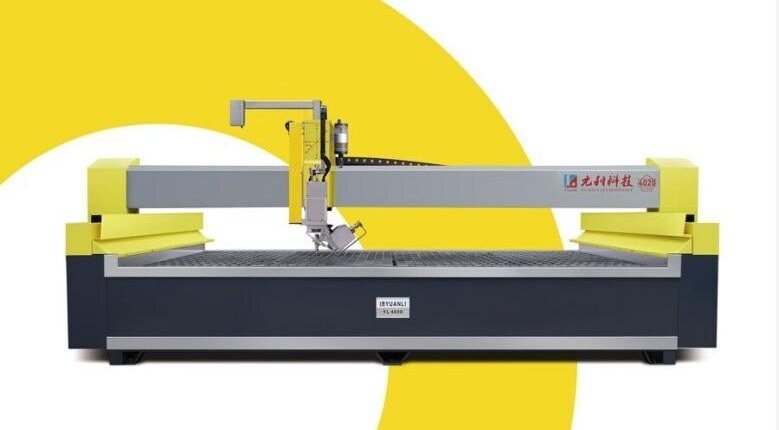
AC 5-axis with Intelligent Vision — slab contour capture and layout on the same platform
The honest answer to "which machine" starts with the work, not the budget. Use this as a first filter, then confirm the configuration against your drawings.
Work you take on | Sensible starting configuration |
|---|---|
Flat 2D profiles, sheet and plate, general stone | 3-axis, multi-head where volume justifies it |
Inlay, mosaic, medallions, controlled angles | AB 5-axis |
Bevel edges, mitred joints, complex contours, metal parts | AC 5-axis |
Large-format slabs, pattern matching, contour extraction | AC 5-axis with Intelligent Vision |
Countertops: straight runs plus internal cut-outs | Water Bridge / SawJet |
Waterjet plus milling, drilling and edge processing | Composite machining centre |
The distinction between 3-axis and the two 5-axis configurations is the one most buyers get wrong, because the sales conversation usually starts with the machine rather than the part. The 3-axis vs 5-axis comparison sets the three configurations side by side against the capabilities that actually decide the question — bevel, angle, contour and repeatability across a batch.
For stone specifically, the stone fabrication page sets out how the platform is applied across countertops, cladding, inlay and sanitaryware, and the sanitaryware page covers the basin and opening work in more detail.
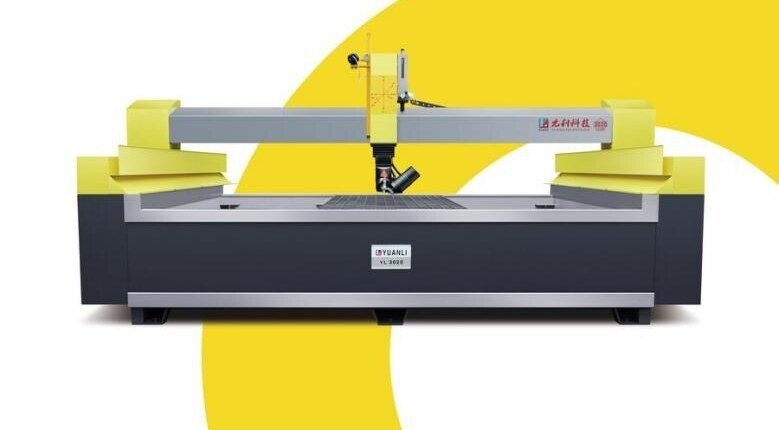
AB 5-axis — the configuration for inlay, mosaic and controlled-angle cutting
This is the part of a waterjet purchase that is discussed least at the point of sale and matters most in year three.
A waterjet has consumables — nozzle, mixing chamber, orifice, abrasive delivery components, high-pressure seals — and it has wear parts on the guideways and the intensifier. Downtime is therefore not a question of whether a part will be needed, but of how long it takes to arrive. When you are evaluating a supplier for a Middle East installation, ask for the consumable list with part numbers and typical replacement intervals, and ask where those parts are held relative to your site.
The second question is calibration and commissioning. A 5-axis machine has to be set up and verified, and the operator has to be trained on the control and on the programming workflow. Ask what commissioning includes, what operator training is provided, and what the remote support arrangement is for the years after installation. Ask what the written response commitment is when a machine stops.
Yuanli supports installations across 40+ countries with service offices, a documented spare-parts and wear-parts programme, and 12 months' machine warranty. Where your workload includes non-standard parts or a platform size outside the standard range, the custom waterjet solutions route is the one to use.
A quote is only as specific as the information behind it. Send these and you will get a configuration recommendation rather than a price range:
The materials you cut, with thicknesses
The largest part or slab the machine has to take — working area, not table size
Whether your work includes bevel, mitre or angled cutting, and whether it includes inlay or mosaic
Your requirement for internal cut-outs without entering from the edge
Production volume — parts per day or per week, and whether the parts repeat
The utility conditions at the machine position: voltage and phase, available water supply and quality, ambient conditions in the building
Your location and the nearest port or city, so service and spares can be planned realistically
If you are still at the stage of choosing between machine types, the 3-axis vs 5-axis comparison is the fastest way to narrow it down. If you already know you are cutting quartz or engineered surfaces, the guide to cutting quartz countertops with a waterjet covers the fabrication workflow in detail.
This 60-second walkthrough follows the machine through a real production sequence — programming, the bridge saw taking the straight cuts, the waterjet head cutting the openings, and vacuum handling moving the finished piece off the table.
The cooling arrangement is the main difference. Machines are offered with water cooling, air cooling or air-conditioning cooling, and the right choice depends on the ambient conditions of the building the machine will run in and on how continuously it will operate. Cabinet cooling and guideway protection should be specified with the same conditions in mind.
Yuanli machines are built for 220 V / 380 V / 415 V at 50 or 60 Hz. Confirm the actual voltage, phase and frequency at the machine position and the available capacity against the machine's connected load, which is considerably higher than the cutting head rating on configurations that include an intensifier, a saw spindle or vacuum handling.
Yes. Abrasive waterjet is a cold cutting process and introduces no heat-affected zone, which is why it is used for stainless architectural metalwork, aluminium façade components and precision parts where thermal distortion is a concern.
AB 5-axis suits inlay, mosaic, medallions and controlled-angle work. AC 5-axis adds the wider head swing used for bevel cutting, mitred joints and complex contours, and it is the configuration to choose when the order book includes architectural edges or precision metal parts.
Ask for the consumable and wear-part list with part numbers and replacement intervals, ask where those parts are held, and ask what commissioning, operator training and remote support are included. Distance changes the value of that answer more than it changes anything else in the specification.
Tell us what you are cutting. Send your material, thicknesses, working area, the utility conditions at the machine position and your location. Our engineers will come back with a configuration recommendation for your process.


