
Views: 0 Author: Site Editor Publish Time: 2026-09-25 Origin: Site


A practical guide for stone fabricators quoting hotel, villa and mosque interiors in 2026.
The Gulf is fitting out restaurants, lobbies, spas and bathrooms at a rate the region has never seen. Turkey is being told by its own government to stop exporting blocks and start exporting finished work. Both of those things land on the same machine: the one that cuts the medallion, the inlay border, the pierced screen and the bespoke vanity top.
This page is about that machine — what the 2026 demand actually consists of, what a marble waterjet cutting machine has to deliver to win the work, and where a waterjet honestly loses to a bridge saw. If you are a fabricator in İzmir, Afyon, Dubai or Abu Dhabi deciding what to buy next, this is written for you.
Three documented numbers explain the demand.
The Gulf hotel pipeline is at a record. Lodging Econometrics reported a Middle East construction pipeline of 724 projects / 178,003 rooms at Q2 2026, up 11% by projects year on year, with 330 projects / 82,353 rooms physically under construction. Luxury reached a record 207 projects / 45,446 rooms and upper-upscale a record 178 projects / 43,896 rooms. (Lodging Econometrics, reported by Hotel-Online, 17 Aug 2026.)
Dubai is in a refurbishment cycle, not just a building cycle. Cavendish Maxwell put Dubai's existing supply at almost 152,140 rooms across 727 hotels at mid-2026, with roughly 3,150 rooms still to be delivered during 2026, and a segment mix where close to 70% of rooms are Upscale, Upper-Upscale or Luxury. H1 2026 occupancy was 56%, down 30% year on year, with ADR at AED 701 (−7%) (Cavendish Maxwell, via Arabian Business, 19 Aug 2026). A soft half-year in a premium-heavy market pushes owners toward differentiation — and in a hotel, differentiation is stone: patterned floors, inlaid feature walls, book-matched vanities. Arabian Business reported in April 2026 that several of Dubai's well-known hotels are closing, refurbishing or rebranding during 2026 — refurbishment is medallion, inlay and cladding work.
Abu Dhabi is now the region's rate-growth market. DCT Abu Dhabi reported a record 26.6 million visitors in 2025, hotel revenue of AED 9.1 billion (USD 2.4 billion), up 19.5%, 5.9 million hotel guests, occupancy up three points to 81%, ADR +19% and RevPAR +23%, plus 6,600 MICE events (+37%). The emirate's Tourism Strategy 2030 targets 39.3 million visitors a year. High occupancy with rising rates is the classic trigger for owners to upgrade finishes.
And Turkey supplies this market — while its own government says it needs more machines. Trade Minister Ömer Bolat, opening Marble İzmir in April 2026, put Turkish natural stone exports at USD 2.1 billion, making Turkey the third-largest natural stone exporter in the world after China and Italy with 11.6% of world exports. Processed stone has reached 65% of the export mix, against a stated target of 80–90% — which he explicitly linked to more technology and more machinery, not more quarries. The same fair — the 31st edition, roughly 1,000 exhibitors from 41 Turkish provinces and 28 countries across more than 150,000 m², with 70,000 visitors expected — is where Turkish fabricators go to buy exactly this kind of capacity.
Read that again, because it is the whole argument for this page: the industry's own trade body and its government are saying that the money has moved from block tonnage to processed, designed, finished stone. Block-to-slab cutting is a saw's job. Designed stone is a waterjet's job.
Inlay is the highest-value, lowest-tonnage work in a stone shop: dark borders set into light marble, floral or calligraphic motifs let into a floor, geometric banding around a bathroom recess. What makes or breaks it is the joint. A waterjet cuts with a kerf in the region of 0.040 in (~1.0 mm), and it is that narrow kerf that makes tight-fitting inlays and intricate curves possible at all.
The customer sees one thing: the line between the two stones. If it reads as a seam, the job is a complaint. If it reads as a drawn line, the job is a reference.
Waterjet-cut medallions routinely carry hundreds of separate pieces to a consistent 1/32 in joint gap, with a well-calibrated machine holding around ±0.005 in (~0.13 mm) on standard stone — tight enough to read as near-invisible under normal light when set with a matching grout or epoxy. The practical threshold is stark: gaps over 1/16 in are immediately visible.
Two rules that decide whether a medallion floor succeeds, and neither is about the machine:
Calibrate thickness, not just shape. Thickness variation between pieces — not cutting accuracy — is the most common cause of visible lippage in a medallion floor. All pieces should be brought to one net thickness before assembly, targeting no more than 1/32 in of lippage between adjacent pieces.
Plan the sequence. Every medallion is a jigsaw that has to be cut, numbered and re-laid. Cut planning is as much part of the specification as the pattern.
This is the application with the least competition in the market and, in our view, the most upside in the Gulf. A stone screen is a plate with hundreds of closed, thin-walled openings and internal corners — and internal corners are where blade cutting fights back. Abrasive waterjet starts from a piercing point and cuts a closed contour, so a pierced panel is not a special case for the machine; it is what the process does naturally.
UAE cutting houses already advertise mashrabiya CNC cutting as a standing service line — the demand exists, and it is currently served mostly by service shops rather than by fabricators who own the capability. That gap is an opportunity.
Hotel bathrooms in a 724-project pipeline are specified in tens of thousands. A vanity top means a basin opening, tap holes, often a mitred drop edge, and sometimes a curved or shaped front — in one slab, with a visible edge, in a room the guest inspects closely. Add the standalone pieces — stone basin blocks, stone furniture — and this is a category that runs continuously rather than in project lumps.
These parts were produced on Yuanli 5-axis waterjet machines for customers in the Middle East. They are the four product families above, in real material.
Project | What it is |
|---|---|
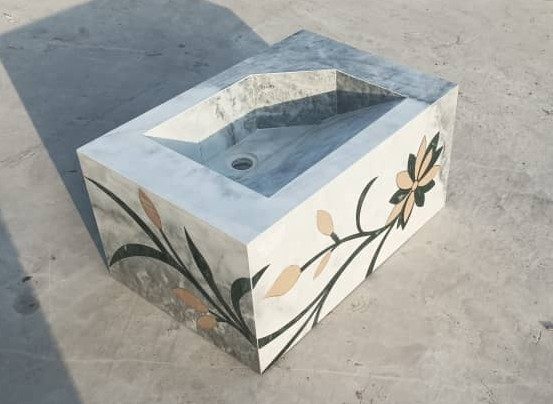 | Inlaid stone basin block — floral motif let into the faces of a carved basin, joints cut to the drawing |
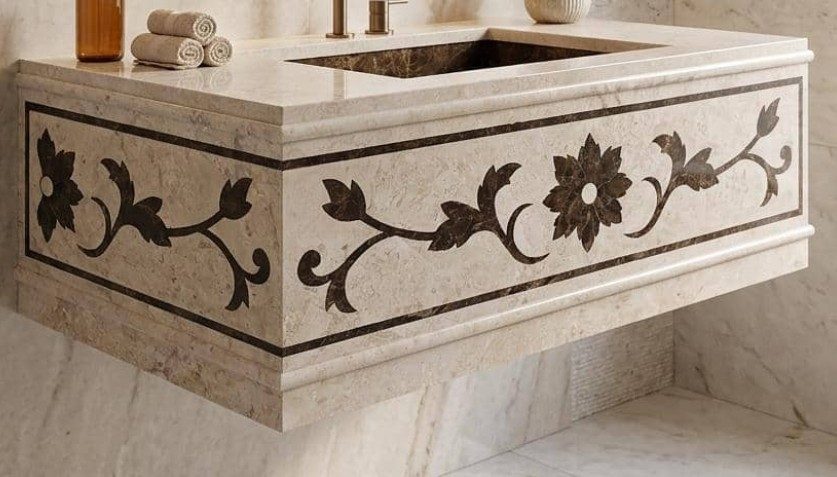 | Wall-hung vanity — inlay border band, integrated basin opening and polished edge in one assembly |
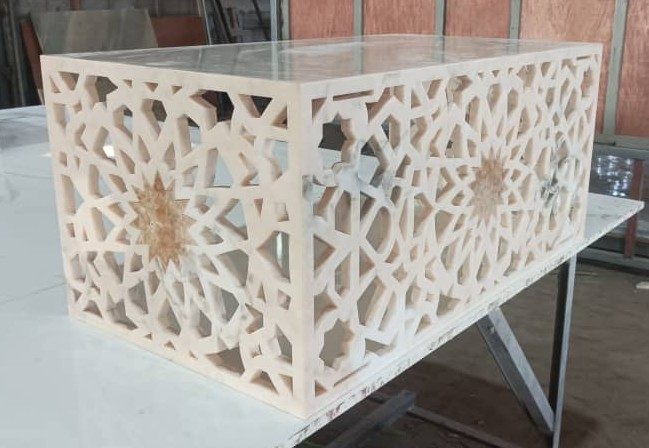 | Pierced limestone panel — a closed, thin-walled geometric lattice cut through the block |
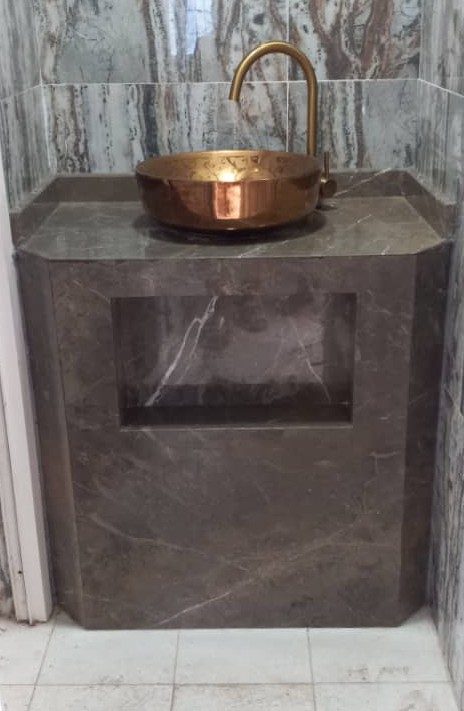 | Dark marble vanity — vessel basin on a shaped top, recess cut into the front face |
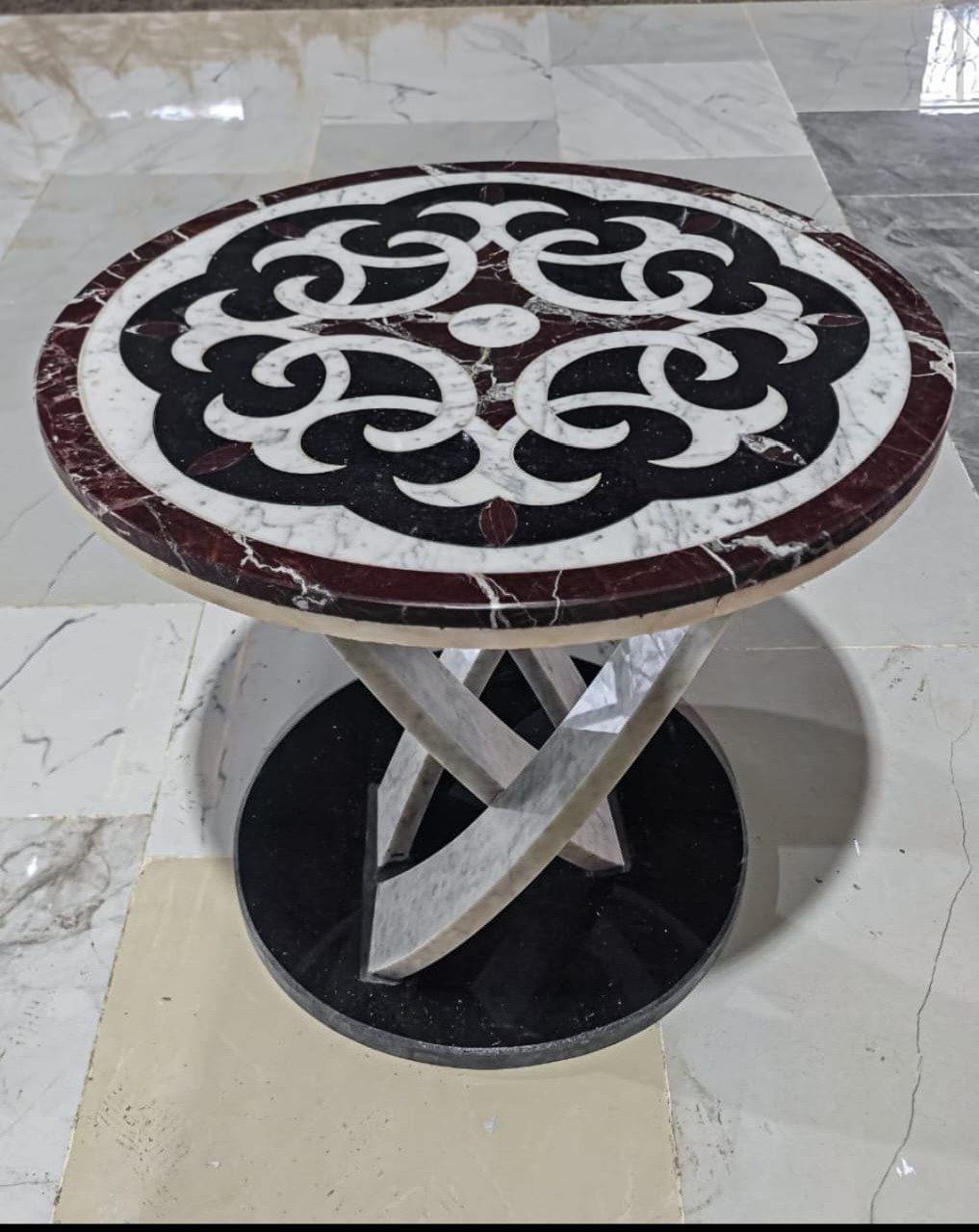 | Medallion work — multi-colour inlay in black, white and red marble, cut as one pattern |
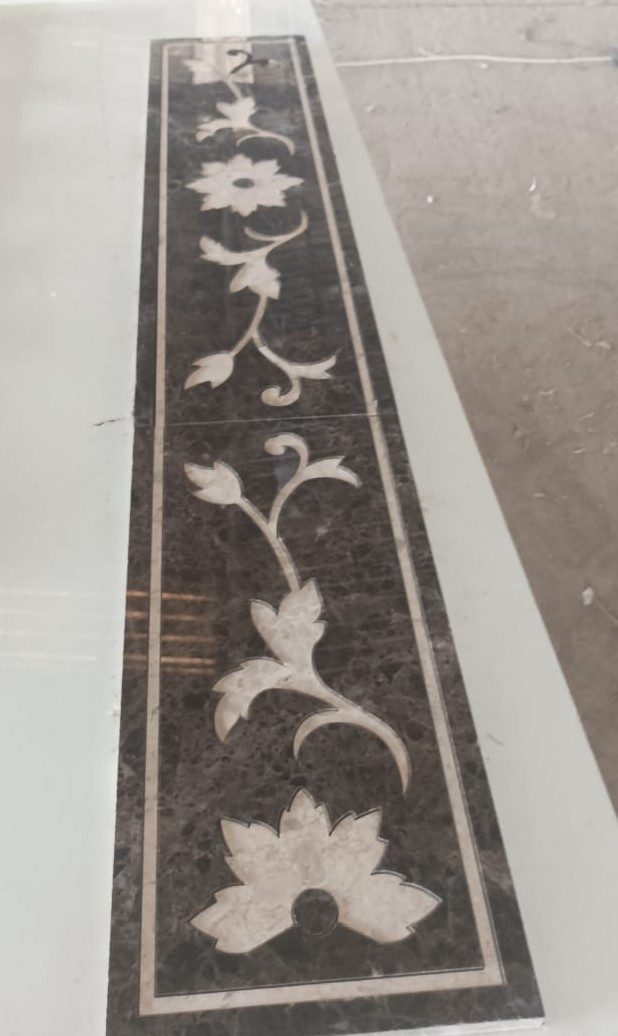 | Border strip in production — floral inlay in a dark marble field, ready for installation |
Send your drawing for a cutting test → contact us
Be sceptical of anyone who tells you one machine does everything. The honest position, which is also the position of the shop-floor literature, is this:
A waterjet wins because of three physical facts, not three features.
It cuts a narrow kerf. With kerf typically 0.8–1.0 mm at 1–10 mm material and widening to 1.0–1.3 mm at 30–80 mm, inlay pieces fit and curved borders become possible. A blade cannot produce that joint.
It applies no heat and no mechanical force. Material is removed hydraulically, so the stone is not stressed by a toothed blade. For brittle porcelain, sintered stone and fragile inlay pieces, that changes yield.
It starts anywhere. Internal openings — basin cut-outs, faucet holes, pierced lattice voids — are pierced and cut as closed contours. No lead-in cut, no drilling step, no blade entry point.
And a bridge saw still wins the bulk work. Waterjet cutting is slow compared with a blade when you are simply breaking down slabs, and it carries real consumable cost — garnet is consumed at roughly 0.3–0.5 kg per minute of cutting, which is why thick waterjet work is normally quoted by the hour rather than the metre. A fabricator who replaces a bridge saw with a waterjet will lose money on cut-to-size volume.
The model that actually works: a saw for breaking down and straight cuts, a waterjet for the geometry the saw cannot make, and a CNC router or polisher for edge finishing. If you already own the saw, the waterjet is an addition that moves you up the value chain — not a replacement.
When you compare machines for this work, do not accept a single tolerance number. Kerf and tolerance are functions of thickness; that is the whole point of fibre in what follows.
Kerf and achievable tolerance by material thickness (independent process reference: CutLinq waterjet process guide)
Material thickness | Typical kerf | Tolerance at quality grade Q3 |
|---|---|---|
1–10 mm | 0.8–1.0 mm | ±0.1 mm |
10–30 mm | 0.9–1.1 mm | ±0.15 mm |
30–80 mm | 1.0–1.3 mm | ±0.25 mm |
80–150 mm | 1.2–1.5 mm | — |
Quality grade is the commercial lever, not the tolerance. Waterjet cutting is specified in grades — Q1, a fast separation cut with visible striations, through to Q5, a finish cut at Ra 3–4 µm — and moving from Q1 to Q5 is roughly a 3× difference in cutting time. That is why two quotes for the same medallion can differ substantially and both be correct: they are quoted at different qualities.
Other limits worth knowing before you promise a design:
Smallest practical inner holes: around 2 mm in thin material, and roughly one times the thickness in plate over 20 mm.
Internal corner radius: 0.5 mm or finer.
Standard table sizes across the industry are 2,000 × 3,000 mm and 3,000 × 4,000 mm — which is why working-area selection matters more than most buyers expect.
Here is the part of the market that is worst explained, so let us be precise.
Taper is physics, not a defect. As the abrasive jet passes through material it loses energy; the bottom of the cut lags the top, so kerf width varies through the thickness and the edge comes out V-shaped, reverse-V or barrel-shaped depending on speed, pressure, material, thickness and nozzle condition. On a plain 3-axis machine, modern heads tilt up to about 5° to compensate that natural taper — enough for near-vertical edges on parts up to roughly 50 mm.
A 5-axis head adds two rotary motions, which buys you three things that matter specifically for decorative stone:
Dynamic taper compensation along the whole path, not a fixed 5°.
Programmed bevels — mitred edges, chamfers, angled faces, weld-prep bevels on metal.
Control of the bottom edge in thicker parts.
What it does not fix. A 5-axis head does not guarantee a tolerance on its own. Accuracy still depends on machine calibration, rotary-axis behaviour, the cutting model, material consistency, nozzle condition, stand-off distance and the quality grade you chose. And it does not fix the commercial problem — speed and consumables are the same as any other waterjet.
Two specification traps, both real:
Envelope. Because the nozzle swings sideways as it tilts, bevel cutting changes the effective working envelope. Clamps, slats, material edges and the bridge all have to be checked for collision before you buy — not after.
Naming. "AB 5-axis" and "AC 5-axis" are not identical across suppliers. Compare usable tilt, rotation range, tool-tip working envelope, rotary positioning and repeatability, maximum contour speed and the software that drives it. Yuanli publishes 0–15° articulation for the AB platform and 0–65° head swing for the AC platform, and you should hold any supplier to the same kind of published figures.
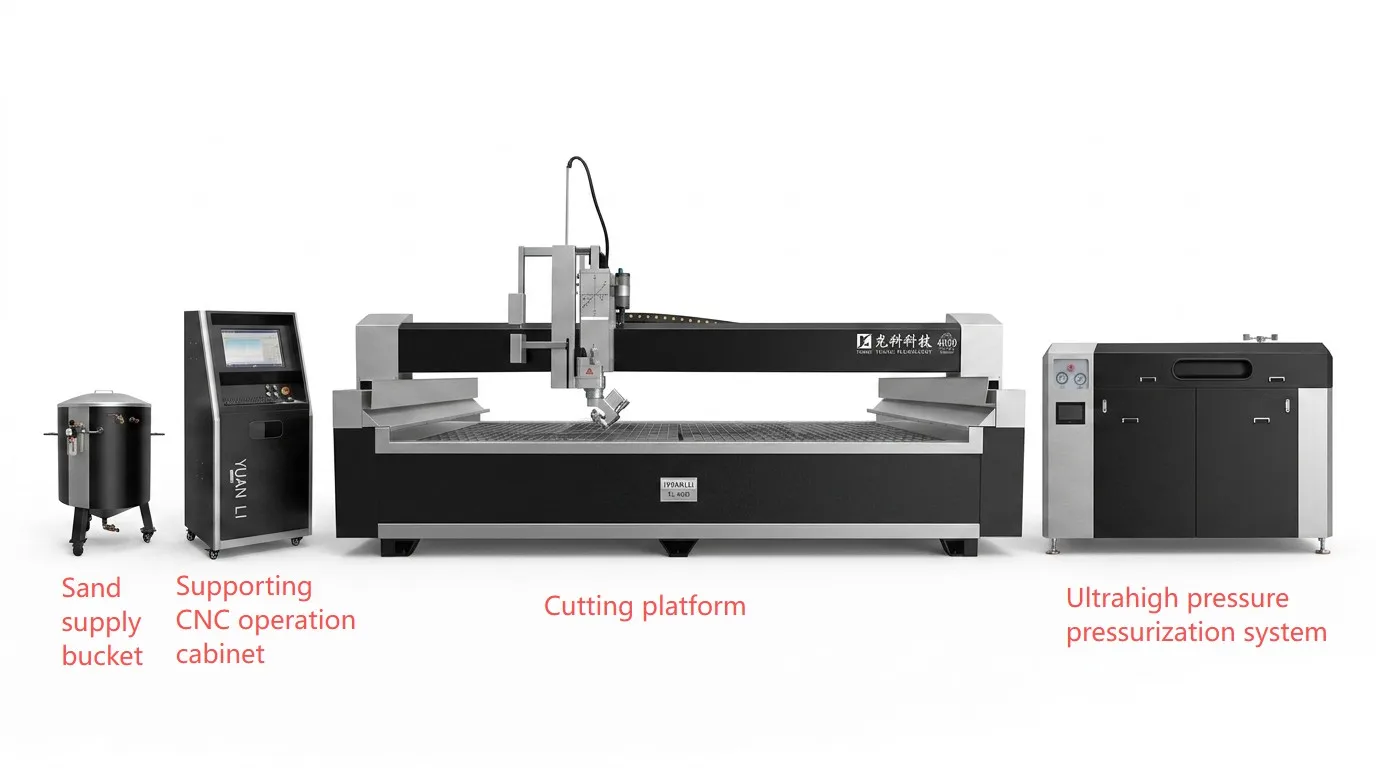
The four subsystems of a 5-axis waterjet installation: sand supply bucket, supporting CNC operation cabinet, cutting platform, ultra-high-pressure pressurization system.
Yuanli builds CNC ultra-high-pressure waterjet cutting machines and nothing else. For decorative stone work the relevant published platform figures are:
Cutting-head swing: 0–65° on the AC 5-axis platform — the full 0–65° range is cuttable; 45° is the typical angle for stone work and up to 75° is occasionally achievable (AB platform: 0–15° articulation)
±0.1 mm cutting accuracy, ±0.01 mm repeatability, ±0.025 mm positioning accuracy — AC platform / YL3020 published figures
Working areas from 2000 × 1500 mm to 4000 × 2000 mm across the model range, with a compact cantilever option
Single, dual or up to four cutting heads on one gantry, depending on model and configuration
450 MPa working pressure on standard models; 600 MPa is available as a customised option with a KMT pump
220 V / 380 V / 415 V, 50/60 Hz, CE certified
Waterjet + milling composite platform available where drilling and edge processing belong in the same setup
Machine selection depends on your part, not on the axis count. Our published 3-axis vs AB 5-axis vs AC 5-axis comparison sets out which configuration addresses which requirement — including where a plain 3-axis machine is the correct and cheaper answer.
Turkey — the processing upgrade. The state's own target is to raise processed stone from 65% toward 80–90% of exports, and the incentive framework and the fair circuit (Marble İzmir, Afyonkarahisar) are built around that. Turkish fabricators already export to Europe and the Gulf; the bottleneck is design-led capacity, not material. Practical note for Turkish buyers: the machine's documentation language and the software's Turkish-language support matter as much as the iron. Our own Turkish-language pages are being developed, and we will state plainly here that they are not live yet — competitors in this market already publish in Turkish.
Dubai — the refurbishment window. With ~3,150 rooms still delivering in 2026 and a premium-heavy roster of hotels going through refit and rebranding, the short-term work is replacement and upgrade: reception floors, feature walls, bathroom vanity programmes. Stone traders and showrooms are concentrated in Al Quoz and Ras Al Khor, so a fabricator quoting from those areas is often competing on turnaround as much as price. That favours owning the decorative capacity rather than subcontracting it.
Abu Dhabi — the specification standard. The emirate's cultural and hospitality build-out — including landmark work such as the Sheikh Zayed Grand Mosque with its 82 Moroccan-designed white marble domes — has set a local expectation of patterned, inlaid, precisely joined stone. With RevPAR up 23% and Strategy 2030 targeting 39.3 million visitors, the buyers specifying stone here are conscious of precedent. In practice that means joint tolerance is a specification item, and a supplier who cannot show a sample at 1/32 in will not win the package.
Send these seven items and you will get a configuration instead of a brochure:
The drawing — DXF, DWG, STEP or a dimensioned PDF
Material and thickness (and whether thickness is calibrated)
Maximum part or panel size
The joint or angle detail you must achieve — 1/32 in joints, a mitre, a bevel, a pierced panel
Typical product mix — inlay, medallion, panel, vanity, signed-off mix
Monthly volume and number of heads you expect to run
Country, so voltage, documentation and service route can be confirmed
If the part is marginal, we will say so — and tell you which configuration is actually required rather than quoting the largest machine.
Send your drawing for a cutting test → contact us or WhatsApp +86 185 2097 1183
What is a marble waterjet cutting machine used for?
Cutting stone to a drawing where the joint, the angle or the opening is part of the specification: stone inlay and borders, medallions and patterned floors, pierced panels and stone screens, vanity tops, basin and faucet openings, mitred edges and architectural panels. It is not a replacement for a bridge saw on bulk slab breakdown.
Can a waterjet cut a medallion with invisible joints?
It can cut the pieces to that standard. Waterjet-cut medallions routinely carry hundreds of pieces at a consistent 1/32 in joint gap, with a calibrated machine holding around ±0.005 in on standard stone; gaps over 1/16 in are immediately visible. Geometry is only half the job — the pieces must also be calibrated to one thickness or the floor will show lippage.
Why does the kerf width matter?
Because kerf is the joint. Abrasive waterjet kerf runs about 0.8–1.0 mm in thin material and widens with thickness to 1.2–1.5 mm at 80–150 mm. A narrow kerf is what makes tight-fitting inlay and fine curved borders possible.
Do I need a 5-axis waterjet for inlay work?
Not always. Flat inlay and mosaic work is normally a 3-axis job, and on a 3-axis machine a head tilting up to about 5° handles ordinary taper compensation. Five axes earn their cost on pierced and bevelled work, on panels where the angle changes along the path, and on removing secondary finishing operations.
Can a waterjet cut Islamic geometric patterns and mashrabiya-style stone screens?
Yes — a pierced screen is a series of closed contours with internal corners, which is what abrasive waterjet does naturally. It is one of the few stone applications where the waterjet faces almost no competing process, and UAE service providers already advertise mashrabiya CNC cutting as a standing service.
What is the difference between AB and AC 5-axis?
Head articulation. Yuanli publishes 0–15° for the AB platform, used for taper compensation, inlay, mosaic and controlled-angle detail, and 0–65° for the AC platform, used for bevels, mitres, advanced angle work, complex contours and precision metal parts. The full 0–65° range is achievable; 45° is the typical stone application and up to 75° is occasionally possible. Compare published figures rather than the label: the AB/AC naming is not consistent between suppliers.
Will a waterjet cut porcelain and sintered stone slabs?
Yes. Large-format porcelain and ultra-compact sintered stone are dense and brittle, which makes them a poor fit for blade cutting at thin gauges and a good fit for abrasive waterjet. Thin slabs may need a supporting substrate, and the slab's body colour affects how clean a mitred edge looks.
What does a waterjet cost to run?
Budget on abrasive, not electricity. Garnet is consumed at roughly 0.3–0.5 kg per minute of cutting and is about a third of running cost, which is why thick or intricate work is quoted by the hour. Quality grade is the other lever: moving from a Q1 separation cut to a Q5 finish cut is roughly a 3× difference in cutting time for the same part.
How much does a marble waterjet cutting machine cost?
Price depends on working area, axis configuration, head count, pump specification, vision and automation, so there is no meaningful list price. Send your drawing, material, thickness and volume and you will get a configuration and a quotation for the machine that fits the work.
What information do I need before requesting a quotation?
Drawing, material and thickness, maximum part size, the joint or angle requirement, typical product mix, monthly volume and country — plus whether you already own a bridge saw, since that decides whether the waterjet is your primary or secondary cutting platform.
Lodging Econometrics — Middle East hotel construction pipeline at an all-time high (724 projects / 178,003 rooms, Q2 2026), via Hotel-Online, 17 Aug 2026: https://www.hotel-online.com/news/middle-east-hotel-construction-pipeline-reaches-new-all-time-high
Cavendish Maxwell — Dubai hotel market H1 2026 (152,140 rooms / 727 hotels; ADR AED 701), via Arabian Business, 19 Aug 2026: https://www.arabianbusiness.com/business/tourism-hospitality/dubai-hotel-market-h1-2026
Arabian Business — Dubai hotels closing, upgrading or reopening in 2026, 20 Apr 2026: https://www.arabianbusiness.com/business/tourism-hospitality/dubai-hotels-which-luxury-properties-are-closing-upgrading-or-reopening-in-2026
DCT Abu Dhabi — 2025 tourism and hotel performance (26.6 m visitors; AED 9.1 bn; RevPAR +23%), via Gulf Daily News / TradeArabia, 6 Apr 2026: https://www.gdnonline.com/Details/1380604
DCT Abu Dhabi — Tourism Strategy 2030 target of 39.3 m visitors, via Zawya, 7 May 2025: https://www.zawya.com/en/business/travel-tourism/dct-abu-dhabi-forges-key-global-partnerships-to-drive-tourism-growth-798816
Turkish Ministry of Culture and Tourism — 2025 tourism receipts USD 65.231 bn and 63.941 m visitors, via Turizm Gazetesi, 30 Jan 2026: https://www.turizmgazetesi.com/haber/bakan-ersoy-acikladi-2025-te-gelir-65-2-milyar-dolara-ziyaretci-sayisi-64-milyona-ulasti/91368
Trade Minister Ömer Bolat — Turkish natural stone exports USD 2.1 bn, 11.6% of world exports, processed share 65% vs an 80–90% target, via Manşet İzmir, 14 Apr 2026: https://www.mansetizmir.com/bakan-bolat-biz-hicbir-arz-krizi-yasamadik/110046/
İzmir Gündem — Marble İzmir 31st edition figures and design programme, 14 Apr 2026: https://izmirgundem.com/marble-izmir-31-kez-kapilarini-acti-fuar-izmir-de-dev-bulusma
Visit Abu Dhabi — Sheikh Zayed Grand Mosque, 82 Moroccan-designed white marble domes: https://visitabudhabi.ae/en/plan-your-trip/article-hub/13-must-see-architecture
CutLinq — abrasive waterjet process guide: kerf by thickness, tolerance grades Q1–Q5, garnet consumption, minimum features: https://cutlinq.com/en/processes/waterjet-cutting
Dynamic Stone Tools — Stone floor medallions: design, fabrication and installation guide (1/32 in joints, ±0.005 in, thickness calibration): https://dynamicstonetools.com/blogs/news/stone-floor-medallions-design-fabrication-installation-guide
YH Waterjet — 3-axis vs 5-axis waterjet cutting: taper physics, the 5° head, 5-axis specification traps (manufacturer-authored): https://www.yhwaterjetmachine.com/news/3-axis-vs-5-axis-waterjet-cutting-taper-compensation.html
MOSCUT — comparing waterjet, CNC and laser cutting for natural stone (rival manufacturer's counter-argument, cited as such): https://moscut.com/comparing-waterjet-cnc-and-laser-cutting-for-natural-stone/
Advances in Mechanical Engineering (SAGE) — assessment of cylindricity and roughness tolerances of holes drilled in Calacatta-Carrara white marble on a 5-axis CNC working centre: https://journals.sagepub.com/doi/10.1177/16878140211040647
United CNC Cutting (UAE) — mashrabiya CNC cutting advertised as a service line: https://unitedcnccutting.com/cnc-cutting-services-uae
Image credits. Project and machine photography © Foshan Yuanli Precision Machinery Co., Ltd. (customer projects in the Middle East, produced on Yuanli 5-axis waterjet machines; supplied by the client).


