
Views: 0 Author: Site Editor Publish Time: 2026-08-14 Origin: Site


Modern kitchen design trends have drastically shifted over the past few years. Homeowners now frequently demand complex sink profiles, intricate mitered edges, and ultra-compact surfaces like porcelain and sintered stone. These evolving design standards have rapidly pushed traditional bridge saws to their absolute limits. Fabricators can no longer rely solely on basic blades to deliver flawless results.
Incorporating waterjet cutting technology provides exact precision without causing thermal distortion or frustrating edge chipping. It utilizes a supersonic stream of water and abrasive to slice through the hardest materials. However, this equipment represents a substantial capital investment alongside significant ongoing consumable expenses.
This guide provides stone fabricators an objective, vendor-agnostic framework to evaluate equipment options. You will learn how to align machine specifications with shop floor realities to ensure optimal productivity. We will help you navigate hardware choices, software requirements, and installation logistics to secure a highly profitable operational strategy.
5-Axis is the Industry Standard: For modern kitchen countertops, a 5-axis cutting head is essential to handle 45-degree miter cuts for waterfall edges.
Hybrids Drive Throughput: High-volume shops often benefit more from SawJet hybrids (bridge saw + waterjet) than pure waterjet machines.
TCO Exceeds Initial CapEx: Operating costs (abrasive garnet, water, power, and pump maintenance) heavily influence long-term ROI.
Software Parity: Machine hardware must be paired with robust photo-nesting CAD/CAM software to minimize slab waste.
Many fabrication shops eventually hit a severe production plateau. Manual sink cutouts slow down production timelines significantly. Radius cuts and delicate faucet hole drilling consume valuable man-hours. Traditional methods simply cannot keep pace with high-volume demands. When skilled workers spend hours grinding inside corners, your overall daily output plummets. Recognizing these specific bottlenecks is the first step toward upgrading your machinery.
Customers frequently request quartzite, Dekton, and porcelain for their remodeling projects. These engineered materials are highly susceptible to cracking under standard blade pressure. A traditional saw generates immense friction and heat. This thermal stress causes expensive slab blowouts and brittle fractures. You need a completely frictionless, cold-cutting method to handle these modern surfaces safely.
You must define clear goals before purchasing advanced equipment. A successful deployment should significantly reduce manual fabrication time across the board. It must eliminate material breakage during intricate cuts entirely. Finally, it should optimize your overall slab yield. By tightly nesting parts together, you squeeze more billable square footage out of every raw slab. You should track these metrics closely post-installation.
Pure systems rely entirely on the high-pressure abrasive stream to cut materials. They offer ultimate precision for demanding projects. You can execute highly intricate inlays effortlessly. They provide completely stress-free cold cutting, which is ideal for delicate materials. However, they deliver slower straight-line speeds compared to spinning diamond blades. They suit shops specializing in highly custom architectural work. They also benefit facilities processing mostly fragile sintered materials.
Hybrid systems combine a traditional bridge saw and a waterjet nozzle on the same gantry. You use the blade for incredibly fast, straight cuts. You then rely on the waterjet for tight inside corners and complex sink cutouts. This hybrid approach maximizes shop throughput. Conversely, they demand a higher initial cost and a much larger floor footprint. They also require complex maintenance routines due to dual cutting technologies. Mid-to-high volume countertop production shops aiming for maximum daily slab output benefit most from this setup.
Evaluation Metric | Pure Waterjet Systems | SawJet Hybrids |
|---|---|---|
Straight-Line Speed | Moderate | Very Fast (using blade) |
Intricate Inlays | Excellent | Good |
Initial Investment | High | Very High |
Footprint Requirements | Standard | Large |
Ideal Material Focus | Fragile/Sintered Stones | Mixed Natural & Engineered Stones |
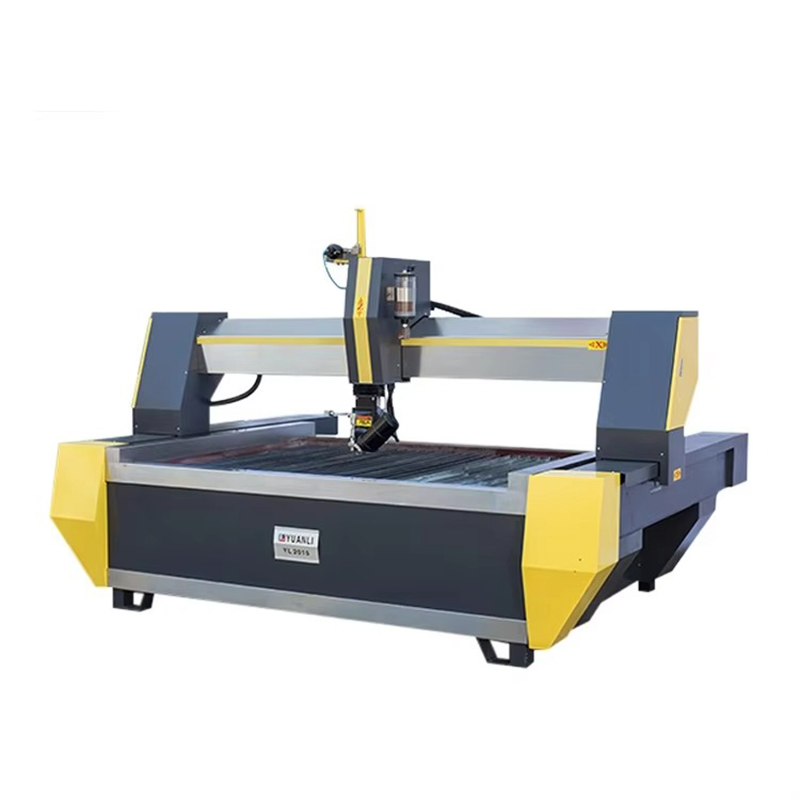
When selecting a Waterjet Machine for Kitchen Countertops, you must look beyond basic marketing brochures. Evaluating specific hardware dimensions determines how well the machine performs under daily shop stress.
Standard 3-axis heads only move along the X, Y, and Z planes. They are largely insufficient for modern countertop fabrication. As a high-pressure stream cuts through thick stone, it naturally loses energy. This energy loss creates a slight V-shaped taper on the cut edge. A 5-axis head tilts dynamically to compensate for this taper. It pushes the angled cut onto the scrap side of the material, leaving perfectly square edges on your final piece. Furthermore, a 5-axis head enables precise 45-degree mitered edges. These miter cuts are absolutely necessary for constructing seamless waterfall kitchen islands.
Pumps act as the beating heart of your equipment. Intensifier pumps operate using hydraulic cylinders. They generally cycle slower, which extends the life of high-pressure seals. Direct drive pumps utilize a crankshaft mechanism. They typically provide superior energy efficiency but may require more frequent seal maintenance. You must also evaluate pressure ratings carefully. A 60,000+ PSI pump cuts faster than a standard 50,000 PSI unit. Higher pressure means you consume less abrasive garnet per inch cut. However, this extreme pressure accelerates wear on internal pump components.
Countertop slabs are growing steadily larger. Manufacturers continually push size limits to offer seamless installations. Ensure your cutting bed easily accommodates jumbo slabs. A minimum table size of 3200mm by 2000mm is crucial for modern shops. Also, inspect the holding tank construction. Stainless steel tanks resist corrosion in wet, highly abrasive environments much better than mild steel. A deteriorating tank will quickly compromise the structural integrity of your cutting bed.
Robust hardware alone cannot guarantee shop success. Seamless integration with digital templating tools is vital. Your laser templates must flow effortlessly into the machine controller. Your CAD/CAM software requires robust slab photo-nesting capabilities. Operators photograph the slab and overlay digital templates directly onto the image. This feature lets you map precise cuts around natural stone veins or prominent defects. It drastically reduces material waste and elevates the final aesthetic of the kitchen.
Operating these machines requires massive amounts of abrasive garnet. You must plan the logistics of garnet storage meticulously. Buying in bulk saves money but requires forklift access and heavy-duty racking. Efficient automated delivery systems keep the machine running without manual refilling interruptions. Additionally, you must invest in automated abrasive removal systems. Digging out heavy, wet garnet sludge by hand is a terrible use of labor. An automated dredge pulls sludge out continuously, keeping your tank clean and your staff focused on fabrication.
Model your monthly operating expenses carefully before committing to a purchase. You will regularly replace several key wear items. Abrasive garnet constitutes your largest ongoing expense. Focusing tubes and mixing chambers degrade naturally and require routine swapping. Water and electricity usage also add up quickly. Accurate projection of these consumables ensures your pricing models remain profitable.
Industrial machinery demands robust facility infrastructure. Check your concrete floor loading capacity. A full water tank combined with stone slabs weighs several tons. Assess your local water quality thoroughly. Hard water destroys high-pressure seals rapidly. You might need to install reverse osmosis (RO) systems or industrial chillers to extend pump life. Ensure you meet all local environmental compliance standards for wastewater disposal and recycling.
Traditional saw operators cannot immediately run advanced CNC equipment. Transitioning your staff requires specific, targeted training investments. They must shift from physical, manual manipulation to technical machine operation. Operators need to learn software programming, precise machine calibration, and basic troubleshooting protocols. Investing in your team guarantees you maximize the potential of your new equipment.
Verify Local Support: Machine downtime is catastrophic for a busy fabrication shop. Always assess local technician availability before signing a contract.
Demand Parts Guarantees: Ask vendors about their domestic parts inventory. Demand overnight parts delivery guarantees to minimize unexpected work stoppages.
Check References: Call existing customers in your region. Ask them how the vendor handles emergency service calls.
Never buy industrial equipment based solely on theoretical specifications. Require vendors to run physical test cuts for your team. Provide them your hardest, thickest, or most fragile materials. Watch closely how the machine handles specific quartzite or difficult porcelain brands. Measure the edge quality, check for chipping, and verify the actual cutting speed. A live demonstration exposes the reality behind marketing promises.
Read the fine print of every warranty document carefully. Differentiate clearly between full-system warranties and pump-specific coverage. Manufacturers rarely cover high-pressure wear parts like seals, orifices, or focusing tubes. Ask specific questions about what is actually protected under the agreement. Understanding your exact liabilities prevents painful financial surprises during your first year of operation.
Integrating advanced cutting technology transforms your fabrication capabilities, but it demands rigorous financial and operational preparation.
Prioritize 5-axis capabilities to handle modern kitchen designs, such as mitered waterfall edges, effortlessly.
Secure robust local support and reliable parts availability to minimize unexpected downtime.
Build your long-term financial planning model around realistic maintenance schedules and consumable usage rather than theoretical cutting speeds.
Next Step: Audit your current production bottlenecks today. Reach out to top vendors and mandate material test cuts using your most difficult stone samples.
A: Yes, it can process these fragile materials cleanly. Operators utilize a low-pressure piercing technique to penetrate the material initially. This prevents surface delamination and cracking. Once pierced, the machine automatically switches to high-pressure abrasive cutting to finish the profile smoothly and efficiently.
A: Abrasive consumption varies based on several operational factors. Most machines use between 0.5 to 1.5 pounds of garnet per minute. This depends heavily on your pump pressure, material thickness, and orifice size. You should calculate this consumption rate carefully to estimate your ongoing operating expenses accurately.
A: Maintenance schedules depend on your pump type and daily operating pressure. You generally need to replace high-pressure seals every 500 to 1000 hours of operation. Additionally, operators must perform routine visual checks on the orifice and focusing tubes weekly to ensure optimal cutting performance.
A: We highly recommend installing a closed-loop water recycling system. Many municipalities enforce strict water usage restrictions. A recycling system significantly reduces the long-term cost of fresh water. Furthermore, it dramatically extends pump life by ensuring ideal water quality and temperature throughout the cutting process.


