
Views: 0 Author: Site Editor Publish Time: 2026-07-01 Origin: Site


Waterjet cutting stands out as more than just a standard machining process. It represents a strategic capability for eliminating heat distortion and expanding your material versatility. Manufacturers face a critical choice when evaluating modern production methods. You might be considering bringing this capability in-house or partnering with a specialized service provider. Either way, investing in a Waterjet Cutting Machine requires evaluating complex trade-offs. You must carefully balance cut quality, daily operating realities, and production cycle times. Our goal is to provide a manufacturer-grade framework for evaluating waterjet technology. We will strip away marketing hype to focus on pure implementation realities. You will learn exactly how the process works. We will also explore what materials it handles best and how it truly compares to alternative machining methods. Understanding these dynamics helps you make smarter manufacturing decisions. It ensures you select the right tool for your specific application requirements.
Zero Heat-Affected Zone (HAZ): Waterjet is a cold-cutting process, preserving material metallurgy and preventing warping.
Unmatched Versatility: A single machine can cut 10-inch titanium, fragile glass, or soft rubber simply by adjusting parameters and abrasives.
High OpEx Reality: While highly versatile, waterjets typically have slower cutting speeds and higher consumable costs (abrasive garnet, pump maintenance) compared to thin-sheet fiber lasers.
Reduced Secondary Processing: Superior edge quality often eliminates the need for post-cut grinding or finishing, balancing out slower raw cutting speeds.
Understanding the underlying mechanics reveals why this technology excels in certain applications. The process relies on extreme fluid dynamics. An intensifier pump pressurizes ordinary tap water to incredible levels, often reaching between 60,000 and 90,000 PSI. This pressurized water travels through specialized plumbing to the cutting head. It then forces its way through a tiny jeweled orifice, usually made of sapphire, ruby, or diamond. This restriction accelerates the water into a supersonic stream reaching speeds up to Mach 3.
Modern equipment operates in two distinct modes depending on the target material. You must choose the right mode to optimize efficiency.
Pure Waterjet: This method uses only the high-pressure water stream. Operators use it for soft, pliable materials like acoustic foam, rubber gaskets, and food products. It introduces no abrasive grit, which significantly lowers your operating costs and reduces component wear.
Abrasive Waterjet: This method injects crushed garnet grit into the water stream inside a mixing chamber. You absolutely need this setup for hard materials like metals, stone, and advanced composites. The garnet acts as millions of microscopic cutting teeth. It drives the bulk of your consumable expenses but unlocks massive cutting power.
You must evaluate three main components when assessing a machine. The intensifier or direct-drive pump serves as the heart of the system. It dictates your overall energy efficiency and maximum cutting pressure. The cutting head acts as the delivery mechanism. Its design determines your kerf width and influences edge taper. Finally, the motion control system controls the physical movement of the head. High-quality linear encoders and robust servos dictate the final dimensional precision of your cut parts.
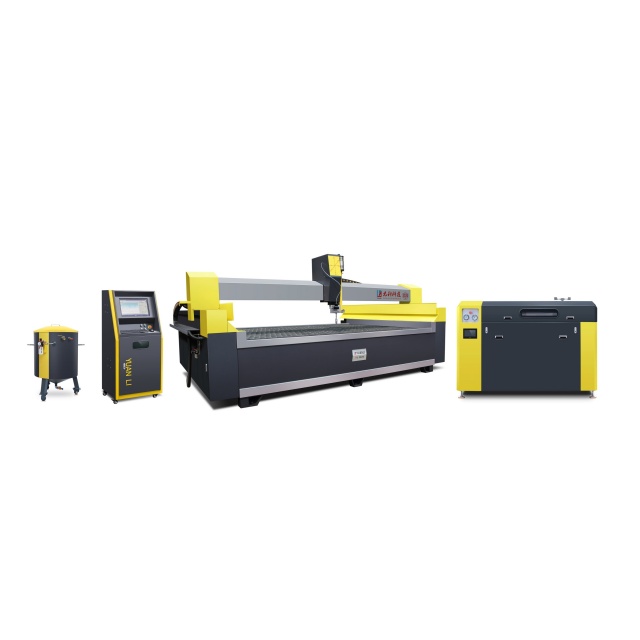
Manufacturers do not choose this technology strictly for raw speed. They choose it to solve specific engineering challenges. It offers unique advantages you cannot achieve through traditional thermal cutting.
The defining advantage is the complete elimination of the Heat-Affected Zone (HAZ). Lasers and plasma torches melt or vaporize material. This localized heating alters the grain structure of the metal. It often leaves hardened edges or causes thin parts to warp. Waterjet cutting remains a fundamentally cold process. The water instantly cools the cutting zone. This preserves the original metallurgy and saves you significant money. You avoid expensive secondary heat treatments or tedious edge grinding. This characteristic makes it highly critical for aerospace and medical device manufacturing.
Raw material costs constantly eat into profit margins. A Waterjet Cutting Machine helps you maximize material utilization. The abrasive stream creates a very narrow kerf, typically measuring between 0.030 and 0.040 inches. Because the cutting head moves omnidirectionally without rotational constraints, software can nest parts incredibly close together. You can utilize shared cut lines. This tight nesting significantly reduces scrap rates on expensive alloys like Inconel and titanium.
Lasers struggle as material thickness increases. Fiber lasers lose efficiency rapidly past one inch of steel. Waterjets handle extreme thicknesses with ease. You can comfortably cut materials up to 10 or 12 inches thick. The stream maintains its cutting energy deep into the material. This capability allows you to cut heavy structural steel, thick aluminum blocks, or massive stone slabs that lasers simply cannot penetrate.
Traditional CNC milling requires constant tool changes. Different materials demand different end mills, speeds, and feeds. Waterjet technology eliminates this hassle. You use the exact same cutting head to process aluminum, tool steel, or composite panels. You only need to adjust the software parameters for pump pressure and feed rate. This seamless transition drastically reduces setup times between varying production runs.
The versatility of this process is legendary, but it still follows the laws of physics. Understanding optimal applications and strict limitations prevents costly mistakes.
The following table outlines the most common materials processed and why the technology suits them.
Material Category | Common Examples | Why It Works Well |
|---|---|---|
Metals | Titanium, Inconel, Tool Steel, Copper, Brass | Easily cuts highly reflective materials that bounce laser beams. Leaves no heat damage or hardened edges on exotic alloys. |
Composites | Carbon Fiber, Kevlar, Fiberglass | Cuts cleanly without melting the sensitive resin matrix or fraying the woven structural fibers. |
Brittle/Delicate | Standard Glass, Stone, Ceramics | Software utilizes low-pressure piercing routines to safely penetrate brittle surfaces without cracking them. |
Despite its broad capabilities, you must watch out for specific material failures. Certain applications require entirely different technologies.
Tempered Glass: You cannot cut tempered glass. The tempering process locks immense internal stress inside the pane. The moment the high-pressure stream breaches the surface, the glass will instantly shatter into thousands of pieces.
Certain Laminates: Layered materials pose a unique risk. If you do not pierce them correctly, the high-pressure water forces its way between the layers. This causes severe delamination. You must use specific low-pressure piercing techniques or pre-drill start holes.
Extreme Precision Micro-Machining: Do not expect microscopic tolerances. While modern machines offer excellent precision, they cannot match Wire EDM. If your print requires tolerances tighter than ±0.001 inches, you must look beyond water-based technology.
Shop owners constantly debate which profiling technology provides the best value. The truth depends entirely on your application variables. No single machine dominates every category.
Fiber lasers operate at blinding speeds on thin sheet metal. They boast a very low cost per part when processing materials under a quarter-inch thick. However, lasers struggle with thick plates and highly reflective materials like copper or brass. Waterjet wins decisively when you process thick materials, reflective metals, or heat-sensitive composites. It trades raw speed for unmatched versatility and superior edge quality.
Plasma cutting serves a very specific industrial purpose. It remains the undisputed leader for cheap, fast, rough-cutting of thick carbon steel. If you are cutting heavy base plates where edge quality does not matter, plasma wins. The plasma torch leaves a heavy heat-affected zone, dross, and an angled edge. You choose waterjet when edge finish, tight tolerances, and net-shape parts are strictly required right off the table.
Use this simple comparative chart to guide your technology selection based on typical shop scenarios.
Application Scenario | Material & Thickness | Required Tolerance | Optimal Technology |
|---|---|---|---|
High-volume HVAC parts | Thin Galvanized Steel (0.05") | Moderate (±0.010") | Fiber Laser |
Heavy machinery bases | Thick Carbon Steel (2.00") | Loose (±0.060") | Plasma |
Aerospace turbine brackets | Inconel or Titanium (1.50") | Tight (±0.005") | Waterjet |
Architectural signage | Thick Copper/Brass (0.50") | Tight (±0.005") | Waterjet |
Evaluating this technology requires looking past the sales brochures. You must understand the daily implementation realities. Operating these systems introduces specific logistical and maintenance challenges.
Abrasive cutting consumes massive amounts of garnet. A standard pump pushes roughly 1 to 2 pounds of garnet per minute. This translates to thousands of pounds of abrasive every week. You must manage the logistics of buying, storing, and loading heavy bags or bulk pallets. This constant consumption directly impacts your hourly operating budget.
Running water at 90,000 PSI creates intense physical wear. You will experience planned and unplanned downtime. High-pressure pump seals require routine replacement. Diamond or ruby orifices eventually crack or wear out of round. The carbide mixing tubes degrade continuously from the inside out. You must stock spare parts and train your staff to rebuild these critical components quickly.
Installation requires significant facility planning. You must figure out how to handle the abrasive sludge. Once the garnet cuts the material, it falls into the catch tank as a heavy, wet mud. You need a mechanical sludge removal system or vacuum truck services to dispose of it. Furthermore, the equipment requires dedicated water softeners, industrial chillers to prevent pump overheating, and acoustic enclosures to mitigate the high-decibel cutting noise.
The water stream naturally loses energy as it penetrates deep into the material. This creates edge taper. The bottom of the cut is slightly narrower than the top. Faster cut speeds increase this V-shaped taper and leave visible diagonal striations on the cut edge. Achieving perfectly smooth, "machine-quality" edges requires significantly slowing down the machine. This trade-off between edge finish and cycle time directly affects your production planning.
Once you understand the capabilities and realities, you face a critical business decision. Should you bring the technology in-house or utilize a contract manufacturer?
Purchasing equipment makes sense for high-mix, low-volume production environments. It provides incredible agility for shops processing diverse materials daily. You should buy if your core business involves heavy processing of heat-sensitive aerospace alloys or specialized composites. Furthermore, successful ownership requires having the capital to maintain a dedicated, proactive maintenance staff. The machines demand consistent mechanical attention to stay profitable.
Outsourcing often serves as the smartest initial step. Rely on contract manufacturers if you primarily run prototypes or intermittent batches. Outsourcing also makes sense for thin-sheet volume runs that are better suited for mixed-technology shops utilizing both lasers and waterjets. Finally, if your facility lacks the required square footage for water treatment systems, chillers, and sludge management hoppers, outsourcing bypasses these heavy infrastructure requirements.
Do not rely on generic speed charts. Before making a capital equipment purchase, always require vendors to perform test cuts on your specific material grades and thicknesses. Measure the taper and inspect the edge finish yourself. Most importantly, demand a detailed breakdown of expected maintenance schedules and consumable usage per 1,000 hours of operation. This transparency prevents unpleasant surprises after installation.
Embrace the Versatility: The technology remains an unparalleled tool for varied, multi-material processing without the need for physical tool changes.
Value the Cold Cut: The complete elimination of heat distortion solves engineering problems that lasers and plasma simply cannot address.
Acknowledge the Logistics: Daily operation requires strict adherence to maintenance schedules and robust material handling for heavy abrasives and wet sludge.
Calculate Smart ROI: Focus your justification on the reduction of expensive material scrap and the elimination of secondary edge-grinding, rather than pure inches-per-minute feed rates.
Test Before Investing: Always request custom sample cuts to verify actual edge quality and cycle times on your proprietary parts.
A: A realistic operating range typically falls between $20 and $40 per hour. This variance depends heavily on your pump horsepower, local water/electricity rates, and the flow rate of your abrasive garnet. This figure strictly covers consumable parts, power, water, and abrasive grit. It does not include operator labor or facility overhead.
A: The standard kerf width ranges from 0.030 to 0.040 inches. This narrow cut path allows for incredibly tight material nesting and sharp internal corners. As the mixing tube wears out over hundreds of hours, this kerf will gradually widen, requiring operators to adjust their software offsets to maintain precise part tolerances.
A: Yes, flash rusting is a very common reality when cutting carbon steel in a submerged or wet environment. You must manage this actively. Shops typically add rust inhibitors directly into the cutting water. Alternatively, operators must immediately dry the steel parts with compressed air and apply a preventative oil coating right off the table.
A: Yes, advanced software can automatically compensate for inherent stream taper. Many modern machines utilize articulating 5-axis cutting heads. The software calculates the natural V-taper based on speed and thickness, then slightly tilts the cutting head in real-time. This dynamic tilting leaves a perfectly square edge on your finished part while pushing the taper into the scrap side.


