
Views: 0 Author: Site Editor Publish Time: 2026-06-12 Origin: Site


Fabrication facilities face mounting pressure to deliver flawless components faster than ever before. Upgrading to advanced manufacturing equipment is a significant capital expenditure. This drive relies on an endless need for tighter tolerances and highly complex part geometries. Manufacturers constantly push toward better technology to stay competitive in global markets.
Traditional 3-axis waterjets remain highly versatile tools for many shops. However, they naturally suffer from stream lag and edge taper. These physical limitations inevitably require secondary machining for precision parts. You lose valuable labor hours correcting these imperfections, which adds unwanted delays to your production schedule.
This guide breaks down the operational realities, evaluation criteria, and implementation risks of modern multi-axis waterjet technology. We explore exactly how an articulating head directly solves everyday manufacturing bottlenecks. Ultimately, this breakdown helps you determine if the investment genuinely aligns with your current production requirements.
A 5-axis cutting machine eliminates the need for secondary finishing by providing active taper compensation and the ability to cut complex 3D geometries (e.g., bevels, countersinks).
Unlike 5-axis CNC milling, 5-axis waterjets produce no Heat-Affected Zone (HAZ), making them ideal for aerospace composites, titanium, and temperature-sensitive alloys.
The primary implementation risks involve steeper learning curves for CAM software and higher maintenance costs for the articulating cutting head.
Evaluating a machine requires looking beyond standard specs to assess kinematic software capability, machine rigidity, and vendor-supplied training.
Integrating a 5 Axis Cutting Machine fundamentally transforms shop floor capabilities. Standard flatbed cutting systems struggle with complex modern part designs. Understanding these limitations helps justify the transition to advanced kinematics.
Traditional 3-axis machines naturally produce a V-shaped edge. We call this phenomenon edge taper. It occurs due to rapid stream energy dissipation. As the high-pressure water penetrates thick material, it loses kinetic energy. The top of the kerf cuts wider than the bottom. You end up with an angled edge instead of a perfectly flat face. Furthermore, these basic machines cannot process angled features. You must manually reposition the workpiece. You have to build expensive custom fixturing to hold parts at specific angles. This double-handling destroys profit margins and increases the risk of human error.
Advanced waterjet systems solve these physical limitations directly through mechanical upgrades and intelligent software.
A and B Axes Addition: A traditional machine moves left, right, and up. A multi-axis system adds an articulating head. This head includes an A-axis for tilting and a B-axis for rotating. They move simultaneously alongside standard X, Y, and Z movements. The nozzle can approach the material from virtually any angle.
Setup Reduction: You can consolidate multiple machining operations into a single setup. The machine cuts the outer profile, drills angled holes, and creates edge bevels all at once. You reduce expensive fixture costs dramatically. Operator handling time drops significantly, freeing up your staff for other tasks.
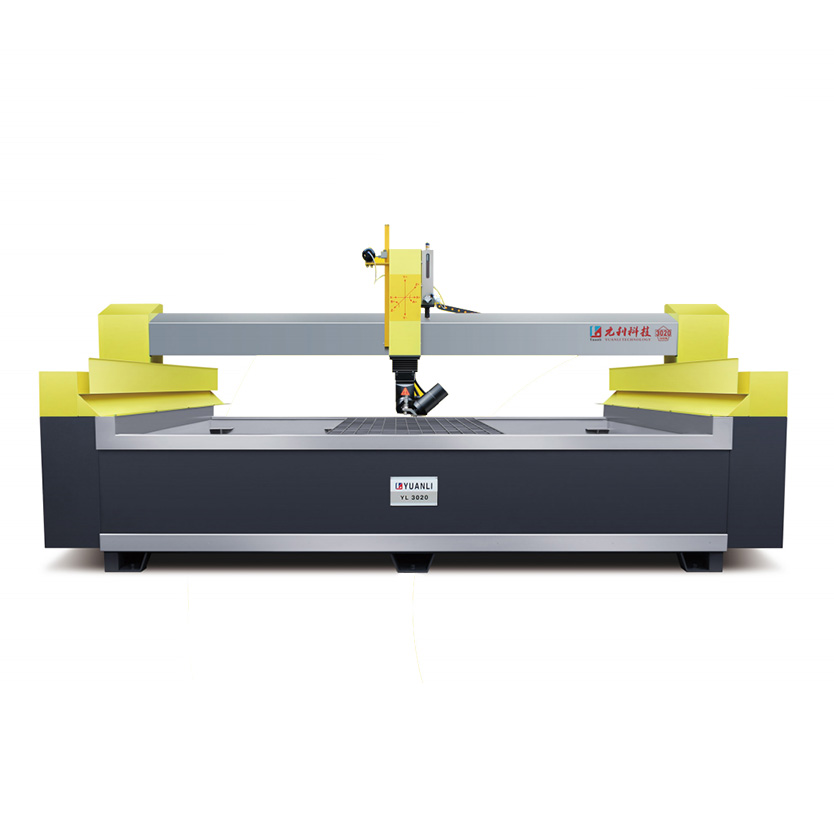
You must evaluate equipment based on actionable outcomes rather than just technical specifications. High-end systems offer distinct advantages for specific manufacturing challenges.
Active taper control represents the most common reason shops upgrade. The machine software calculates the exact stream lag for your specific material and thickness. It automatically tilts the cutting head a few degrees. It pushes the natural V-shaped taper entirely into the scrap material. The resulting part edge becomes truly perpendicular. You achieve tight tolerances effortlessly. You bypass the need to send parts to the milling department for final squaring.
Heavy industries rely heavily on structural welding. Multi-axis systems excel at preparing plates for these joints. They have the ability to cut chamfers, countersinks, and complex bevels directly on the cutting table. You can produce precise V, Y, and K bevels in one pass. This eliminates hours of manual grinding or secondary routing.
Thermal cutting methods like plasma and laser destroy material edges. They create a Heat-Affected Zone (HAZ). Waterjet technology is a cold cutting process. You can cut thick metals, laminated composites, and bulletproof glass without thermal distortion. The material retains its original temper. You avoid edge hardening, which ruins drill bits later. Laminated materials do not suffer from micro-cracking. This makes the technology essential for aerospace and defense contractors.
Material costs continually rise. Evaluating material utilization becomes critical for profitability. The waterjet kerf remains extremely narrow. A thin cutting stream allows for tighter part nesting. You can place components millimeters apart on the raw sheet. You reduce scrap waste significantly compared to traditional tooling. Thin kerfs also allow you to cut intricate internal corners easily.
Many shops debate between purchasing an articulating waterjet or a multi-axis CNC mill. Both technologies offer unique strengths. They often complement each other on the shop floor.
Feature / Capability | 5-Axis Waterjet | 5-Axis CNC Milling |
|---|---|---|
Thermal Impact | Zero thermal distortion (Cold process) | Can generate significant heat; requires coolant |
Tooling Costs | Low (Water and abrasive garnet only) | High (Expensive carbide end-mills) |
Fixturing Needs | Minimal (Low lateral cutting forces) | Substantial (High lateral forces require rigid clamping) |
Blind Features | Poor (Must pierce through material) | Excellent (Perfect for pockets and blind holes) |
Surface Finish | Good (Slight striations visible) | Superior (Ultra-fine surface finishes achievable) |
Waterjet systems win when preserving material properties is paramount. They deliver zero thermal distortion. They preserve the original metallurgy of exotic alloys like Inconel and titanium. They feature much lower tooling costs. You never have to worry about expensive carbide end-mills dulling or breaking mid-cut. Additionally, the process requires minimal fixturing. The downward force of the water stream pushes the material into the table grates. Low lateral cutting forces mean you can secure heavy plates with simple weights.
Milling remains necessary for specific geometries. Waterjets fail at creating blind features. They must pierce entirely through the material to cut. They cannot mill precise pockets or blind holes effectively. Furthermore, if your blueprint demands ultra-fine surface finishes, milling wins. Waterjets leave faint striation marks on the cut edge. CNC milling achieves mirror-like finishes using specialized face mills.
Adopting advanced kinematics introduces new challenges. You must prepare your team for the operational realities of running an articulating cutting system.
The machine is ultimately only as good as its controller. Running 5-axis CAM programming requires skilled operators. It takes significantly more effort than 2D flatbed routing. The programmer must manage continuous collision avoidance. The software needs to calculate stream lag continuously around tight corners. If the programmer fails, the expensive cutting head might crash into the material clamps. Investing in comprehensive software training is absolutely mandatory.
You must prepare for increased maintenance demands. The articulating wrist of a multi-axis system contains highly sensitive seals and swivels. These components operate under extreme pressure, typically ranging from 60,000 to 90,000 PSI. The constant tilting and rotating motion wears down high-pressure seals quickly. Expect a higher maintenance frequency compared to standard 3-axis heads. You must keep spare rebuild kits in your inventory. Ignoring scheduled maintenance leads to catastrophic leaks and extended downtime.
You face a higher initial purchase price when buying an articulating system. However, you must balance this cost against massive operational savings. Calculate your return on investment carefully. Look at the immediate reduction in secondary machining labor. Factor in the drop in scrap rates because parts no longer require manual bevel grinding. The equipment pays for itself when you eliminate multi-step manufacturing processes.
Not all multi-axis systems are identical. You must evaluate various vendors to find the exact hardware configuration suitable for your specific applications.
Determine your actual production requirements first. Do you genuinely need true 3D cutting? True 3D cutting handles complex tasks like shaping aerospace domes or processing molded composite tubes. Alternatively, do you merely need 2.5D taper compensation? Many vendors offer dedicated "taper-control only" heads. These cost significantly less than full 3D articulating heads. They tilt just enough to square the edge. Do not overbuy if you only process flat plates.
You must scrutinize the machine frame. Multi-axis cutting requires a highly robust gantry. The heavy articulating head moves dynamically. It stops and changes direction rapidly. The frame must absorb this dynamic motion without introducing vibration errors. If the gantry flexes, the cutting tip shakes. Vibration destroys edge quality and ruins tight tolerances. Always look for heavy steel construction and precision linear bearings.
The equipment requires ongoing support. Evaluate the vendor's overall ecosystem. Check the availability of local field service technicians. A machine down for a week destroys your delivery schedules. Investigate proprietary software licensing fees. Some manufacturers charge expensive annual subscriptions. Ask about included operator training programs. Good vendors provide intensive onsite training during the initial installation phase.
Never buy a machine based on brochure specifications alone. Always request a physical test cut. Supply your own specific material. Provide a complex CAD file from your actual production line. Inspect the final cut part in your own quality control lab. Verify the vendor's tolerance claims personally before shortlisting their equipment.
A multi-axis cutting system acts as a powerful asset for modern fabrication shops. It handles high-precision, complex geometries effortlessly. It delivers these results without inducing thermal distortion. However, your business must be prepared to support the advanced programming and increased maintenance requirements. Integrating this technology fundamentally upgrades your manufacturing capabilities.
Weigh the ongoing cost of your current secondary machining processes against the initial investment required for new equipment. The labor savings often justify the capital expenditure quickly. You eliminate bottlenecks and deliver better parts to your clients.
Take the following actionable steps to move forward:
Audit your current production line to identify how many hours you spend on secondary edge grinding and beveling.
Determine whether your shop requires true 3D part profiling or simply 2.5D active taper compensation.
Contact reputable manufacturers to request comprehensive time-studies.
Send your most difficult material and CAD files to vendors for custom test cuts.
A: Most commercial machines offer a mechanical tilt angle between 60 and 90 degrees. However, practical cutting angles often max out around 60 degrees. This limitation depends heavily on material thickness and nozzle collision risks. Cutting at extreme angles reduces the effective penetration depth of the water stream.
A: Some manufacturers offer modular articulating heads. You can retrofit these onto existing gantries. However, it requires a complete overhaul. You must upgrade the controller and install new kinematic software. You also typically need to replace the entire Z-axis carriage to support the heavier cutting head.
A: The actual linear cutting speed (inches per minute) might be slightly slower. The machine must accommodate complex kinematics and cornering calculations. However, the overall production time drops drastically. You eliminate secondary machining, manual edge grinding, and multi-setup processes completely.
A: With high-quality motion control systems and active taper compensation engaged, precision machines achieve excellent results. They can typically hold tolerances of ±0.001 to ±0.003 inches. Actual results always depend on the specific material thickness, density, and the condition of the abrasive nozzle.


